
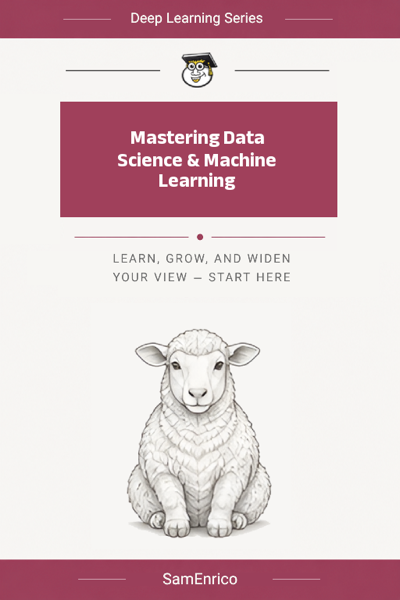
Non-FictionInformativeEducational
Mastering Data Science & Machine Learning eBook
A Coursebook on Mastering Data Science & Machine L
A Coursebook on Mastering Data Science & Machine Learning
Formats
Free sample
Chapter 1: The Factory Floor--The conveyor belt hummed at exactly 47 decibels — Ana had measured it herself during her third week at Tangle Co. The sound was somewhere between a refrigerator’s soft complaint and a dentist’s drill muffled by three walls. She stood on the grated metal walkway, tablet in hand, watching identical metal housings slide past the optical sensor. Every 2.4 seconds, another part. Every 2.4 seconds, another opportunity for failure.“You get used to the noise,” said Marcus, the shift supervisor, appearing beside her without warning.
His voice carried the gravel of someone who had spent thirty years shouting over machinery. “The new ones always stand here first. Looking for magic.”Ana turned off her tablet’s screen. “I’m not looking for magic, Marcus. I’m looking for data.”He laughed — a short, percussive sound.
“Same thing, where I’m from.”She smiled despite herself. Marcus wasn’t wrong. In the six weeks since Tangle Co had hired her as their first data scientist, virtually everyone she’d met had treated data science as a kind of industrial sorcery. The plant manager wanted a “predictive AI” that would “just tell us when things break.” The quality director wanted a “dashboard that shows everything, but simple.” The CEO, in a memorably uncomfortable town hall, had asked whether they could “just feed all the sensor logs into Chat GPT and let it figure out the factory.”No magic. No Chat GPT oracle.
No dashboard that solved poverty and predicted defects simultaneously.What Ana had instead was a problem: Tangle Co’s defect rate had crept from 1.8 percent to 3.4 percent over eighteen months. In manufacturing, that wasn’t a creep. That was a hemorrhage. At current production volumes, 3.4 percent meant 47,000 defective parts per year — each requiring rework, each delaying shipments, each eating margins that were already thinner than the aluminum stock they stamped.And no one knew why.Marcus pointed toward the far end of the line, where a yellow light flashed above an inspection station. “Another reject.
Third one this hour. Tuesday’s gonna be a long day.”Ana watched the defective part tumble into a red bin. Somewhere in the chain of sensors, temperature readings, vibration patterns, and shift schedules, there was a signal buried in the noise. Her job was to find it.But first, she had to survive the meeting.The First Mistake: What Data Science Is Not The conference room smelled of burnt coffee and desperation. Ana sat at the long table between Marcus (who clearly didn’t want to be there) and Diane from Quality (who clearly did).
Across from them: Raj Patel, the plant manager, whose tie was loosened by 10:00 AM.“Let me be direct,” Raj said, tapping his pen against a printout of last quarter’s numbers. “We’ve spent eighteen months trying to fix this defect issue. We replaced the cooling system. We retrained the press operators. We even brought in consultants from Germany, who charged us a fortune and told us our ‘organizational alignment’ was ‘suboptimal’ — whatever that means.” He pointed the pen at Ana.
“Now we’ve hired you. So tell me: when does the data science start fixing things?”Ana had prepared for this question. She had slides. She had charts. She had carefully worded explanations about feature engineering and model selection and cross-validation.
But standing in that factory, listening to the distant hum of the conveyor belt, she realized that none of that was the right answer.“Data science doesn’t fix things, Raj,” she said. “People fix things. Data science tells people where to look.”Diane leaned forward. “So what do we look at?”“I don’t know yet. That’s the point.”Silence.Marcus snorted.
“You’re not very good at selling yourself, are you?”“I’m not selling,” Ana said. “I’m diagnosing. If I came in here promising you a magic model that predicts every defect, you’d be right to fire me. Because that’s not how this works.”She pulled up a diagram on the room’s battered projector — a pyramid she’d drawn the night before. The Data Science Hierarchy of Needs.“Here’s what everyone thinks data science is,” she said, pointing to the tiny triangle at the top.
“Machine learning. Neural networks. Generative AI. The sexy stuff.”She moved her finger down the pyramid. “But here’s what data science actually is.
At the bottom: data collection. Then data storage. Then cleaning. Then preprocessing. Then exploration.
Then — only then — do you get to machine learning. And at the very top, after all that, you get to product — actually fixing the problem.”Raj squinted at the pyramid. “How much of the work is at the bottom?”“Eighty percent. Minimum.”Diane looked physically pained. “Eighty percent cleaning data?”“Eighty percent making data usable,” Ana corrected.
“The machine learning part — the part everyone thinks is the whole job — is maybe twenty percent. Sometimes less.”This is the first lesson that every aspiring data scientist must learn, and it is the lesson that virtually every best-selling book gets backwards. Open any popular machine learning textbook, and what do you find? Beautiful models. Clean datasets.
Pre-packaged CSV files where every column is ready for model.fit(). The reader spends three chapters learning about random forests and two chapters on neural networks and never once encounters the horror of a timestamp column with three different date formats or a “temperature” field where someone typed “too hot” instead of 87.4.Real data science is not about models. Real data science is about what happens before the model — and what happens after.Raj set down his pen. “Okay. Let’s say I believe you.
Eighty percent cleaning, twenty percent fancy math. What do we do first?”Ana smiled. “First, we stop believing that generative AI can solve this.”The Generative AI Distraction The CEO’s suggestion — “just feed the sensor logs into Chat GPT” — wasn’t stupid. It was uninformed, which was different. In 2026, large language models had become so capable, so conversational, so seemingly intelligent, that non-technical leaders had begun to suspect they could solve anything.
Need a contract drafted? Chat GPT. Need a marketing email written? Chat GPT. Need a manufacturing defect diagnosed from ten thousand sensor readings?
Chat GPT.Ana pulled up a second slide. “What LLMs Can and Cannot Do.”“Generative AI is extraordinary at working with language,” she said. “It can summarize documents. It can answer questions about your internal wikis. It can write code — mostly.
But it cannot, out of the box, look at a table of 200 sensor readings and tell you why a part failed.”“Why not?” Raj asked.“Because LLMs don’t understand numbers. They understand tokens — statistical relationships between words. If I give Chat GPT a CSV file, it’s not ‘analyzing’ your data. It’s converting your numbers into text approximations and then guessing. It’s like asking a poet to perform open-heart surgery.
The poet might say something beautiful, but the patient will die.”This did not mean LLMs were useless for Tangle Co’s problem. Far from it. Ana had already begun using GPT-4o to generate synthetic repair documentation, to summarize maintenance logs, and to write docstrings for her…
This is the end of the free sample. Get the eBook to keep going. Buy now
About this book
Details
- Author
- Bowens Lauretta
- Publisher
- SamEnrico
- Language
- English
- Genre
- Non-Fiction, Informative, Educational
- Released
- 2026-05-04
- Pages (approx.)
- 157
- Available as
- eBook, Audiobook

Read better in the ZLOADR app
Your eBooks on your phone or tablet. Sign in with your SamEnrico account and start reading.
More by Bowens Lauretta
 Financial Stress And EatingBowens Lauretta$11.99
 Press Release Success MetricsBowens Lauretta$11.99
 The $10 or Less TrapBowens Lauretta$11.99
 Anapanasati for ChildrenBowens Lauretta$11.99
 Figure Skating Jump Hypnosis GuideBowens Lauretta$11.99
 Congolese Family War EscapeBowens Lauretta$11.99
 Infantile Dream SourcesBowens Lauretta$11.99
 Building Alumni Network ConnectionsBowens Lauretta$11.99
 Agoraphobia Outdoor SittingBowens Lauretta$11.99
 The Titan Submersible: Descent into the DeepBowens Lauretta$11.99
 The Lion Architects of Nubia: Building Temples for the GodsBowens Lauretta$11.99
 Blood and Bushveld: The Zulu’s Last Stand at Ulundi (1879)Bowens Lauretta$11.99
You may also like
 Hong Kong Handover 1997Dunn Johnnie$11.99
 Zumba For Postnatal Recovery CourseNeal Christian$11.99
 Zumba for BeginnersLadner Nikia$11.99
 YouTube Comment Mining GuideHumes Pandora$12.99
 Worry Box MeditationCarlin Rudy$11.99
 Workplace Stress MeditationNguyen Lynn$11.99
 Workplace Stress and Sleep RepairHawley Ivory$11.99
 Workplace Perfectionism CureDelaney Jeffry$11.99
 Workplace Injustice Anger GuideWallen Isabelle$11.99
 Work Addiction and Burnout LinkGreenwood Ester$11.99
 Women in Yoga and WellnessBeattie Galina$11.99
 Women in Stand Up ComedyChun Evangeline$11.99