
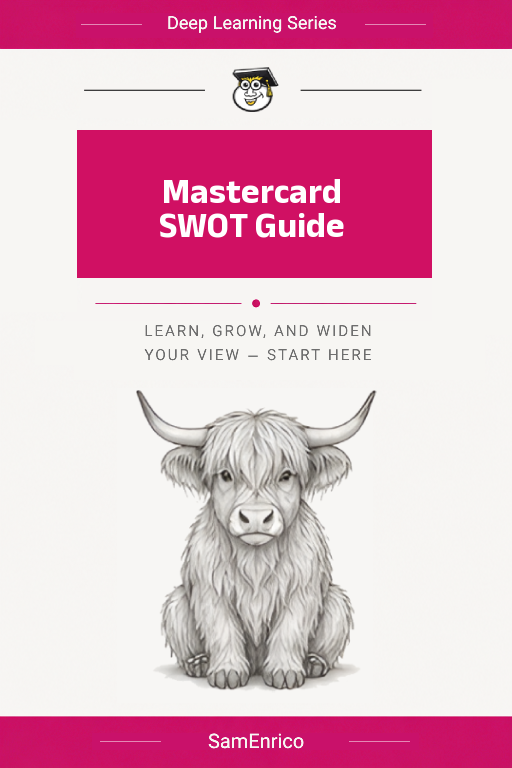
Non-FictionStrategic AtlasPayments
Mastercard SWOT Guide eBook
Evaluate two-sided platform, cross-border revenue,
Evaluate two-sided platform, cross-border revenue, digital wallet competition, and fraud risk management.
Formats
Free sample
Chapter 1: The Matchmaker’s Fortune-- In the basement of a Kansas City bank in 1966, a group of competing bankers did something that would have landed them in prison just a decade earlier. They agreed to fix prices. Not to raise them—but to lower them, together, so that a customer holding a card from Bank A could walk into a store that only accepted cards from Bank B and still complete the purchase. That act of forbidden cooperation birthed a mechanism so powerful that sixty years later, it would move over nine trillion dollars annually without ever touching a single dollar of its own money.This is the story of a company that sells nothing but permission. It does not print the plastic in your wallet.
It does not lend you the money you spend. It does not hold your balance or charge you interest when you are late. And yet, every time you tap your phone, swipe a card, or click “buy now” on an e-commerce site, Mastercard decides whether that transaction lives or dies. The company occupies a strange and enviable position in the global economy: it is simultaneously essential and invisible, powerful and powerless, a monopoly that competes fiercely with its only true rival, Visa, while facing threats that did not exist a decade ago.The purpose of this chapter is to strip away the complexity and reveal the core engine that has made Mastercard one of the most profitable companies in the history of commerce. That engine is not technology, though technology enables it.
It is not brand, though brand reinforces it. It is something far more fundamental and far harder to replicate: a two-sided platform held together by network effects that create a self-reinforcing loop of value. Once you understand this engine, you understand why new competitors almost always fail, why merchants complain bitterly yet continue to accept Mastercard, and why the company can generate operating margins that exceed those of Google, Apple, and Goldman Sachs.The Architecture of Access To understand Mastercard, you must first unlearn everything you think you know about how companies make money. A normal company buys raw materials, adds labor and capital, produces a product, and sells that product for more than the cost of production. The difference is profit.
Mastercard does none of this. It has no inventory. It has no manufacturing plants. It has no loan portfolio. It does not even have customer relationships in the traditional sense, because the person holding a Mastercard is technically the customer of the issuing bank—Chase, Citibank, Bank of America—not of Mastercard itself.So what does Mastercard actually sell?
It sells access. Specifically, it sells access to a network that connects two distinct groups: cardholders (consumers and businesses) and merchants (stores, restaurants, websites, and any other entity that wants to accept electronic payments). The transaction is the product. Every time a cardholder presents a Mastercard to a merchant, Mastercard facilitates the exchange of information between the cardholder’s bank (the issuer) and the merchant’s bank (the acquirer). It verifies that the card is valid, that the funds are available or the credit line is sufficient, and that the transaction is not fraudulent.
In exchange for this service, Mastercard collects a tiny fee—typically between one and three percent of the transaction value—split across several parties, with Mastercard keeping a fraction of a percentage point.That fraction, multiplied by billions of transactions, becomes an ocean of revenue. In 2025, Mastercard processed approximately 120 billion transactions totaling more than nine trillion dollars in gross dollar volume. The company’s net revenue exceeded twenty-five billion dollars. And because the marginal cost of processing one more transaction is effectively zero—the infrastructure is already built, the network already runs—each additional transaction flows almost entirely to the bottom line.But this description, while accurate, misses the magic. The magic is not in the transaction itself.
The magic is in the relationship between the two sides of the platform.The Two-Sided Tango Economic theory calls Mastercard a “two-sided platform.” Other examples include Uber (connecting drivers and riders), Airbnb (hosts and guests), and e Bay (buyers and sellers). What distinguishes two-sided platforms from ordinary businesses is that they create value not by making something better or cheaper, but by bringing two groups together that need each other. The platform’s job is to solve the “chicken and egg” problem: you cannot attract cardholders without merchants, and you cannot attract merchants without cardholders.Mastercard solved this problem decades ago, and the solution is the source of its enduring strength. The company built its network through a cooperative structure in which banks were both owners and customers. Those banks had every incentive to issue Mastercard-branded cards to their customers and to sign up merchants to accept those cards.
The cooperative model meant that the cost of building the network was distributed across thousands of financial institutions, each pursuing its own self-interest. No single entity had to bear the full cost of achieving critical mass.Once critical mass was achieved, network effects took over. As more cardholders carried Mastercard, merchants faced a choice: accept Mastercard or lose sales to competitors who did. As more merchants accepted Mastercard, cardholders faced a choice: carry a Mastercard or find themselves unable to shop at the stores they wanted. This mutual reinforcement creates a virtuous cycle that is extraordinarily difficult to reverse.
A new entrant would need to attract both cardholders and merchants simultaneously, with neither side willing to join first. That is why, despite decades of technological change and billions of dollars in investment, no meaningful competitor has emerged to challenge the duopoly of Mastercard and Visa.The Geometry of the Loop Let us be precise about how the network effect operates, because precision matters for strategy. Economists distinguish between same-side network effects and cross-side network effects. Both are at work in Mastercard’s business, and both reinforce the company’s position.Cross-side network effects are the primary driver. More cardholders make the network more valuable to merchants (because they can reach more potential customers).
More merchants make the network more valuable to cardholders (because they can shop in more places). This cross-side effect is positive and strong. It is the reason that a merchant in a small town accepts Mastercard even if only ten percent of customers use it—the cost of declining that ten percent is higher than the cost of accepting the card.Same-side network effects are more subtle but equally important. On the cardholder side, more cardholders can actually create mild negative effects, because cardholders compete for rewards programs and for the attention of issuers. But on the merchant side, more merchants can create positive same-side effects because a dense network of merchants makes the entire payment ecosystem more convenient, which encourages more cardholders to use cards, which benefits all merchants.
The geometry is complex, but the overall direction is clear: growth reinforces growth.There is a threshold effect at work here. Below a certain density, network effects are weak or negative. A payment network with only a few thousand cardholders and a few hundred merchants is not very useful to anyone. But once the network crosses a critical…
This is the end of the free sample. Get the eBook to keep going. Buy now
About this book
Details
- Author
- Corrigan Ronni
- Publisher
- SamEnrico
- Language
- English
- Genre
- Non-Fiction, Strategic Atlas, Payments
- Released
- 2026-05-30
- Pages (approx.)
- 134
- Available as
- eBook, Audiobook

Read better in the ZLOADR app
Your eBooks on your phone or tablet. Sign in with your SamEnrico account and start reading.
More by Corrigan Ronni
 Vaccine Injury Compensation ProgramCorrigan Ronni$11.99
 The Equifax 2017 Shutdown PlanCorrigan Ronni$11.99
 Senior Housing Esteem GuideCorrigan Ronni$11.99
 Musician Performance AffirmationsCorrigan Ronni$11.99
 The Body Image Relationship InsecurityCorrigan Ronni$11.99
 The Deep Blue Pioneers: Black Navigators of the Indian OceanCorrigan Ronni$11.99
 Understanding Muscular Dystrophy, FacioscapulohumeralCorrigan Ronni$17.99
 How to Start a Music Plate Engraving Business (Beginners Guide)Corrigan Ronni$11.99
 Great Philosophers in Six WeeksCorrigan Ronni$11.99
 AI Financial Data MonitoringCorrigan Ronni$12.99
You may also like
 Hong Kong Handover 1997Dunn Johnnie$11.99
 Zumba For Postnatal Recovery CourseNeal Christian$11.99
 Zumba for BeginnersLadner Nikia$11.99
 YouTube Comment Mining GuideHumes Pandora$12.99
 Worry Box MeditationCarlin Rudy$11.99
 Workplace Stress MeditationNguyen Lynn$11.99
 Workplace Stress and Sleep RepairHawley Ivory$11.99
 Workplace Perfectionism CureDelaney Jeffry$11.99
 Workplace Injustice Anger GuideWallen Isabelle$11.99
 Work Addiction and Burnout LinkGreenwood Ester$11.99
 Women in Yoga and WellnessBeattie Galina$11.99
 Women in Stand Up ComedyChun Evangeline$11.99