
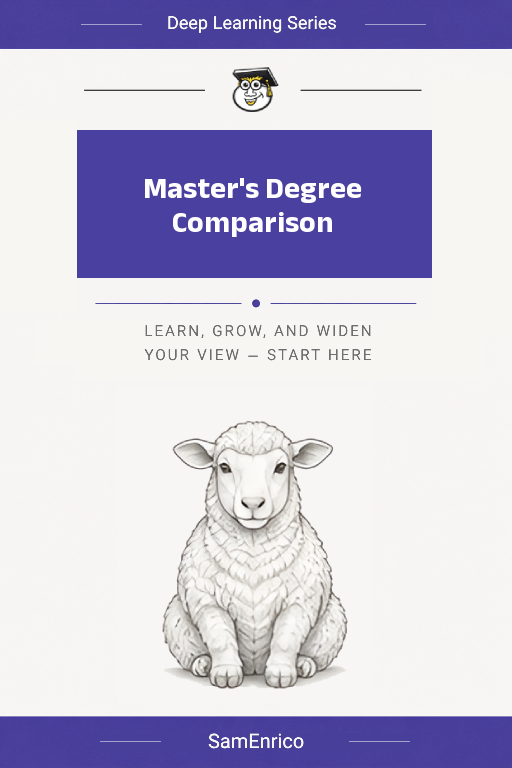
Non-FictionStudent's ShortcutMasters
Master's Degree Comparison eBook
Compare UK 1-year taught masters, US 2-year progra
by Mims Miquel
Compare UK 1-year taught masters, US 2-year programs, and Australian 1.5-2 year master's degrees.
Formats
Free sample
Chapter 1: The Three Doors...–- Imagine standing in a long, fluorescent-lit hallway. There are three doors in front of you. Above the first door, a sign reads “UK – 1 Year – £20k–£40k.” Above the second: “US – 2 Years – 50k–50k–50k–80k per year.” Above the third: “Australia – 1.5–2 Years – A35k–A35k–A35k–A50k per year.”Behind each door is not just a degree. Behind each door is a different philosophy of time, money, expertise, and belonging. Behind each door is a different version of your future self.Most students choose a door the way they choose a restaurant when they are already hungry: they look at the prettiest picture, listen to the loudest friend, or pick the one their parents ate at twenty years ago.
Then they spend two years and a hundred thousand dollars discovering they walked into the wrong room.This book exists to make sure that does not happen to you.The paradox of choice in international education has never been more paralyzing. In 2025, a student from Mumbai, Shanghai, or Lagos can apply to a thousand master’s programs across three continents with a few clicks. You Tube is flooded with vlogs titled “Why I Chose London” and “My Harvard Nightmare” and “Living the Australian Dream.” The noise is deafening. And underneath all that noise is a simple, uncomfortable truth: the “best” university in the world is not the best university for you if its system fights against your nature.This chapter introduces the three systems as living, breathing ecosystems. We will not compare rankings.
We will not recite mission statements. Instead, we will uncover the hidden logic that drives each country’s approach to graduate education. By the end of this chapter, you will understand not just what each system offers, but what each system demands of you as a person.The UK Door: The Sprint Let us begin with the shortest door: the United Kingdom’s one-year taught master’s degree.On paper, one year sounds efficient. One year sounds cheap (half the tuition of a US program, zero years of lost salary beyond twelve months). One year sounds like a smart financial shortcut to a better job.But efficiency is not the same as ease.The UK master’s is a sprint.
And sprints hurt.Here is what a typical week looks like for a UK master’s student in, say, International Relations at the London School of Economics or a history degree at the University of Edinburgh. You will attend eight to ten hours of lectures. That is the easy part. The remaining thirty to forty hours of your week will be consumed by independent reading: journal articles, book chapters, primary sources, theoretical frameworks. You will read not because your professor assigns every page, but because the seminar discussion the next morning will assume you have read everything.This expectation of prior knowledge is the first cultural shock for students arriving from less specialized undergraduate systems.
A UK master’s does not begin with foundational courses. It begins where your undergraduate degree ended. If you studied business as an undergraduate and now want to study international political economy, many UK programs will reject you outright (as we will explore in Chapter 3). If they accept you, they will not slow down to explain basic concepts. The assumption is that you already possess deep subject alignment.The year is divided into three terms.
The first two terms are coursework: dense, fast-paced, and unforgiving. Then comes the third term. The final third of the year is dedicated entirely to your dissertation: a solo research project of 15,000 to 20,000 words. There are no electives. There is no “exploration.” You do not take a coding class as an English major.
You do not sample philosophy while studying finance. You stay in your lane, and you run.The classroom culture reflects this intensity. In most UK universities, the relationship between student and professor is more hierarchical than in the United States. You address your lecturer as “Dr.” or “Professor” unless invited otherwise. Participation in seminars is expected but rarely graded.
The emphasis is on your independent work: your reading, your thinking, your writing. Group projects are uncommon. Collaboration can feel almost discouraged, as if asking for help signals weakness.Who thrives behind the UK door? The student who already knows what they want. The student with two to five years of work experience who needs a credential to advance, not a transformation.
The student who reads quickly, writes clearly, and does not need external validation to stay motivated. The student who sees a master’s degree as a box to check, not a journey of self-discovery.Who suffers behind the UK door? The career changer. The slow reader. The student who learns through discussion and feedback rather than solitary reading.
The student who believed “one year” meant “less work.” The student who arrives without strong undergraduate preparation and finds themselves drowning by October, unable to catch up because there is no summer break to reset.And about that summer break: there is none. The UK academic year runs from September or October to the following September. You have short breaks at Christmas (two to three weeks) and Easter (two to three weeks). You do not have a ten-week summer vacation. You do not have time for a summer internship.
You can work part-time during term (up to twenty hours per week on a student visa) and full-time during those short Christmas and Easter breaks. But you will not spend three months gaining work experience between terms. The sprint does not pause.This is the hidden cost of the UK model that no glossy brochure advertises. Yes, you finish faster. Yes, you pay less total tuition.
But you also finish more exhausted, with fewer professional connections, and with no built-in time to test your skills in a real workplace before you graduate.The US Door: The Marathon Now walk back to the hallway and look at the second door. The United States offers two-year master’s degrees that operate on a completely different logic.If the UK is a sprint, the US is a marathon. And marathons require pacing.The typical US master’s program spans four semesters (including summers, though many students use summers for internships rather than coursework). You will take three to four courses per semester. That translates to roughly fifteen hours of classroom time per week, plus another twenty to thirty hours of reading, assignments, and group projects.
On paper, that sounds similar to the UK workload. But the distribution is radically different.The first year of a US master’s is often foundational. Even students with strong undergraduate backgrounds may be required to take introductory courses in their field. This is the legacy of the American liberal arts philosophy, which values breadth over depth. A US master’s in economics might begin with intermediate micro and macroeconomics — material that a UK program would assume you already mastered as an undergraduate.
A US master’s in computer science might accept students from non-STEM backgrounds, then spend the first semester teaching programming fundamentals.This foundational year is both a blessing and a curse. The blessing: you can change…
This is the end of the free sample. Get the eBook to keep going. Buy now
About this book
Details
- Author
- Mims Miquel
- Publisher
- SamEnrico
- Language
- English
- Genre
- Non-Fiction, Student's Shortcut, Masters
- Released
- 2026-05-26
- Pages (approx.)
- 151
- Available as
- eBook, Audiobook

Read better in the ZLOADR app
Your eBooks on your phone or tablet. Sign in with your SamEnrico account and start reading.
More by Mims Miquel
 Willing Hands TechniqueMims Miquel$11.99
 Autism Sleep RoutineMims Miquel$11.99
 Design Thinking for RoadmapsMims Miquel$11.99
 Teresa of Ávila Interior Castle GuideMims Miquel$11.99
 Validating Failure FeelingsMims Miquel$11.99
 Remote Work for DesignersMims Miquel$11.99
 NVC for Teenagers GuideMims Miquel$11.99
 Elizabeth Virgin Queen MythMims Miquel$11.99
 The Silent Crusade: How a 12th-Century Nun Outsmarted the ChurchMims Miquel$11.99
 The Empress and the Iron Cage: Japan's First Solitary Confinement CaseMims Miquel$11.99
 A Collector's Handbook to the Hillman Minx Phase IMims Miquel$11.99
 ARIPO Well Known Marks ProtectionMims Miquel$12.99
You may also like
 Hong Kong Handover 1997Dunn Johnnie$11.99
 Zumba For Postnatal Recovery CourseNeal Christian$11.99
 Zumba for BeginnersLadner Nikia$11.99
 YouTube Comment Mining GuideHumes Pandora$12.99
 Worry Box MeditationCarlin Rudy$11.99
 Workplace Stress MeditationNguyen Lynn$11.99
 Workplace Stress and Sleep RepairHawley Ivory$11.99
 Workplace Perfectionism CureDelaney Jeffry$11.99
 Workplace Injustice Anger GuideWallen Isabelle$11.99
 Work Addiction and Burnout LinkGreenwood Ester$11.99
 Women in Yoga and WellnessBeattie Galina$11.99
 Women in Stand Up ComedyChun Evangeline$11.99