
Non-FictionStudent's ShortcutMethodology
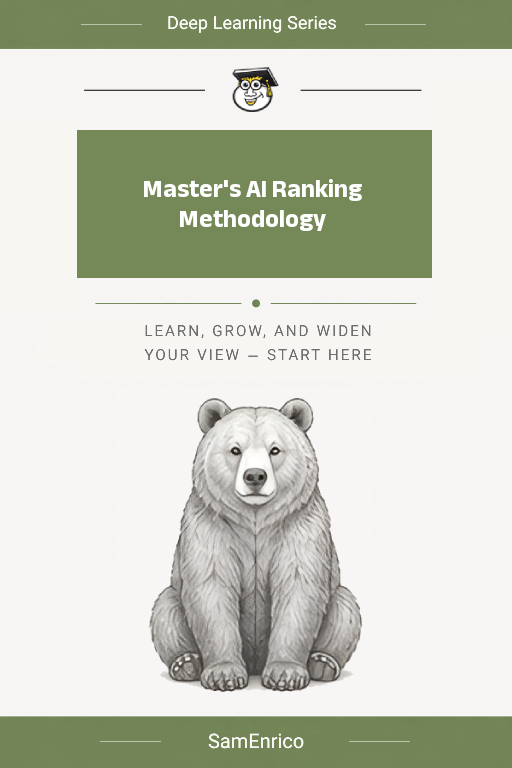
Master's AI Ranking Methodology
Explains how QS, THE, and CSRankings calculate the
by Huang Herta
Explains how QS, THE, and CSRankings calculate their AI and CS rankings, with methodology critiques.
Formats
About this book
Free sample
Chapter 1: The Ranking Paradox...--You have been lied to. Not maliciously, perhaps. Not even intentionally. But the numbers you see every autumn—the lists that determine where students apply, where faculty accept jobs, where millions of dollars in research funding flow—are built on assumptions that collapse under scrutiny.Here is the paradox that drives this book: a single computer science department can be ranked #10 in the world by one system, #47 by another, and not appear at all in a third. All three systems claim to measure "excellence." All three use published methodologies.
All three are produced by reputable organizations. Yet they produce answers that are not merely different but contradictory.This is not a rounding error. This is not a statistical anomaly. This is the fundamental truth about university rankings: they measure different things, weight them differently, and then pretend the resulting number represents an objective reality.You are about to learn why.The Mystery That Launched This Book In 2023, a mid-tier public university in the American Midwest made a curious discovery. Its computer science department had published three papers at Neur IPS—the Neural Information Processing Systems conference, widely considered the top venue for machine learning research.
This was more than half the universities in the Ivy League had managed that year. The department chair celebrated. Then the rankings came out.THE placed the university at #187 worldwide for computer science. QS put them at #203. CSRankings, which counts only conference publications, had them at #89—respectable but not reflective of their Neur IPS outperformance.
The chair called a colleague at a private university ranked #34 by THE. "How many Neur IPS papers did you publish?" he asked. "None," the colleague replied. "But our endowment is $4 billion."That conversation is the seed of this book.The public university had higher research output in the most competitive AI venue. The private university had more money, more international students, and a reputation built over a century.
Which one is "better"? The answer depends entirely on what you value. But the rankings do not ask you what you value. They decide for you.This chapter introduces…
This is the end of the free sample. Get the eBook to keep going. Buy now
Contents
- Chapter 1
- Chapter 2
- Chapter 3
- Chapter 4
- Chapter 5
- Chapter 6
- Chapter 7
- Chapter 8
- Chapter 9
- Chapter 10
- Chapter 11
- Chapter 12
Details
- Author
- Huang Herta
- Publisher
- SamEnrico
- Language
- English
- Genre
- Non-Fiction, Student's Shortcut, Methodology
- Released
- 2026-05-30
- Pages (approx.)
- 136
- Available as
- eBook, Audiobook

Read better in the ZLOADR app
Your eBooks on your phone or tablet. Sign in with your SamEnrico account and start reading.
More by Huang Herta
 Remote Company Retreats For EnterprisesHuang Herta$11.99
 Chunking Project MilestonesHuang Herta$11.99
 Living with Rheumatoid ArthritisHuang Herta$11.99
 The Tenzing Norgay Sherpa GuideHuang Herta$11.99
 Legal Professional Burnout RescueHuang Herta$11.99
 The Golden Weavers of Meroë: Luxury Textiles of the Kushite EmpireHuang Herta$11.99
 Retail StrategistHuang Herta$11.99
 10 Ways to Use Dulse (Recipe Book)Huang Herta$11.99
 EU Organic Certification SheaHuang Herta$12.99
 Understanding Sensory NeuropathyHuang Herta$17.99
You may also like
 Hong Kong Handover 1997Dunn Johnnie$11.99
 Zumba For Postnatal Recovery CourseNeal Christian$11.99
 Zumba for BeginnersLadner Nikia$11.99
 YouTube Comment Mining GuideHumes Pandora$12.99
 Worry Box MeditationCarlin Rudy$11.99
 Workplace Stress MeditationNguyen Lynn$11.99
 Workplace Stress and Sleep RepairHawley Ivory$11.99
 Workplace Perfectionism CureDelaney Jeffry$11.99
 Workplace Injustice Anger GuideWallen Isabelle$11.99
 Work Addiction and Burnout LinkGreenwood Ester$11.99
 Women in Yoga and WellnessBeattie Galina$11.99
 Women in Stand Up ComedyChun Evangeline$11.99