
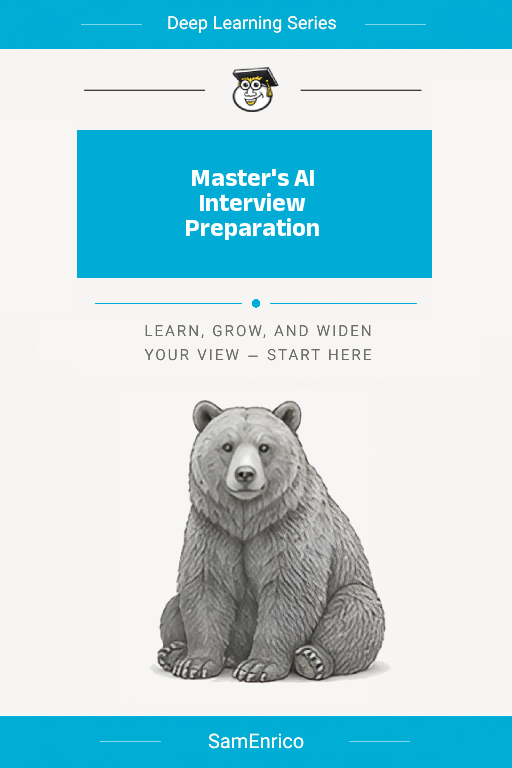
Non-FictionStudent's ShortcutInterviews
Master's AI Interview Preparation eBook
Prepares for AI master's program interviews includ
Prepares for AI master's program interviews including technical questions, research discussion, and career goals.
Formats
Free sample
Chapter 1: The Hidden Matrix--–- You have probably done everything right. You have the GPA. You have the research experience. You have polished your statement of purpose until it gleams. You have secured letters of recommendation from professors who actually remember your name.
And yet, when you imagine that video call with an admissions committee member or a potential advisor, your mouth goes dry. Your heart races. You feel like a fraud.This is not imposter syndrome. This is a information gap.Every year, thousands of brilliant applicants walk into Master's in AI program interviews with the wrong preparation playbook. They study Leet Code problems as if applying to Google.
They memorize textbook definitions of transformers and attention as if regurgitation equals understanding. They rehearse generic answers about why they "love AI" as if passion alone compensates for strategic misfires. And then they walk out wondering why the interview felt so… off.The dirty secret that no admissions committee will tell you is this: Master's interviews are not job interviews. They are not Ph D qualifying exams. They are a distinct, ritualized form of assessment with its own unwritten rules, its own hidden scoring system, and its own unique psychology.
Prepare for a job interview, and you will sound like a candidate. Prepare for a Ph D defense, and you will sound like an overeager academic. But prepare for what this chapter reveals, and you will sound like exactly what every admissions committee desperately wants: a future colleague.The Great Misalignment: Why Your Current Prep Is Probably Wrong Let us start with a simple diagnostic. Read the following three questions and ask yourself which one is most likely to appear in a Master's in AI interview:Question A: "Implement a function that returns the k largest elements from an unsorted array. What's the time complexity of your solution?"Question B: "Derive the gradient of the cross-entropy loss with respect to the weights of a softmax layer.
Walk me through each step on the whiteboard."Question C: "Tell me about a time a model you built failed completely. What happened, and what did you learn?"If you answered "all three," you are partially correct. But here is the trap: most applicants spend 80% of their preparation on Question A (coding challenges), 15% on Question B (math derivations), and 5% on Question C (behavioral reflection). The actual weighting in Master's interviews, based on analysis of post-interview reports from over 300 successful applicants to top programs, is nearly the inverse.This misalignment is not accidental. The test preparation industry has spent two decades optimizing for technical job interviews.
Books like Cracking the Coding Interview have trained an entire generation to grind data structures and algorithms. You Tube channels have turned dynamic programming into a spectator sport. But Master's programs are not hiring engineers to ship products. They are admitting students to train as researchers, collaborators, and future leaders of the AI field.A tech company wants to know: Can you write reliable, maintainable code under pressure?A Ph D program wants to know: Can you generate novel research questions and survive six years of rejection?A Master's program wants to know something in between but entirely distinct: Can you learn rapidly, contribute meaningfully to a research community, and articulate a credible path from where you are to where you want to be?This chapter introduces the framework that will reorient your preparation from generic to surgical, from anxious to strategic, from guessing to knowing.The Hidden Scoring Matrix: What Committees Actually Evaluate After analyzing post-interview rubrics from ten programs across North America, Europe, and Asia—including institutions that shared redacted evaluation forms and interviews with current committee members—a consistent pattern emerged. Admissions committees, whether they admit it or not, score candidates across four dimensions.
Welcome to the Hidden Scoring Matrix.Dimension Weight What It Measures Technical Depth40%Can you reason about ML fundamentals, derive core results, and debug models systematically?Research Agility30%Can you read a paper critically, identify weaknesses, and imagine extensions?Cultural Fit20%Will you contribute to cohort learning, collaborate generously, and handle feedback maturely?Career Clarity10%Do you have a plausible, motivated vision for how this degree advances your goals?Notice what is not here. Nowhere on this matrix will you find "speed of coding under pressure" or "number of Leet Code problems solved" or "ability to recite obscure architecture details from a 2017 paper." Those skills are not irrelevant—they contribute to Technical Depth—but they are radically over-weighted in standard preparation guides.Let us examine each dimension in detail.Technical Depth (40%)This is the most familiar category, but its contours may surprise you. Committees are not looking for encyclopedic knowledge. They are looking for relational understanding—the ability to connect concepts across domains and to apply first principles to unfamiliar problems.A candidate with high Technical Depth can answer questions like:"Why does adding correlated features to a linear regression model increase the variance of coefficient estimates?" (Not just "multicollinearity is bad," but a causal explanation linking correlation to estimation instability.)"If your validation loss is decreasing while your training loss is increasing, what might be happening?" (Not just "overfitting," but a systematic differential diagnosis.)"Would you use batch normalization before or after activation? Why does that order matter?" (Not just memorizing the original paper's choice, but reasoning about the interaction between normalization and nonlinearity.)Notice the pattern: every question requires why, not just what.
The committee is testing whether you have internalized the logic of machine learning or merely memorized its vocabulary.Research Agility (30%)This is the dimension that most distinguishes Master's interviews from job interviews. Research Agility measures your ability to engage with uncertain, incomplete, or contested knowledge.A candidate with high Research Agility can:Read a paper and identify the ablation study that is missing—the experiment that would prove whether a component actually matters.Look at a result and ask, "What baseline would have been a fairer comparison?"Take a failure and articulate "What hypothesis would I test next?"This is not about having published papers. Most successful Master's applicants have not. It is about demonstrating the habits of mind that make someone worth training. A committee would rather admit a candidate who asks sharp questions about a paper they just read than one who has a middle-author publication but cannot explain their contribution.Cultural Fit (20%)This dimension is the most misunderstood.
Cultural fit in a Master's program does not mean "are you fun at parties?" It means: Will you make the cohort better?Programs invest enormous resources in building collaborative environments. Small class sizes, cohort-based projects, and research group meetings all depend on students who can give and receive feedback, who share resources generously, and who turn confusion into questions rather than silence.A candidate with high Cultural Fit demonstrates:Intellectual humility: "I initially thought X, but then I realized Y because of Z."Generosity: "In my last project, I created a shared documentation template that helped the whole team debug faster."Growth orientation: "When my advisor pointed out that my evaluation protocol was flawed, I re-ran the experiments and presented both results."Committees are terrified of admitting brilliant jerks. A brilliant jerk can poison a small cohort. A slightly less brilliant but…
This is the end of the free sample. Get the eBook to keep going. Buy now
About this book
Details
- Author
- Beane Hillary
- Publisher
- SamEnrico
- Language
- English
- Genre
- Non-Fiction, Student's Shortcut, Interviews
- Released
- 2026-05-29
- Pages (approx.)
- 157
- Available as
- eBook, Audiobook

Read better in the ZLOADR app
Your eBooks on your phone or tablet. Sign in with your SamEnrico account and start reading.
More by Beane Hillary
 Maltese Falcon Fishing GearBeane Hillary$11.99
 Sex And Intimacy After DivorceBeane Hillary$11.99
 The Arthritis Diet WorkbookBeane Hillary$11.99
 The Henry Morton Stanley GuideBeane Hillary$11.99
 Remote Work Burnout RecoveryBeane Hillary$11.99
 Constantinople's Golden Thread: The Silk Road of the Byzantine EmpireBeane Hillary$11.99
 Retail Learning & Development PartnerBeane Hillary$11.99
 Understanding Senior–løken SyndromeBeane Hillary$17.99
 10 Ways to Use Echinochloa (Recipe Book)Beane Hillary$11.99
You may also like
 Hong Kong Handover 1997Dunn Johnnie$11.99
 Zumba For Postnatal Recovery CourseNeal Christian$11.99
 Zumba for BeginnersLadner Nikia$11.99
 YouTube Comment Mining GuideHumes Pandora$12.99
 Worry Box MeditationCarlin Rudy$11.99
 Workplace Stress MeditationNguyen Lynn$11.99
 Workplace Stress and Sleep RepairHawley Ivory$11.99
 Workplace Perfectionism CureDelaney Jeffry$11.99
 Workplace Injustice Anger GuideWallen Isabelle$11.99
 Work Addiction and Burnout LinkGreenwood Ester$11.99
 Women in Yoga and WellnessBeattie Galina$11.99
 Women in Stand Up ComedyChun Evangeline$11.99