
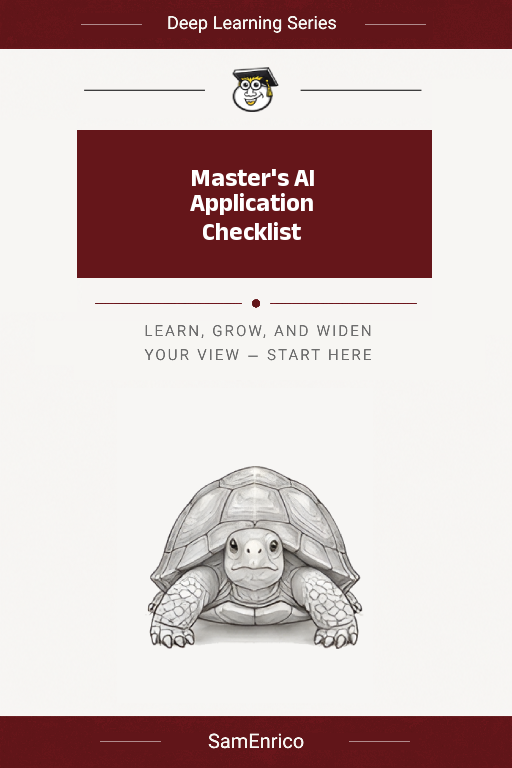
Non-FictionStudent's ShortcutChecklist
Master's AI Application Checklist eBook
Tracks all required materials for AI graduate appl
Tracks all required materials for AI graduate applications including transcripts, tests, essays, and deadlines.
Formats
Free sample
Chapter 1: The Six-Month Trap--–- Priya checked her email for the seventeenth time that day. Nothing. She had submitted her application to UT Austin's AI master's program three weeks ago, confident in her 3.6 GPA and three glowing recommendation letters. Today, she checked the portal on a whim. The status read: "Application Incomplete – Official Transcript Missing."She called the admissions office in a panic.
"Your transcript arrived three days after the deadline," the coordinator told her. "We cannot consider your application."Priya had ordered her transcript two weeks before the deadline. It took three days to process, four days to ship, and arrived exactly three days late. She didn't know she needed to order it six weeks early. She didn't know she needed to upload an unofficial copy immediately.
She didn't know that a single logistical failure would erase her otherwise strong candidacy.Priya is not real. But her story happens to thousands of applicants every year.This chapter exists so it does not happen to you.The Engineering Mindset Applying to graduate school in artificial intelligence is not like applying to college. It is not a holistic, forgiving process where a strong essay can overcome a late transcript. It is closer to launching a rocket: every component must be in its place at the exact right time, or the entire mission fails.The most successful applicants treat the process like an engineering project. They create timelines.
They identify dependencies. They build buffers for failure. They verify each component before moving to the next. They do not assume anything will work unless they have confirmed it.This chapter gives you the architectural blueprint for that project. By the time you finish reading, you will understand exactly how to build a six-month timeline that accounts for every moving part: test scores that take eight weeks to arrive, transcripts that take three weeks to process and ship, recommenders who need six weeks of lead time, and essays that require five drafts before they are ready.You will also understand the single most important concept in this entire book: the priority deadline is your real deadline.The Priority Deadline Fallacy Every AI master's program publishes two dates: a priority deadline and a final deadline.
Most applicants assume the final deadline is the one that matters. This assumption is catastrophic.Here is what the priority deadline actually means. At UT Austin, the priority deadline is March 15th. The final deadline is April 15th. Priority deadline applicants receive decisions by late March and early April.
They are considered for all available funding, including research assistantships that cover tuition plus a living stipend. They compete against a smaller, more organized pool of applicants who also submitted early.Final deadline applicants receive decisions in late May and June. By then, most funding has been allocated. The remaining slots are filled from whatever is left after the priority pool has been processed. The applicant pool is larger but not necessarily stronger; many of the strongest applicants submitted early.At Boston University, the difference is even starker.
Priority deadline applicants are guaranteed a decision within six weeks. Final deadline applicants wait three to four months. By the time a final deadline applicant receives an offer, priority applicants have already secured housing, researched their professors, and started building relationships with future classmates.At the University of Washington, priority applicants receive first consideration for teaching assistantships. Final deadline applicants are eligible only if priority applicants decline. At the Singapore University of Technology and Design, priority applicants receive a 20 percent tuition reduction automatically.The pattern is consistent across every competitive AI program: the priority deadline is the real deadline.
The final deadline exists primarily for administrative completeness and for applicants who discovered the program late through no fault of their own.Therefore, every timeline in this book assumes you are applying by the priority deadline. If you miss the priority deadline, the same principles apply, but your odds of funding drop significantly.Back-Scheduling: The Core Method Back-scheduling is the most important operational skill in this entire book. It is how engineers build timelines for complex projects. Instead of starting at the beginning and guessing how long each step will take, you start at the deadline and work backward.Here is how it works. Identify your earliest priority deadline.
For most programs, this is December 15th for Fall admission or September 15th for Spring admission. Write that date in bold. Now subtract each task's required time, in reverse order, from that date.The tasks, in order from deadline moving backward, are:Final decision and enrollment (after acceptance, not before deadline – included here for completeness)Official transcript delivery (requires 2-3 weeks from order to arrival)Test score delivery (TOEFL/IELTS requires 4-6 weeks; GRE requires 10-15 days)Test exams (must be taken 4-8 weeks before scores are needed)Essay final drafts (requires 2-3 weeks of revision after first draft)Essay first drafts (requires 4-6 weeks of writing)Recommender outreach (requires 6 weeks of lead time)Transcript requests (requires 3 weeks lead time for official copies)Program research (requires 8 weeks of focused study)Initial timeline creation (today)Let us work through a concrete example. Assume your earliest priority deadline is December 15th for a Fall start.Official transcripts must arrive by December 15th. They take 3 weeks to process and ship.
Therefore, you must request official transcripts by November 24th at the latest.Test scores must arrive by December 15th. TOEFL takes 6 weeks to be delivered after the exam. Therefore, you must take the TOEFL by November 3rd.The TOEFL is offered only on specific dates. If you miss the November 3rd window, the next available test date might be November 17th, which would deliver scores on December 29th – after the deadline. Therefore, you must register for the test by mid-October at the latest, which means you must begin preparing by September.Recommenders need 6 weeks of lead time.
You must ask them by November 1st. But you cannot ask them without a draft of your Statement of Purpose and your updated resume. Therefore, you must have a draft SOP by October 15th.A strong first draft of an SOP takes 4 weeks to write. Therefore, you must begin writing your SOP by September 17th.Before you can write your SOP, you must have researched each program's professors and labs. This takes approximately 8 weeks of part-time work.
Therefore, you must begin program research by July 22nd.That is back-scheduling. You started at December 15th and arrived at July 22nd – nearly five months of preparation hidden behind a single deadline. Most applicants do not realize this. They start in October, rush their essays, submit mediocre recommendations, and wonder why they are rejected.You will not be one of them.The Quarterly Planner: Fall Admission The six-month timeline breaks naturally into three phases of approximately two months each. Think of them as quarters, even if they do not align perfectly with calendar quarters.Quarter 1 (Months 6-4 before deadline): Research and Strategy This phase is about understanding where you are applying and why.
It requires zero writing and zero test preparation. It requires only reading, note-taking, and honest self-assessment.Your tasks during this quarter:Identify 6-10 programs that match your profile. Do not apply to more…
This is the end of the free sample. Get the eBook to keep going. Buy now
About this book
Details
- Author
- Dexter Angelika
- Publisher
- SamEnrico
- Language
- English
- Genre
- Non-Fiction, Student's Shortcut, Checklist
- Released
- 2026-05-30
- Pages (approx.)
- 129
- Available as
- eBook, Audiobook

Read better in the ZLOADR app
Your eBooks on your phone or tablet. Sign in with your SamEnrico account and start reading.
More by Dexter Angelika
 Rheumatoid Arthritis Treatment PlanDexter Angelika$11.99
 Divorce And Substance UseDexter Angelika$11.99
 Burnout Prevention for High AchieversDexter Angelika$11.99
 Caymanian Offshore BankingDexter Angelika$11.99
 The Alexander Mackenzie PathfinderDexter Angelika$11.99
 The Last Stand of the Sepoys: Flames of Rebellion in 1857Dexter Angelika$11.99
 Retail Account ManagerDexter Angelika$11.99
 Franchise HR Global GuideDexter Angelika$12.99
 Understanding Sengers–hamel–otten SyndromeDexter Angelika$17.99
 10 Ways to Use Eel (Recipe Book)Dexter Angelika$11.99
You may also like
 Hong Kong Handover 1997Dunn Johnnie$11.99
 Zumba For Postnatal Recovery CourseNeal Christian$11.99
 Zumba for BeginnersLadner Nikia$11.99
 YouTube Comment Mining GuideHumes Pandora$12.99
 Worry Box MeditationCarlin Rudy$11.99
 Workplace Stress MeditationNguyen Lynn$11.99
 Workplace Stress and Sleep RepairHawley Ivory$11.99
 Workplace Perfectionism CureDelaney Jeffry$11.99
 Workplace Injustice Anger GuideWallen Isabelle$11.99
 Work Addiction and Burnout LinkGreenwood Ester$11.99
 Women in Yoga and WellnessBeattie Galina$11.99
 Women in Stand Up ComedyChun Evangeline$11.99