
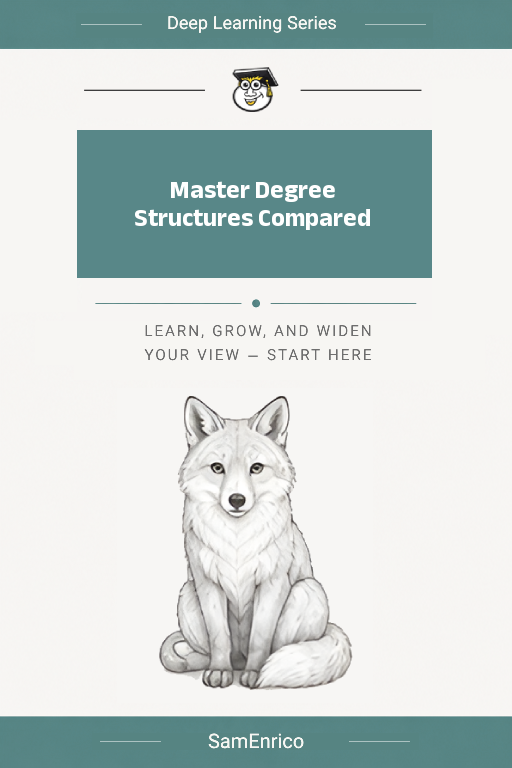
Master Degree Structures Compared
Compare 1-year UK taught masters, 2-year US progra
Compare 1-year UK taught masters, 2-year US programs, and 1.5-year Australian master's degrees, balancing depth against opportunity cost.
Formats
About this book
Free sample
Chapter 1: The Calendar Lie--Every year, 1.2 million students make a $100 billion decision based on a single, unexamined assumption: that a longer master’s degree is automatically deeper, and a shorter one is automatically shallower. This assumption is wrong. It is not merely imprecise—it is actively misleading, and it has cost generations of students hundreds of thousands of dollars in forgone earnings, unnecessary debt, and career delays that could have been avoided.The problem is not that students are unintelligent. The problem is that universities, ranking agencies, and even well-meaning advisors have conflated two entirely different things: time spent and learning achieved. They have treated the calendar as a proxy for rigor, as if the sheer number of months on a diploma guarantees intellectual depth.
This is the Calendar Lie, and it is the most expensive myth in international education.Consider two students. Emma graduates from a UK master’s program in Data Science at age 23, having completed 180 credits in 12 months of intensive, specialized study. She took eight modules—all data science, all the time—and wrote a 15,000-word dissertation on a real-world industry problem. She paid £32,000 in tuition and lived in London for one year, total cost of attendance approximately £50,000. She started her first full-time role as a junior data scientist at a London fintech firm three weeks after her final exam, earning £45,000.Consider Liam.
He graduates from a US master’s program in Data Science at age 25, having completed a similar number of credits over 24 months. His program required four core data science courses, two electives in unrelated fields (technical communication and project management), and a summer internship between his first and second years. He paid 65,000intuition(privateuniversity)plustwoyearsoflivingexpensesin Boston,totalcostapproximately65,000 in tuition (private university) plus two years of living expenses in Boston, total cost approximately 65,000intuition(privateuniversity)plustwoyearsoflivingexpensesin Boston,totalcostapproximately130,000. He started his first full-time role as a data analyst at a US tech firm, earning $85,000.Who made the better decision? The conventional answer—the one you will hear from university marketing departments, from study abroad advisors, and from parents who remember a different era—is that Liam made the safer, deeper, more rigorous choice.…
This is the end of the free sample. Get the eBook to keep going. Buy now
Contents
- Chapter 1
- Chapter 2
- Chapter 3
- Chapter 4
- Chapter 5
- Chapter 6
- Chapter 7
- Chapter 8
- Chapter 9
- Chapter 10
- Chapter 11
- Chapter 12
Details
- Author
- Whitehead Lashaun
- Publisher
- SamEnrico
- Language
- English
- Genre
- Non-Fiction, Student's Shortcut
- Released
- 2026-05-29
- Pages (approx.)
- 147
- Available as
- eBook, Audiobook

Read better in the ZLOADR app
Your eBooks on your phone or tablet. Sign in with your SamEnrico account and start reading.
More by Whitehead Lashaun
 Senior Family Respect GuideWhitehead Lashaun$11.99
 Shift Work Diabetes RiskWhitehead Lashaun$11.99
 Metabolic Adaptation ExerciseWhitehead Lashaun$11.99
 Eisenhower For New ManagersWhitehead Lashaun$11.99
 Gamblers Anonymous ExplainedWhitehead Lashaun$11.99
 Creative Meeting DesignWhitehead Lashaun$11.99
 Weight Gain Prevention After QuittingWhitehead Lashaun$11.99
 Diabetes ManagementWhitehead Lashaun$11.99
 The Whale Who Remembered War: A Cetacean’s SecretWhitehead Lashaun$11.99
 Love and Gunpowder in the Sudan: The Mahdist War's Forgotten RomanceWhitehead Lashaun$11.99
 How to Produce Inflatable Bouncer AccessoriesWhitehead Lashaun$11.99
 A Collector's Handbook to the Horch 930Whitehead Lashaun$11.99
You may also like
 LSE Online Program LengthAgee Letisha$11.99
 Harvard Extension School for Working AdultsRoush Yer$11.99
 LSE Online Reading ListAshford Ludivina$11.99
 LSE Online Language RequirementsWhitten Daphine$11.99
 LSE Online Class SizeHughey Garret$11.99
 LSE Online Alumni MentorshipWild Lyla$11.99
 London School of Economics Alumni NetworkDutton Chantal$11.99
 Harvard Extension School Student SupportCantrell Christene$11.99
 Harvard Extension School Library AccessSantana Adah$11.99
 Harvard Extension School Degree CompletionBray Wyatt$11.99
 Harvard Extension School Course AuditingAbbott Craig$11.99
 Harvard Extension School Extension DiplomaNew Joane$11.99