
Non-FictionHealth & WellnessPosture
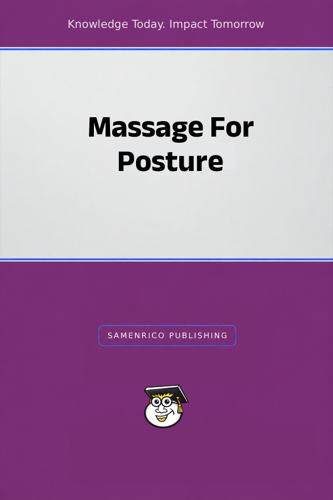
Massage For Posture eBook
Teaches pectoral and upper back release for rounde
by Read Tamie
Teaches pectoral and upper back release for rounded shoulders.
Formats
Free sample
Chapter 1: The Mirror Never Lies...--–- You have probably stood sideways in front of a mirror sometime in the last week. Maybe it was in a dressing room, bathed in that unflattering fluorescent light, trying to decide if a shirt fit properly. Maybe it was the full-length mirror in your bedroom, the one you glance at while rushing to get dressed. Or perhaps you caught your reflection in a store window on a busy street. And in that moment, you noticed something.
Your head was slightly forward of your shoulders. Your upper back had a gentle, unmistakable curve. Your shoulders rolled inward, as if trying to protect your chest from an invisible threat. You looked, in a word, slouched.You probably corrected it immediately. You pulled your shoulders back.
You lifted your chest. You tucked your chin. For three seconds, you looked like a different person—taller, more confident, healthier. And then you let go, and your body snapped back to its default position like a rubber band releasing tension. The slouch returned within seconds.Here is what you likely told yourself in that moment: I need to sit up straighter.
I need to strengthen my back. I need to try harder.Here is what you were not told: None of those things will work.Not because you are lazy. Not because you lack discipline. Not because you have somehow failed at the simple act of standing up straight. You have failed because you were given the wrong map.
You have been trying to fix a posture problem by addressing the symptoms while ignoring the root cause. And the root cause is not what you think.This book exists because that misunderstanding has caused millions of people to waste thousands of hours and countless dollars on back extensions, posture correctors, ergonomic chairs, and painful stretching routines that produced zero lasting change. The posture industry has sold you a lie: that rounded shoulders are a weakness problem. In reality, rounded shoulders are a tightness problem. Specifically, they are a chest tightness problem.By the time you finish this chapter, you will understand exactly why your shoulders roll forward, why your attempts to fix them have failed, and—most importantly—why the solution is simpler, faster, and more effective than anything you have tried before.
You will also perform the first diagnostic test of this book, the Supine Hand Test, which will tell you in ten seconds whether your posture problem is driven by a tight chest. Spoiler: if you are reading this book, it almost certainly is.Let us begin by dismantling everything you thought you knew about posture.The Posture Industry's Multi-Billion Dollar Mistake Walk into any gym, and you will see them. People doing rows. People doing lat pulldowns. People doing reverse flyes.
All of them trying to strengthen their upper back muscles, operating under the assumption that weak rhomboids and trapezius muscles are the reason their shoulders slump forward. It makes intuitive sense, does it not? If the front of your body is strong and the back of your body is weak, the front will win the tug-of-war. So you strengthen the back. Balance the forces.
Problem solved.This logic is so simple, so elegant, and so completely backwards that it has hoodwinked an entire generation of fitness professionals, physical therapists, and well-intentioned internet experts.The problem is not that your back muscles are too weak. The problem is that your chest muscles are too tight. And a tight muscle does not behave like a weak muscle. A tight muscle behaves like a locked door. You cannot simply strengthen your way past a locked door.
You must first unlock it.Here is the biomechanical reality that changes everything. Your pectoralis minor—a small, triangular muscle that runs from your ribs to your shoulder blade—attaches to a bony projection on your scapula called the coracoid process. When this muscle becomes chronically shortened, which happens to virtually every desk worker, smartphone user, and driver in the modern world, it physically pulls your shoulder blades forward and down. This is not a matter of strength imbalance. This is a matter of anatomy.
The pec minor is shorter than it should be. It has adapted to its shortened position. It has laid down new fascia, new connective tissue, to maintain that position.Your rhomboids and lower trapezius are not weak because they lack strength. They are weak because they have been neurologically inhibited. Your brain has literally turned them down, like a volume knob, because your chest has been screaming at your nervous system for so long that it has learned to accept the slouch as normal.This is called neuromuscular inhibition, and it is the single most important concept you will learn in this book.The Neuromuscular Handshake You Never Agreed To Every muscle in your body has an antagonist—a muscle that performs the opposite movement.
Your biceps flex your elbow; your triceps extend it. Your quadriceps straighten your knee; your hamstrings bend it. Your pectoral muscles pull your shoulders forward; your rhomboids and trapezius pull them back.Under normal circumstances, these pairs work in harmony. When you contract your biceps, your triceps relax proportionally. This is called reciprocal inhibition.
It is automatic, efficient, and essential for smooth movement.But reciprocal inhibition works both ways. When one muscle becomes chronically tight—not just contracting briefly, but actually shortening over time—it sends a constant inhibitory signal to its antagonist. Your pec minor, shortened from hours of sitting at a desk, leaning over a phone, or driving a car, is constantly telling your rhomboids and lower trapezius to relax. Not to contract. Not to pull your shoulders back.
To relax.You cannot override this signal with willpower. You cannot do enough rows to cancel it out. As long as your pec minor remains locked short, your brain will continue to receive the instruction: Shrug. Slouch. Protect the front of the body.This is why posture correctors—those strap contraptions that pull your shoulders back—provide only temporary relief.
The moment you remove the straps, your body returns to its default position because the underlying neurological signal has not changed. You have mechanically forced your shoulders into retraction, but you have not addressed the muscle that is demanding protraction.This is also why stretching your back feels good but accomplishes nothing lasting. When you stretch your rhomboids, you are pulling on a muscle that is already long and weak. You are not fixing the problem. You are temporarily relieving the tension that the problem created, like taking a painkiller for a broken bone.The solution is not to work on the weak muscles.
The solution is to release the tight muscles. Only after the chest has been released can the back be strengthened. That sequence—release first, then strengthen—is the entire architecture of this book.The Supine Hand Test: Ten Seconds to the Truth Before we go any further, you need to know where you stand. The Supine Hand Test is a diagnostic tool developed from clinical observation of hundreds of posture patients. It requires no equipment, takes ten seconds, and will tell you with startling accuracy whether your posture problem is…
This is the end of the free sample. Get the eBook to keep going. Buy now
About this book
Details
- Author
- Read Tamie
- Publisher
- SamEnrico
- Language
- English
- Genre
- Non-Fiction, Health & Wellness, Posture
- Released
- 2026-06-06
- Pages (approx.)
- 150
- Available as
- eBook, Audiobook

Read better in the ZLOADR app
Your eBooks on your phone or tablet. Sign in with your SamEnrico account and start reading.
More by Read Tamie
 Role Play Creativity WorkshopRead Tamie$11.99
 Flow Distraction EliminationRead Tamie$11.99
 The Dubai Alumni NetworkRead Tamie$11.99
 Nap for Creative ProfessionalsRead Tamie$11.99
 Self Hypnosis for Night AnxietyRead Tamie$11.99
 Forensic Odontology EthicsRead Tamie$11.99
 Acupuncture for ImmunityRead Tamie$11.99
 The Golden Voices of the Nile: Africa's Opera PioneersRead Tamie$11.99
 The Last Emperor of Mali: Sundiata’s Shadow and the Golden LegacyRead Tamie$11.99
 Sheep: Sheep Behavior, Breeds & FarmingRead Tamie$11.99
 How to Become a Membership SecretaryRead Tamie$11.99
 Remote Termination and Exit WorkbookRead Tamie$12.99
You may also like
 Hong Kong Handover 1997Dunn Johnnie$11.99
 Zumba For Postnatal Recovery CourseNeal Christian$11.99
 Zumba for BeginnersLadner Nikia$11.99
 YouTube Comment Mining GuideHumes Pandora$12.99
 Worry Box MeditationCarlin Rudy$11.99
 Workplace Stress MeditationNguyen Lynn$11.99
 Workplace Stress and Sleep RepairHawley Ivory$11.99
 Workplace Perfectionism CureDelaney Jeffry$11.99
 Workplace Injustice Anger GuideWallen Isabelle$11.99
 Work Addiction and Burnout LinkGreenwood Ester$11.99
 Women in Yoga and WellnessBeattie Galina$11.99
 Women in Stand Up ComedyChun Evangeline$11.99