
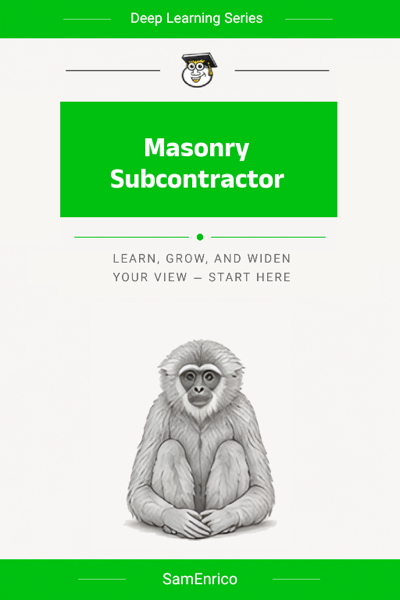
Non-FictionInformativeEducational
Masonry Subcontractor eBook
A Coursebook on Masonry Subcontractor
A Coursebook on Masonry Subcontractor
Formats
Free sample
Chapter 1: The Scaffold’s Shadow...--–- The first time I watched a masonry business die, it wasn’t because the owner couldn’t lay brick. He could lay brick faster than anyone I’d ever seen. His walls were plumb, his joints were razor-straight, and his mortar mix was perfect every time. The problem was that he had built his entire company on a handshake and a prayer. When a scaffold collapsed on a windy Tuesday afternoon—through no fault of his own, the GC had overloaded it—his insurance company denied the claim because he had signed a contract that made him the “additional insured” for everyone else’s negligence.
Within ninety days, he lost his truck, his house, and his marriage. The scaffold didn’t kill him. The paperwork did.That story haunts every page of this book because it reveals the uncomfortable truth that most masonry textbooks won’t tell you: being a great mason is almost completely irrelevant to being a successful masonry subcontractor. The market is littered with brilliant craftsmen who went bankrupt, and it’s also full of mediocre masons who retired rich. The difference was never the trowel.
It was always the business structure.This chapter is about building the legal and financial foundation that will determine whether you die with a trowel in your hand or retire with a portfolio. We are going to talk about liability, licenses, bank accounts, and credit lines. It will not be glamorous. But if you skip it, nothing else in this book will save you.The Handshake Delusion Walk onto any masonry job site in America, and you will hear the same refrain: “We’ve been doing business on a handshake for twenty years.” That statement is usually followed by a story about how someone got screwed last season. There is a profound difference between trust and structural protection.
Trust is what allows you to sleep at night. Structural protection is what allows you to keep your house when trust fails.The masonry trade is uniquely vulnerable to handshake arrangements because it operates in a gray zone between construction and craft. Many masons start as sole proprietors—often unlicensed, often uninsured, often working for cash—because the barrier to entry is low. You need a trowel, a mixer, and a truck. That’s it.
But that low barrier is a trap. It convinces you that you don’t need the legal and financial scaffolding that supports every other legitimate construction business.Here is the brutal arithmetic of the handshake delusion. If you are a sole proprietor working without a contract and someone gets injured on your job site—even if you did nothing wrong—your personal assets are exposed. Your house. Your truck.
Your kid’s college fund. Your retirement accounts. All of it can be taken in a lawsuit because, in the eyes of the law, you and your business are the same person. There is no separation. There is no shield.
There is only the handshake that suddenly doesn’t mean anything when a lawyer gets involved.I have interviewed dozens of failed masonry subcontractors over the past five years. Almost every single one started with a handshake. Almost every single one ended with a lawsuit or a tax lien. The pattern is so predictable that it has become a cliché in the construction industry: the brilliant mason who works twenty years, builds nothing of his own, and retires broke.The Legal Trinity: Structure, License, Contract Before you lay a single brick, you need three things in place. I call this the Legal Trinity because if any one leg is missing, the entire stool collapses.Leg One: Business Structure Your business structure determines who gets sued when things go wrong.
There are four primary options for masonry subcontractors, and each comes with a distinct risk profile.Sole Proprietorship is the default. You do nothing to set it up beyond getting a business license. The problem is that you are the business. If your company is sued for 500,000,youowe500,000, you owe 500,000,youowe500,000 personally. Creditors can seize your house, garnish your wages, and empty your bank accounts.
The only reason to remain a sole proprietor is if you are working alone on small residential jobs, have no significant personal assets, and are willing to accept the risk. Even then, it is a bad idea.Limited Liability Company (LLC) is the most common structure for masonry subcontractors with employees or commercial work. An LLC creates a legal wall between your personal assets and your business debts. If the company is sued, the plaintiff can take the company’s equipment and bank accounts, but they cannot touch your house. The trade-off is that LLCs require paperwork—annual filings, operating agreements, separate tax returns—and in some states, you must publish notice of your formation in a local newspaper.
The annual cost is typically between 100and100 and 100and800, depending on your state. That is cheap insurance.S Corporation (S-Corp) is a tax election that can be applied to an LLC or a corporation. It allows you to pay yourself a reasonable salary and then take additional profits as distributions, which are not subject to self-employment tax. For a profitable masonry business making over $60,000 per year in net income, the S-Corp election can save you thousands of dollars annually. The downside is stricter payroll rules, required board meetings, and more complex tax filings.
You will need a certified public accountant to help you set this up correctly.C Corporation (C-Corp) is almost never the right choice for a masonry subcontractor. It creates double taxation—the company pays tax on profits, and then you pay tax again when you take dividends. The only exception is if you plan to reinvest all profits into equipment and expansion and never take distributions. For 99% of readers, ignore the C-Corp.The critical insight: You can start as an LLC and later elect S-Corp tax treatment. You cannot easily go backward from an S-Corp to a sole proprietorship.
Start simple, but start protected.Leg Two: Licensing Masonry licensing is a patchwork of state and local requirements, and ignorance is not a defense. Twenty-eight states require some form of contractor licensing for work over a certain dollar amount—typically 1,000to1,000 to 1,000to10,000. Of those, fourteen have specific classifications for masonry or concrete work. The remaining states license at the local level, meaning your city or county requires a permit and a license even if the state does not.Here is what you need to research before you submit your first bid. First, determine whether your state requires a contractor license for the type of work you perform.
The key phrase is "type of work"—some states license only general contractors, others license specialty trades like masonry separately. Second, identify the licensing exam requirements. Many states require you to pass a business and law exam, even if you already know how to lay brick. Some states also require a trade exam specific to masonry. Third, verify the financial requirements.
Most states require you to show proof of net worth or a surety bond. For example, California requires a 25,000bondandproofofatleast25,000 bond and proof of at least 25,000bondandproofofatleast2,500 in…
This is the end of the free sample. Get the eBook to keep going. Buy now
About this book
Details
- Author
- Buckingham Shiloh
- Publisher
- SamEnrico
- Language
- English
- Genre
- Non-Fiction, Informative, Educational
- Released
- 2026-06-02
- Pages (approx.)
- 144
- Available as
- eBook, Audiobook

Read better in the ZLOADR app
Your eBooks on your phone or tablet. Sign in with your SamEnrico account and start reading.
More by Buckingham Shiloh
 Attempt Survivor Coming OutBuckingham Shiloh$11.99
 Mindfulness For Rotator Cuff PainBuckingham Shiloh$11.99
 Vegan Fast Food GuideBuckingham Shiloh$11.99
 Retirement Account Contribution LimitsBuckingham Shiloh$11.99
 Road Rage and Anger Log TransferBuckingham Shiloh$11.99
 The Embassy Siege of Khartoum: Terror in the Heart of SudanBuckingham Shiloh$11.99
 Scholarship Visa Success GuideBuckingham Shiloh$12.99Scholarship Visa Success GuideBuckingham Shiloh$12.99
 AI Accounting Tools for Small BusinessBuckingham Shiloh$12.99
 Understanding Neurofibrillary TanglesBuckingham Shiloh$17.99
 How to Start a Choke Manifolds Business (Beginners Guide)Buckingham Shiloh$11.99
You may also like
 Hong Kong Handover 1997Dunn Johnnie$11.99
 Zumba For Postnatal Recovery CourseNeal Christian$11.99
 Zumba for BeginnersLadner Nikia$11.99
 YouTube Comment Mining GuideHumes Pandora$12.99
 Worry Box MeditationCarlin Rudy$11.99
 Workplace Stress MeditationNguyen Lynn$11.99
 Workplace Stress and Sleep RepairHawley Ivory$11.99
 Workplace Perfectionism CureDelaney Jeffry$11.99
 Workplace Injustice Anger GuideWallen Isabelle$11.99
 Work Addiction and Burnout LinkGreenwood Ester$11.99
 Women in Yoga and WellnessBeattie Galina$11.99
 Women in Stand Up ComedyChun Evangeline$11.99