
Non-FictionHealth & WellnessMedical Grade
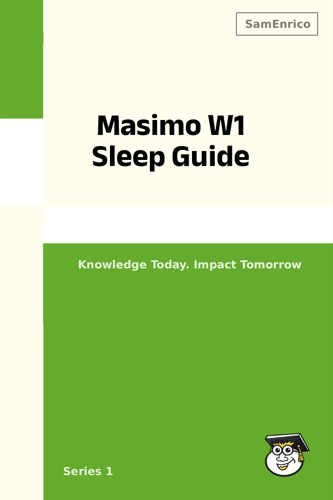
Masimo W1 Sleep Guide eBook
Use hospital grade pulse oximetry in consumer wear
by Grice Tobi
Use hospital grade pulse oximetry in consumer wearable for accurate tracking.
Formats
Free sample
Chapter 1: The 8-Hour Lie--–- You check your smartwatch every morning. The screen reads “Sleep Score: 85” and “Sp O2: 96%.” You slept eight hours. By the numbers, you should feel like a superhero. Instead, you drag yourself out of bed, your head feels stuffed with cotton, and the coffee maker has become your most important relationship. You tell yourself everyone is tired.
You tell yourself this is just what adult life feels like. You are wrong.This chapter reveals a hidden flaw in nearly every consumer wearable on the market today—a flaw so fundamental that it has convinced millions of people that their sleep is fine when it is quietly destroying their health. By the time you finish these pages, you will understand why your expensive watch has been lying to you, how to prove it to yourself in under sixty seconds, and why a technology originally developed for hospital operating rooms is now the only reliable way to track what actually happens to your oxygen levels while you sleep.The Most Dangerous Number on Your Wrist Let us start with a simple question: What does that 96% Sp O2 reading on your smartwatch actually mean? If you are like most people, you assume it means that throughout the night, your blood oxygen level stayed safely around 96%. You assume the device watched over you continuously, like a vigilant guardian, and reported back an accurate summary of your physiology.
Both assumptions are dangerously incorrect.The average consumer wearable—whether from Apple, Garmin, Fitbit, Samsung, or any other major brand—measures your oxygen saturation intermittently. The typical sampling interval ranges from every thirty seconds to every several minutes. Some devices sample even less frequently during sleep to conserve battery life. A few take a single measurement every five minutes. That means in an eight-hour night, your watch might check your oxygen level only 96 to 480 times.
That sounds like a lot until you understand what it is missing.A single apnea event—a pause in breathing—typically lasts ten to thirty seconds. A hypopnea, or shallow breathing event, can last twenty to forty seconds. In both cases, your oxygen saturation begins to drop within seconds of the breathing interruption. The drop continues until you either resume breathing or your brain partially arouses you from sleep to restore normal airway function. The entire desaturation and recovery cycle can happen in forty-five seconds.Now do the math.
If your watch samples every sixty seconds, it has a fifty percent chance of catching any given desaturation event. If it samples every two minutes, that probability drops to less than twenty-five percent. If it samples every five minutes—as some devices do during deep sleep to save power—it will miss nearly every desaturation event that occurs. You are not getting a summary of your night. You are getting a handful of snapshots taken blindfolded.The Study That Exposed the Truth In 2022, researchers conducted a head-to-head comparison between the Masimo W1 (which uses continuous wave technology sampling at approximately eight times per second) and a leading consumer smartwatch known for its health features.
The study involved subjects wearing both devices simultaneously during overnight sleep studies in a certified sleep laboratory, with concurrent reference standard pulse oximetry on the finger.The results were staggering. The consumer smartwatch missed more than fifty percent of all desaturation events—drops in Sp O2 of three percent or more from baseline. More concerning, it missed nearly seventy percent of clinically significant desaturations (drops below ninety percent lasting ten seconds or longer). In several cases, the smartwatch reported an average overnight Sp O2 of ninety-five percent while the reference device recorded multiple desaturations into the mid-eighties, each lasting twenty to thirty seconds.Why the discrepancy? The answer lies in how the two devices sample.
The consumer watch took a reading approximately every sixty seconds, then averaged those readings to produce an overnight average. The Masimo W1 took more than seventy thousand measurements per night—roughly eight per second—and preserved the waveform, allowing it to detect events that began and ended entirely between the consumer watch's sampling intervals.This is not a minor difference in engineering philosophy. This is the difference between knowing whether your oxygen is stable and having no idea that your brain is being starved of oxygen dozens of times each night.The Sixty-Second Test That Will Change Everything You do not need to take anyone's word for this. You can prove it to yourself in under sixty seconds with a simple experiment.Put on your current smartwatch and ensure its Sp O2 sensor is active. If your device does not provide real-time on-demand Sp O2 readings, borrow a finger pulse oximeter from a pharmacy (typically fifteen to twenty dollars) as a reference.
Now take a normal seated position with your arm resting comfortably at heart level. Observe your baseline Sp O2 reading for thirty seconds to establish stability. Write down that number.Now take a normal breath in and a normal breath out. At the end of that normal exhalation—not a deep breath first, which would artificially increase your oxygen stores—hold your breath. Do not strain.
Simply hold. Watch your Sp O2 reading.On a properly functioning continuous monitor, you will see your oxygen level begin to drop within ten to fifteen seconds. The drop will be one to two percentage points per five seconds of breath-hold. By twenty seconds, your Sp O2 may have dropped three to five points. When you resume breathing, the monitor should show a rapid recovery back to baseline within ten to fifteen seconds.Now watch your smartwatch during this same breath-hold.
In most cases, one of three things will happen. First, the watch may show no change at all, maintaining a steady reading even as your actual oxygen drops. Second, the watch may show a delayed change, suddenly dropping five to ten seconds after you resume breathing—a lag that makes it useless for detecting real-time desaturations. Third, the watch may simply display an error message or refuse to give a reading during movement or low perfusion.If your watch fails this test, you have just discovered why you have been feeling exhausted despite apparently normal numbers. Your watch is not broken.
It is working exactly as designed. Its design is simply inadequate for detecting what happens to your oxygen during sleep.Why Your Watch Is Not Designed for This The engineers who designed your smartwatch made a series of deliberate trade-offs. They prioritized battery life, slim form factor, and general wellness tracking over clinical accuracy. This is not a conspiracy. It is simply a different set of design constraints.A typical smartwatch must last one to two days on a single charge.
Continuous oxygen monitoring at eight samples per second would drain the battery in a few hours. To conserve power, manufacturers sample intermittently and use algorithms to "fill in" the gaps with educated guesses based on heart rate and movement data. These algorithms work reasonably well for detecting gross trends—whether your oxygen is generally higher or lower across a week. They fail catastrophically at detecting brief, clinically significant desaturations.There is another constraint: computation. Running signal extraction algorithms on a wrist-worn…
This is the end of the free sample. Get the eBook to keep going. Buy now
About this book
Details
- Author
- Grice Tobi
- Publisher
- SamEnrico
- Language
- English
- Genre
- Non-Fiction, Health & Wellness, Medical Grade
- Released
- 2026-06-08
- Pages (approx.)
- 128
- Available as
- eBook, Audiobook

Read better in the ZLOADR app
Your eBooks on your phone or tablet. Sign in with your SamEnrico account and start reading.
More by Grice Tobi
 Fear Of Failure In Job SearchGrice Tobi$11.99
 Endometriosis and InsuranceGrice Tobi$11.99
 The Baltic Budget Master DirectoryGrice Tobi$11.99
 UAE Green Tax CreditsGrice Tobi$11.99
 Jutland: The Last Gasps of the DreadnoughtsGrice Tobi$11.99
 Logistics Business AnalystGrice Tobi$11.99
 Communication Tools ComparisonGrice Tobi$12.99
 Student Discounts in TurkeyGrice Tobi$12.99
 Understanding Retrolental FibroplasiaGrice Tobi$17.99
 How to Become a Lens-molding-equipment OperatorGrice Tobi$11.99
You may also like
 Hong Kong Handover 1997Dunn Johnnie$11.99
 Zumba For Postnatal Recovery CourseNeal Christian$11.99
 Zumba for BeginnersLadner Nikia$11.99
 YouTube Comment Mining GuideHumes Pandora$12.99
 Worry Box MeditationCarlin Rudy$11.99
 Workplace Stress MeditationNguyen Lynn$11.99
 Workplace Stress and Sleep RepairHawley Ivory$11.99
 Workplace Perfectionism CureDelaney Jeffry$11.99
 Workplace Injustice Anger GuideWallen Isabelle$11.99
 Work Addiction and Burnout LinkGreenwood Ester$11.99
 Women in Yoga and WellnessBeattie Galina$11.99
 Women in Stand Up ComedyChun Evangeline$11.99