
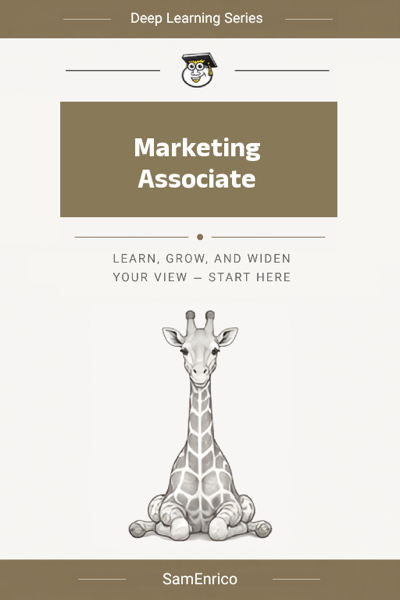
Marketing Associate eBook
A Coursebook on Marketing Associate
A Coursebook on Marketing Associate
Formats
Free sample
Chapter 1: Beyond the Banner Ad--–- The blinking cursor on Emma Chen’s screen had been mocking her for forty-seven minutes. Three tabs were open: a competitor’s Instagram feed, a half-finished email draft with a subject line she had already rewritten twelve times, and a spreadsheet full of last quarter’s metrics that she didn’t fully understand but was too embarrassed to ask about. She was three weeks into her first Marketing Associate role at a mid-sized software company called Scribe Technologies, and her manager had just asked her to “do something creative” for the upcoming product launch. No brief. No objective.
No budget. No definition of what “creative” meant. Just those two words followed by a cheerful “You’ve got this!”Emma did not, in fact, “got this.”She had graduated with honors from a respected university. She had memorized the 4 Ps for her final exam. She could recite Maslow’s Hierarchy of Needs in her sleep, forwards and backwards.
She had a crisp portfolio filled with case studies and campaign mockups that had earned her A grades and professor praise. But none of that told her what to type next. None of that explained whether she should write a blog post, design a social graphic, or ask for a budget to run Linked In ads. None of that answered the question screaming inside her head: What am I actually supposed to be doing?Emma Chen is not real. But her predicament is.
Every single day, thousands of new Marketing Associates sit down at their desks at thousands of companies—small startups, massive enterprises, nonprofit organizations, government agencies—with the same knot in their stomachs. They have been told to “do marketing,” but no one has explained what that actually means in a modern, data-driven, revenue-accountable, AI-disrupted, attention-scarce world. They have been trained on tools—Canva, Hub Spot, Google Analytics, Mailchimp, Hootsuite—but not on the single question that separates successful associates from the ones who quietly update their Linked In status to “open for work” after eleven months.That question is this: What is marketing actually for?If you cannot answer that question in one clear, confident sentence, you will spend your career as an order-taker. You will execute tasks without understanding purpose. You will measure activities instead of outcomes.
You will burn out wondering why your hard work never seems to translate into results or recognition.This chapter answers that question. And the answer will change how you see every campaign, every email, every social post, every meeting, and every request that lands on your desk for the rest of your career.The Lie You Were Sold (And Probably Believed)Let us start with an uncomfortable confession. Most introductory marketing courses, most Linked In influencers with perfect lighting and inspirational captions, most well-meaning senior colleagues, and most marketing blogs with titles like “10 Ways to Boost Engagement” perpetuate a lie. The lie is this: Marketing is about advertising. Or worse: Marketing is about being creative.
Or even worse: Marketing is about getting likes and shares.None of those is true. Advertising is a tactic. Creativity is a tool. Likes and shares are vanity metrics. Marketing itself is something far more fundamental, far more strategic, and far more valuable to a business than any of those things.Here is the definition that will anchor this entire book and your entire career.
Write it down. Type it into a note on your phone. Tape it to your monitor. Recite it before every campaign you launch, every email you write, and every meeting you attend:Marketing is the strategic process of creating, communicating, delivering, and exchanging offerings that have value for customers, clients, partners, and society at large.Notice what this definition does. It does not say “making ads.” It does not say “posting on social media.” It does not say “getting followers.” It says creating, communicating, delivering, and exchanging.
That is four distinct activities, and only one of them (communicating) resembles what most people think of as “marketing.”Before you write a single word of copy, design a single graphic, or launch a single campaign, you must understand where your work fits into this broader process. An associate who knows how to write an email is useful. An associate who knows how to write an email and understands why that email exists, who it is for, what value it delivers, and how it will be measured is indispensable. That associate gets promoted. That associate gets invited to strategy meetings.
That associate becomes a manager before their thirtieth birthday.The Five Eras: How Marketing Evolved (And Why It Matters to You)To understand where marketing is today, you must understand where it came from. Marketing has evolved through five distinct orientations over the past century. Each era left behind tools, assumptions, and habits that still influence how companies operate. And here is the secret that no textbook tells you and no manager will explain: Most companies are not operating in the most modern era. Different departments, different leaders, different products, and even different campaigns can reflect different eras simultaneously.
Your job as a Marketing Associate—a job that will immediately set you apart from your peers—is to recognize which era you are working in and adapt your execution accordingly.Era One: The Production Orientation (Roughly 1900s to 1930s)During the Industrial Revolution, when assembly lines were new and factories were the engines of economic growth, companies believed one thing above all else: customers wanted products that were widely available and inexpensive. The focus was entirely on production efficiency, economies of scale, and distribution reach. The mantra was: “If we make it, they will buy it.” Henry Ford famously said of the Model T: “Any customer can have a car painted any color that he wants, so long as it is black.” Marketing, such as it existed, was about shipping product and taking orders. There were no brand managers, no customer research departments, no social media teams. There were factory managers and salespeople.If you work in a manufacturing company, a commodity business (think corn, steel, or shipping), or a B2B industrial company, you may still encounter this orientation.
The marketing team’s role is often limited to creating spec sheets, managing distribution channel relationships, and ensuring that product is available where customers expect it. Creativity takes a backseat to logistics. If this is your world, your job is not to invent clever campaigns. Your job is to make sure the product flows efficiently and that customers can find it.Era Two: The Product Orientation (Roughly 1930s to 1960s)As competition increased and customers had more choices, companies shifted their focus from efficiency to quality. The belief was: “If we build a better mousetrap, the world will beat a path to our door.” Marketing meant highlighting superior engineering, new features, and craftsmanship.
This era gave us the concept of the “unique selling proposition” (USP)—a single, compelling benefit that differentiated a product from its competitors. Think of advertisements for Volvo focusing on safety, or for Maytag focusing on reliability. The assumption was that customers were rational and would choose the objectively best product.Many technology companies, pharmaceutical firms, engineering-driven organizations…
This is the end of the free sample. Get the eBook to keep going. Buy now
About this book
Details
- Author
- Tilley Arlette
- Publisher
- SamEnrico
- Language
- English
- Genre
- Non-Fiction, Informative, Educational
- Released
- 2026-05-09
- Pages (approx.)
- 146
- Available as
- eBook, Audiobook

Read better in the ZLOADR app
Your eBooks on your phone or tablet. Sign in with your SamEnrico account and start reading.
More by Tilley Arlette
 Executive Summary FormulaTilley Arlette$11.99
 Vocal Tone InfluenceTilley Arlette$11.99
 Gratitude Practice for Sex AddictsTilley Arlette$11.99
 Chronic Illness PartnershipTilley Arlette$11.99
 The Iron Bridge of Burma: Chen Fu-Hsien’s War-Time Engineering Miracle (1942-1945)Tilley Arlette$11.99
 How to Start a Picking Bands Made of Leather Business (Beginners Guide)Tilley Arlette$11.99
 Learn to Play the KadlongTilley Arlette$11.99
 Grant Proposal Template GuideTilley Arlette$12.99