
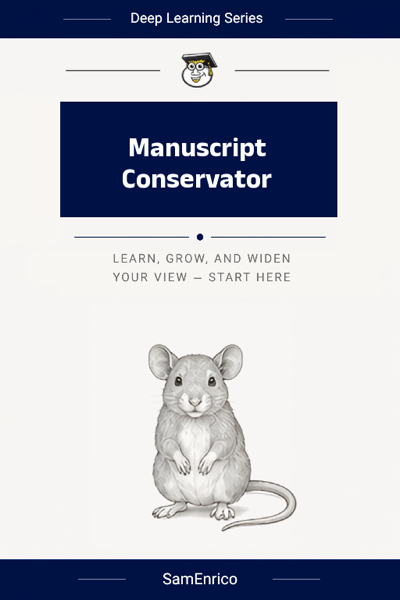
Non-FictionInformativeEducational
Manuscript Conservator eBook
A Coursebook on Manuscript Conservator
A Coursebook on Manuscript Conservator
Formats
Free sample
Chapter 1: The First Cut--–- The manuscript arrived in a cardboard box, wrapped in 1970s newspaper and smelling of attic dust. Its spine had been repaired once before—badly—with brown packing tape that had migrated into the paper fibers like a cancer. The original leather was red-rotted to powder. The sewing had failed entirely, leaving the text block in two separate halves. And on the front pastedown, someone had written in pencil: “Do not open.
Falling apart. 1982.”That note was forty years old. For four decades, this manuscript had sat unopened, unread, untended, because one well-intentioned person had tried to fix it and made things worse. The packing tape was the first cut—not into the manuscript itself, but into its future.This is where the conservator begins: not with solutions, but with damage. The damage done by time.
The damage done by neglect. And most painfully, the damage done by people who meant well but lacked training.Every conservator remembers their first manuscript. Mine was a Book of Hours from the 1480s, a devotional prayer book meant to be held, touched, thumbed through by a wealthy layperson in Bruges. By the time it reached me, its wooden boards were detached, its spine covering was gone, and its final fifteen leaves were so brittle they crumbled at the touch. The previous owner had attempted to “preserve” it by sealing it in a plastic bag—which trapped humidity and fed a dormant mold colony that was now actively digesting the parchment.I didn't know how to save it.
Not yet. But I knew what not to do. And that was the first real lesson of this profession: conservation is not about what you add. It is about what you choose not to do.The Three Paths: Conservation, Restoration, Preservation Before a conservator touches a single fiber, they must understand the landscape of possible interventions. Most people outside the field use three words interchangeably: conservation, restoration, preservation.
To the trained conservator, these are radically different concepts, and confusing them can destroy a manuscript.Preservation is the broadest category. It concerns the environment, the storage, the handling protocols, and the disaster planning that keeps manuscripts safe without directly treating them. When you install UV filters on windows, move manuscripts out of a damp basement, or train library staff not to eat near rare books—that is preservation. It is proactive. It affects whole collections.
And it is the single most cost-effective intervention a conservator can recommend. A dollar spent on environmental control prevents ten dollars of future curative treatment.Conservation is the direct, hands-on treatment of an individual manuscript to stabilize its condition and extend its usable life. Conservation accepts that every manuscript will eventually decay; the goal is to slow that decay, reverse damage where possible, and leave the object in a state where future conservators can continue the work. The key word is stabilize. A conservator does not try to make a manuscript look new.
They try to make it safe, functional, and authentic.Restoration is the dangerous cousin. Restoration attempts to return an object to an earlier, idealized state—often the state it was in when it was first created. This means replacing missing parts, removing later additions (even historically significant ones), and making the object look “as good as new.” To a collector, restoration sounds wonderful. To a conservator, it sounds like erasing history. A manuscript that has been aggressively restored has lost evidence: marginal notes from later readers, binding repairs that tell a story of use, even the wear patterns on pages that show which prayers were most popular.
Restoration prioritizes aesthetics over authenticity. Conservation prioritizes stability and honesty.Here is the test I give new students: You have a fifteenth-century prayer book with a sixteenth-century annotation in the margin—a farmer's note about a failed harvest. A restoration approach would remove the annotation as a “blemish.” A conservation approach would keep it as part of the object's biography. A preservation approach would ensure the book is stored in a stable environment so future generations can study both the original text and the marginal note.The chapter will use these three terms precisely. When you see preservation, think of storage rooms and humidity monitors.
When you see conservation, think of scalpels and wheat starch paste. When you see restoration, think carefully—because most professional conservators avoid it.The Ethical Code: Reversibility, Minimal Intervention, Respect for Integrity Conservation is not a set of techniques. It is a set of ethical commitments that guide technique. Without the ethics, you are just a skilled craftsperson—and skill without restraint can cause catastrophic damage.Three principles form the foundation of every professional conservator's practice. They appear in the code of ethics of the American Institute for Conservation (AIC), the International Institute for Conservation (IIC), and every national conservation body worldwide.Reversibility Every treatment you apply today must be removable by a future conservator using reasonable methods.
This does not mean every treatment must be literally reversible in the sense of “peel it off like a sticker.” Some treatments—washing paper, for example—change the object at a molecular level and cannot be fully reversed. But the principle requires that you never close off future options. You do not use irreversible adhesives when reversible ones exist. You do not cut away original material to insert a repair. You document everything so that a future conservator can understand what you did and undo it if necessary.I learned this the hard way early in my training.
A supervisor asked me to mend a torn leaf of parchment using a modern adhesive that cured fast and strong. I reached for the wheat starch paste—reversible, gentle, time-tested—and he stopped me. “No,” he said. “Use the acrylic.” I did. The mend held beautifully.
Ten years later, that acrylic adhesive had yellowed, stiffened, and begun to crack the parchment around the repair. The manuscript came back to the lab. The adhesive could not be removed without dissolving the underlying parchment. A simple tear was now a permanent disfigurement.Reversibility is not a theoretical nicety. It is the difference between a manuscript that can be retreated and a manuscript that has been permanently compromised.Minimal Intervention Do only what is necessary.
This sounds simple, but it is the most difficult principle to apply because “necessary” is a judgment call. Is it necessary to clean off every speck of dirt? No—some dirt is historically significant (charcoal from a house fire recorded in parish records) or is so embedded that removal would abrade the surface. Is it necessary to flatten every wrinkle? No—some wrinkles are original to the binding process, and flattening them stresses the fibers.
Is it necessary to fill every hole? No—a hole that does not affect structural integrity or text legibility can remain as evidence of the manuscript's journey.The principle of minimal intervention means you start with the gentlest possible treatment, assess the results, and only escalate if the manuscript remains unstable. You never perform a treatment just because you can. You never treat a manuscript to satisfy your own aesthetic preferences. You are the steward, not the artist.Respect for Historical Integrity A…
This is the end of the free sample. Get the eBook to keep going. Buy now
About this book
Details
- Author
- Paxton Jannie
- Publisher
- SamEnrico
- Language
- English
- Genre
- Non-Fiction, Informative, Educational
- Released
- 2026-06-02
- Pages (approx.)
- 158
- Available as
- eBook, Audiobook

Read better in the ZLOADR app
Your eBooks on your phone or tablet. Sign in with your SamEnrico account and start reading.
More by Paxton Jannie
 The Social Media Harasser ProfilePaxton Jannie$11.99
 Financial Problem Dream Guidance HandbookPaxton Jannie$11.99
 Active Listening WorkbookPaxton Jannie$11.99
 The Chronically Ill Student GuidePaxton Jannie$11.99
 DBT For College StudentsPaxton Jannie$11.99
 The Silk Road Merchants of Axum: Africa's Ancient Trade TitansPaxton Jannie$11.99
 How to Become a Configuration Management AnalystPaxton Jannie$11.99
 Pop Up Holiday Season GuidePaxton Jannie$12.99
 African Green Investment GuidePaxton Jannie$12.99
 Understanding TelangiectasiaPaxton Jannie$17.99
You may also like
 Hong Kong Handover 1997Dunn Johnnie$11.99
 Zumba For Postnatal Recovery CourseNeal Christian$11.99
 Zumba for BeginnersLadner Nikia$11.99
 YouTube Comment Mining GuideHumes Pandora$12.99
 Worry Box MeditationCarlin Rudy$11.99
 Workplace Stress MeditationNguyen Lynn$11.99
 Workplace Stress and Sleep RepairHawley Ivory$11.99
 Workplace Perfectionism CureDelaney Jeffry$11.99
 Workplace Injustice Anger GuideWallen Isabelle$11.99
 Work Addiction and Burnout LinkGreenwood Ester$11.99
 Women in Yoga and WellnessBeattie Galina$11.99
 Women in Stand Up ComedyChun Evangeline$11.99