
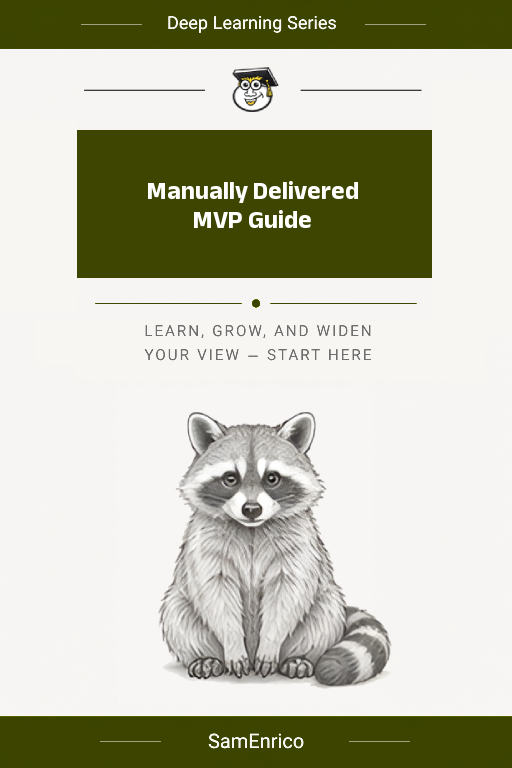
Non-FictionStartup GuideManual MVPConcierge
Manually Delivered MVP Guide eBook
Test your idea by manually delivering service usin
Test your idea by manually delivering service using email spreadsheets before building any automation or software.
Formats
Free sample
Chapter 1: The $50,000 Mistake...--Most founders fail not because they built a bad product, but because they built too much of a product before knowing if anyone wanted it.Let me tell you about Sarah.Sarah had a brilliant idea. She noticed that small business owners in her city were struggling to manage their customer feedback. They had Google Reviews, Yelp, Facebook comments, and direct emails—all scattered across different platforms. No single dashboard showed them what people were saying.Sarah was a designer. She couldn't code.
So she did what every sensible founder is told to do: she found a technical co-founder. Together, they spent six months building "Feedback Flow"—a beautiful web application that aggregated reviews from seven different platforms into a single, elegant dashboard.They launched with a splash. Product Hunt. Linked In announcements. Email to 500 beta testers.Three people signed up for the free trial.Zero paid.Sarah's technical co-founder left.
She had spent $18,000 of her savings on developers and hosting. She had nothing to show for it except a codebase she couldn't maintain and a lesson she learned too late.The problem wasn't the product. The product was excellent. The problem was that Sarah never tested whether anyone actually wanted to pay for a feedback dashboard before she built it.She could have tested the entire concept in one week with a spreadsheet and thirty emails. Instead, she spent six months and eighteen thousand dollars learning what thirty emails would have told her: small business owners don't care enough about aggregated reviews to pay for them.This chapter is the warning label on the bottle.
Read it carefully, because everything else in this book depends on you understanding one simple truth: software is a liability until value is proven.The Builder's Fallacy There is a specific cognitive bias that destroys more startups than bad ideas ever could. I call it the Builder's Fallacy.The Builder's Fallacy is the belief that writing code is progress. It feels productive. It looks impressive to investors, friends, and family. You can point to a working application and say, "Look what I built."But here's the trap: building feels like progress, but it is actually the last step in a sequence that should begin with learning.
When you build first, you are placing a bet that you already know what customers want. And the data is merciless: you don't.Eric Ries, author of The Lean Startup, documented this phenomenon across hundreds of startups. He observed that the startups most likely to fail were not the ones with bad ideas or incompetent teams. They were the ones that spent the most time building before they started measuring. Ries codified the Build-Measure-Learn loop: you must build the smallest possible thing, measure how customers react, and learn whether you were right.
Then repeat.Notice the order: Build comes after you have something to measure. But most founders invert the loop. They Build, Build, Build—then finally Measure, and discover they built the wrong thing. That's not a loop. That's a death spiral.The Builder's Fallacy is seductive because it offers certainty.
Code is deterministic. If you write it correctly, it does what you intended. That feels good. Customer behavior, by contrast, is chaotic, unpredictable, and often disappointing. So founders retreat to the one thing they can control: building.This book exists to break that pattern.The Low-Fidelity Revolution Every product exists on a spectrum of fidelity.
Fidelity means how close the product is to the final, polished, automated version.High-fidelity products are what most founders imagine when they think of an MVP. They want a working web application. A mobile app with push notifications. An API that integrates with other tools. High-fidelity feels real.
It feels like a business.Low-fidelity products are the opposite. A low-fidelity MVP might be an email you write manually. A spreadsheet you update by hand. A phone call you make to deliver information. Low-fidelity feels fake.
It feels like cheating.Here is the secret that successful founders know: low-fidelity is always the right place to start.Consider the fidelity spectrum:Fidelity Level Example Time to Create Cost Ability to Change Very Low A single email to a friend5 minutes$0Instant Low A spreadsheet shared with 5 prospects2 hours$0Minutes Medium A Typeform connected to a Google Sheet1 day$0Hours High A no-code app built in Bubble1 week$100Days Very High A custom web application1-6 months5,000−5,000-5,000−50,000Weeks Most founders start at "Very High" or "High" because that's where they want to end up. But starting at the top of the ladder is like building a skyscraper's penthouse before you've poured the foundation. You don't know if the ground can support the weight.The low-fidelity revolution says: start at the bottom. Send the email. Share the spreadsheet.
Make the phone call. Only climb the ladder when you have evidence that the next rung is necessary.Here's why this works, and why most founders resist it.Optionality: The Hidden Superpower of Manual Delivery When you write code, you make decisions that are expensive to reverse. You choose a database. You choose a programming language. You choose a hosting provider.
Each of these choices feels neutral at the time, but each one reduces your optionality—your ability to change direction when you learn something new.Manual delivery preserves optionality completely. When your "product" is a spreadsheet that you update by hand, you can change everything about it in five minutes. Add a column. Delete a column. Change the pricing.
Change the delivery method. Change the entire value proposition. There is no code to rewrite, no database to migrate, no API to deprecate.This flexibility is not a nice-to-have. It is the most valuable asset you own in the first ninety days of a startup.Let me give you a concrete example.A few years ago, I advised a founder who wanted to build a "Tinder for mentors." The idea was that experienced professionals would swipe on mentees, and the app would match them for coffee meetings. He had a technical co-founder, a wireframe, and a pitch deck.
He wanted to raise $50,000 to build the app.I asked him: "What is the smallest manual action you could take to test this?"He looked at me like I had three heads.I walked him through it. He would post on Linked In: "I'm testing a new service. I will personally match you with a mentor in your industry within 48 hours. No app. Just me and my spreadsheet.
First five matches are free."He did it. Fifteen people replied within 24 hours. He manually matched five of them. He sent each pair an email introduction. Four of the five pairs actually met for coffee.Then he asked the mentees: "Would you pay $20 for this service?"Three said yes.
One said maybe. One said no.In one week, with zero code, he learned: (1) demand exists, (2) the matching process was the hardest manual step, (3) $20 was probably too low, and (4) the mentors needed incentive to participate—they weren't showing up just for altruism.He did not raise 50,000.Instead,hebuiltasimple Typeformconnectedtoaspreadsheet.Hemanuallymatchedcustomersforsixmonths.Hegenerated50,000. Instead, he built a simple Typeform connected to a spreadsheet. He manually matched customers for six months. He…
This is the end of the free sample. Get the eBook to keep going. Buy now
About this book
Details
- Author
- Marcus Ardith
- Publisher
- SamEnrico
- Language
- English
- Genre
- Non-Fiction, Startup Guide, Manual MVP, Concierge
- Released
- 2026-06-01
- Pages (approx.)
- 127
- Available as
- eBook, Audiobook

Read better in the ZLOADR app
Your eBooks on your phone or tablet. Sign in with your SamEnrico account and start reading.
More by Marcus Ardith
 Innocence Project Delaware CasesMarcus Ardith$11.99
 Design Thinking Collaboration WorkbookMarcus Ardith$11.99
 Intermittent Fasting GuideMarcus Ardith$11.99
 Israel Green Tax Reform GuideMarcus Ardith$11.99
 The Holiday Sleep Survival GuideMarcus Ardith$11.99
 Freedom’s Echo: The Forgotten Voices of the 1963 March on DetroitMarcus Ardith$11.99
 The Alchemy of Colors: The Lost Palette of the MayaMarcus Ardith$11.99
 Understanding Chromosome 3 Duplication SyndromeMarcus Ardith$17.99
 IT AuditorMarcus Ardith$11.99
 Social Media Business SetupMarcus Ardith$12.99
 How to Become a Cable Installer-repairerMarcus Ardith$11.99
You may also like
 Hong Kong Handover 1997Dunn Johnnie$11.99
 Zumba For Postnatal Recovery CourseNeal Christian$11.99
 Zumba for BeginnersLadner Nikia$11.99
 YouTube Comment Mining GuideHumes Pandora$12.99
 Worry Box MeditationCarlin Rudy$11.99
 Workplace Stress MeditationNguyen Lynn$11.99
 Workplace Stress and Sleep RepairHawley Ivory$11.99
 Workplace Perfectionism CureDelaney Jeffry$11.99
 Workplace Injustice Anger GuideWallen Isabelle$11.99
 Work Addiction and Burnout LinkGreenwood Ester$11.99
 Women in Yoga and WellnessBeattie Galina$11.99
 Women in Stand Up ComedyChun Evangeline$11.99