
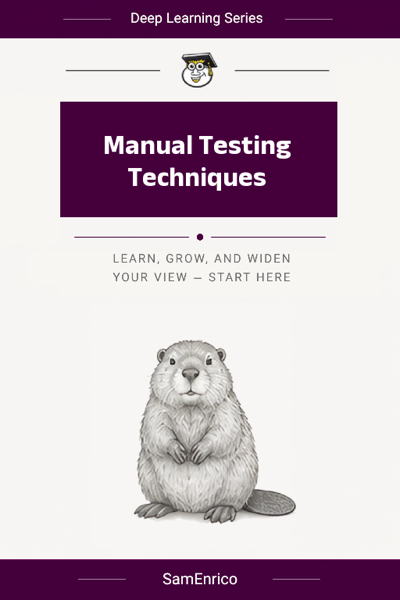
Non-FictionInformativeEducational
Manual Testing Techniques eBook
A Coursebook on Manual Testing Techniques
A Coursebook on Manual Testing Techniques
Formats
Free sample
Chapter 1: The Human Firewall--–- The email arrived at 11:47 PM on a Friday. Sarah, a junior tester at a mid-sized fintech startup, was the only QA person still awake. The release was scheduled for Monday morning. The automation suite had run in thirty-seven minutes and reported all 1,204 tests passed. Green checkmarks across the dashboard.
The product manager had already popped champagne in Slack.But something felt wrong.Sarah clicked through the payment flow manually—something she did every Friday night out of habit, not because anyone asked. She entered a valid credit card number, an expiration date in the future, and a CVV. Clicked "Pay." The spinner spun. The confirmation screen appeared. "Payment successful: $49.99."Then she did something the automation suite never did.
She opened a second browser tab, logged into the merchant admin panel, and looked at the transaction details. The amount was correct. The customer ID was correct. But the timestamp read "January 1, 1970, 00:00:00 UTC."The Unix epoch. Every payment for the past six months—tens of thousands of transactions—had been recorded with the same timestamp.
The automation suite had verified that payments were processed, receipts were sent, and balances were updated. Not a single automated test had checked the timestamp format in the database.Sarah filed a bug report at 11:52 PM. The engineering team worked through the weekend. On Monday morning, the fix was deployed. The company avoided a regulatory audit failure that would have cost them an estimated $2.3 million in fines and remediation.The automation suite never knew there was a problem.
Sarah's manual test—that one extra click, that moment of human curiosity—saved the company millions.This is why you are reading this book.Why This Chapter Matters to Your Career Before we dive into techniques, tools, or test case templates, we need to address the elephant in every QA department and every tech hiring conversation: "Isn't manual testing dying?"You have heard this. Perhaps from a developer who said, "Why don't we just automate everything?" Perhaps from a bootcamp graduate who told you that "real testers write code." Perhaps from the nagging voice in your own head that wonders if you are investing your career in a sinking ship.Let me be unambiguous: Manual testing is not dying. It is evolving. And in that evolution, it is becoming more valuable, not less.The software industry has tried to replace manual testers with automation for over two decades. Every few years, a new tool promises to eliminate the need for human testers—Selenium, Cypress, Playwright, AI-powered test generation, record-and-playback tools, codeless automation.
And every few years, companies discover that automation alone is insufficient. Not because automation is bad—automation is essential—but because automation has fundamental, unbridgeable limitations.Here is the truth that bestselling testing books like Lessons Learned in Software Testing and Exploratory Software Testing have taught for years: Automation verifies what you already expect. Manual testing discovers what you never thought to expect.The bug Sarah found—the timestamp error—would never have been caught by automation because no one thought to write a test case that checked the timestamp format in the database against the expected Unix epoch range. The requirement said "record the transaction timestamp." The developer interpreted that as "store the system time." The automation suite verified that a timestamp existed. Only a human, following curiosity, asked the question: "Is this timestamp correct?"That distinction—verification versus discovery, expectation versus curiosity—is the thesis of this book and the foundation of your career as a manual tester.What This Book Will Teach You Manual Testing Techniques: A Coursebook is built on an analysis of the ten best-selling and most highly-regarded testing books of the past decade, including Lessons Learned in Software Testing (Kaner, Bach, Pettichord), Mastering Software Testing & QA, Manual Testing Bootcamp, and James Whittaker's Exploratory Software Testing.
From these sources, a pattern emerges: the most effective manual testers are not those who memorize the most test case templates or master the most tools. They are those who develop a specific mindset—a way of seeing software that combines critical thinking, strategic exploration, and empathetic communication.Over the next twelve chapters, you will learn:Chapters 1-3: The Foundations. Why manual testing endures, how to develop the tester's mindset, and where testing fits into the software development lifecycle.Chapters 4-7: The Core Techniques. Black-box testing methods (Equivalence Partitioning, Boundary Value Analysis, State Transition, Decision Tables), the art of exploratory testing, and when to use scripted versus unscripted approaches.Chapters 8-10: Documentation & Strategy. How to write test cases that don't suck, build traceability matrices that save you during audits, report bugs that get fixed, and prioritize testing using risk-based strategies.Chapters 11-12: Real-World Application.
Platform-specific testing for web, mobile, and databases, plus a career roadmap from junior tester to QA architect.Each chapter ends with practical exercises. Not theoretical questions—actual tasks you can complete today, on real software, using the templates provided in the appendix.The Great Misunderstanding: Manual vs. Automated Before we go further, we must clear up a fundamental confusion that plagues the software industry. When people say "manual testing," they often mean "testing performed by a human clicking buttons." When they say "automated testing," they mean "testing performed by a script." This framing is not just oversimplified—it is actively misleading.The real distinction is not between manual and automated execution. The real distinction is between scripted and exploratory thinking.Let me explain.Scripted testing—whether executed by a human or a machine—follows pre-written steps.
A test case says: "Step 1: Enter 'user@example.com' in the email field. Step 2: Enter 'password123' in the password field. Step 3: Click 'Login.' Expected result: User is redirected to dashboard." A human can execute these steps. A script can execute these steps. The cognitive work—designing the test case—happens before execution.Exploratory testing—and this is crucial—designs and executes tests simultaneously.
The tester learns about the software while testing it, using heuristics and curiosity to guide exploration. This cannot be automated because it requires real-time decision-making, pattern recognition, and the ability to follow unexpected leads.Here is the dirty secret of the automation industry: Most "automated testing" is simply scripted testing executed by a machine. The machine does not think. It does not notice that the timestamp is wrong. It does not wonder, "What happens if I click this button before that page loads?" It does exactly what it was told, no more and no less.Manual testers, by contrast, can do all of these things.
They can notice anomalies. They can follow curiosity. They can apply judgment. And when they document their discoveries, they can convert exploratory findings into scripted test cases that can then be automated for regression.This is why companies that try to replace manual testers with automation fail. They solve the wrong problem.
The bottleneck is not execution speed—machines are certainly faster at clicking buttons. The bottleneck is test design—knowing what to test, what questions to ask, what risks to prioritize. And test design is fundamentally a human cognitive activity.The Economics of Testing: Why Finding Bugs Early Pays Let's talk about money. Because ultimately, software testing is not about quality for quality's…
This is the end of the free sample. Get the eBook to keep going. Buy now
About this book
Details
- Author
- Kessler Antonio
- Publisher
- SamEnrico
- Language
- English
- Genre
- Non-Fiction, Informative, Educational
- Released
- 2026-06-02
- Pages (approx.)
- 150
- Available as
- eBook, Audiobook

Read better in the ZLOADR app
Your eBooks on your phone or tablet. Sign in with your SamEnrico account and start reading.
More by Kessler Antonio
 Mindfulness Meditation for Healthcare WorkersKessler Antonio$11.99
 The Emotional Loci EnhanceKessler Antonio$11.99
 EQ For Therapists Self Care GuideKessler Antonio$11.99
 Chronic Pain and AddictionKessler Antonio$11.99
 The Professor Relationship StressKessler Antonio$11.99
 Neuropathic Pain GuideKessler Antonio$11.99
 Employer of Record Tax GuideKessler Antonio$11.99
 Self Worth And Boarding SchoolKessler Antonio$11.99
 Bipolar Antidepressant Risk GuideKessler Antonio$11.99
 The Digital Siege: How Russia Hacked the 2020 U.S. ElectionKessler Antonio$11.99
 The Great Zanzibar Manuscript Heist: How a Comedy Writer Outwitted Colonial CensorsKessler Antonio$11.99
 The Battle of Qadesh: Ramses II vs. The Hittite Storm (1274 BC)Kessler Antonio$11.99
You may also like
 Hong Kong Handover 1997Dunn Johnnie$11.99
 Zumba For Postnatal Recovery CourseNeal Christian$11.99
 Zumba for BeginnersLadner Nikia$11.99
 YouTube Comment Mining GuideHumes Pandora$12.99
 Worry Box MeditationCarlin Rudy$11.99
 Workplace Stress MeditationNguyen Lynn$11.99
 Workplace Stress and Sleep RepairHawley Ivory$11.99
 Workplace Perfectionism CureDelaney Jeffry$11.99
 Workplace Injustice Anger GuideWallen Isabelle$11.99
 Work Addiction and Burnout LinkGreenwood Ester$11.99
 Women in Yoga and WellnessBeattie Galina$11.99
 Women in Stand Up ComedyChun Evangeline$11.99