
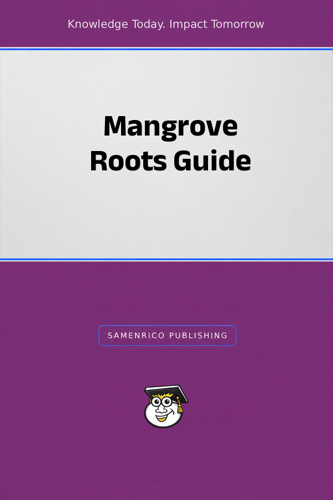
Non-FictionSelf-HelpMangroveRoots
Mangrove Roots Guide eBook
Look into imagined clear water at mangrove roots s
Look into imagined clear water at mangrove roots sheltering small fish.
Formats
Free sample
Chapter 1: The Cathedral of Roots--You are standing at the edge of a coastal forest, but not one you have been taught to recognize. There is no solid ground beneath your feet, only a spongy mat of living roots that rises and falls with each breath of the tide. The air smells of salt and something darker, sweeter, like wet earth and decaying leaves left to steep in warm seawater. Mosquitoes hum near your ears, and the mud sucks at your boots with every step. Everything about this place seems designed to repel you.
And yet, when you kneel down and look into the water, everything changes.Before you is a window into another world. The water is so clear that you can count the individual barnacles encrusting the submerged roots. Sunlight filters through the canopy above, dappling the underwater scene in shifting patterns of gold and green. And there, no bigger than your thumbnail, a juvenile fish hangs motionless among the arching prop roots. Its body is almost transparent, its eyes two dark pinpricks watching you with an attention that feels impossibly deliberate.
Then, without any signal you can perceive, it darts sideways into the tangle, and a dozen more appear from nowhere, then a hundred, flickering like silver leaves in a sudden wind.This moment – kneeling in the mud, peering into clear water at small fish sheltering among roots – is the secret heartbeat of one of the most productive, most endangered, and most misunderstood ecosystems on Earth. What you are looking at is not a swamp. It is not a wasteland. It is not a place to drain, fill, or pave. You are looking at a nursery, a filter, a storm barrier, and a carbon vault all at once, compressed into a single square meter of clear water and living wood.
And by the time you finish this book, you will never look at a tangle of mangrove roots the same way again.The Swamp That Isn't a Swamp Let us begin by unlearning something. The word "mangrove" conjures, for most people, an image of something dark, stagnant, and vaguely dangerous. Hollywood has not helped. Movies send villains into mangrove swamps to hide bodies or lose pursuers in a maze of slimy roots and crocodile-infested channels. Travel guides warn tourists to stay away from the "mosquito coast." Even the scientific name for many mangrove forests – "swamp" – carries centuries of cultural baggage, suggesting a place that is sick, unproductive, and better off converted into something useful like a shrimp farm or a beachfront hotel.This could not be further from the truth.What you are looking at when you peer into clear water at mangrove roots is one of the most biologically productive ecosystems on the planet, rivaling tropical rainforests and coral reefs in the sheer density of life it supports.
A single hectare of mangrove forest can produce more than three tons of organic matter per year. That is not a typo. Three tons of leaves, twigs, flowers, and fruit falling into the water every twelve months, where it decomposes into a rich soup of detritus – the foundation of a food web that extends for miles out to sea.Mangroves are not swamps. They are coastal forests that have evolved to live where no other trees can survive: in salt water, with their roots submerged for half the day, in oxygen-starved mud that would suffocate an oak or a pine. They are extremophiles, biological engineers, land-builders, and life-givers.
They are, quite simply, superheroes of the plant kingdom.The Clear Water Promise Before we dive into the science, let me make you a promise. This book is built around a single image: clear water, mangrove roots, small fish. That image is not just a pretty picture. It is a diagnostic tool, a window into the health of an entire ecosystem, and a call to action.Here is the promise: By the time you finish this book, you will be able to look at any mangrove forest anywhere in the world and, within minutes, tell whether it is healthy or dying. You will know what to look for, what to listen for, and what to count.
You will know why clear water matters, what clouds it, and how to bring it back. And you will know exactly what you can do – as an individual, a citizen, a traveler, and a voter – to protect these extraordinary places.The small fish you saw in the opening scene are not just cute. They are the future of coastal fisheries. Up to ninety percent of commercially important fish species in tropical regions spend their juvenile stages in mangrove roots. That snapper on your dinner plate?
It grew up here. That grouper you paid thirty dollars for at the seafood market? It hid from predators in these very roots when it was no bigger than your fingernail. That shrimp cocktail? The story is even more complicated – and we will get to that in Chapter 8.When you see clear water and small fish, you are seeing a system that works.
When the water turns murky – brown with sediment, green with algae, or simply empty – you are seeing a system that is failing. And unlike coral reefs, which are thousands of miles away for most people, or rainforests, which require expensive plane tickets, mangroves are often right there, at the edge of coastal cities, hidden in plain sight, waiting for someone to look down.A World Tour of Roots Mangroves grow on every continent except Antarctica, hugging tropical and subtropical coastlines between approximately twenty-five degrees north and south of the equator. The largest continuous mangrove forest on Earth is the Sundarbans, a sprawling, thousand-square-mile labyrinth of rivers, mudflats, and roots that straddles the border between India and Bangladesh. This is tiger country – the only place on Earth where wild Bengal tigers have learned to swim between islands and hunt in salt water. But mangroves are not just a feature of exotic, faraway lands.Florida has mangroves.
Louisiana has mangroves, creeping northward as winters warm. The Caribbean islands are ringed with them. Brazil's Amazon Delta hosts vast mangrove forests that are only now being properly mapped. West Africa's coastline, from Senegal to Angola, is lined with mangroves that support millions of artisanal fishers. The east coast of Africa, from Kenya to Mozambique, is fringed with mangrove forests that shelter the last remaining dugongs and sea turtles.
Southeast Asia – Indonesia, Malaysia, Thailand, the Philippines, Vietnam – contains nearly a third of the world's mangroves, and also the highest rates of loss. Australia has some of the best-protected mangroves on Earth, along with saltwater crocodiles that will remind you, forcefully, that you are not at the top of the food chain.Wherever mangroves grow, they share a common set of superpowers. But the specific shapes and strategies vary by species, and understanding those differences is the first step to reading the landscape.The Three Architects: Red, Black, and White Not all mangroves are created equal. In most healthy forests, you will find three main species, each occupying a slightly different zone along the tidal gradient, each with its own distinctive root architecture. Learning to tell them apart is like learning to recognize…
This is the end of the free sample. Get the eBook to keep going. Buy now
About this book
Details
- Author
- Washburn Jackqueline
- Publisher
- SamEnrico
- Language
- English
- Genre
- Non-Fiction, Self-Help, Mangrove, Roots
- Released
- 2026-06-09
- Pages (approx.)
- 142
- Available as
- eBook, Audiobook

Read better in the ZLOADR app
Your eBooks on your phone or tablet. Sign in with your SamEnrico account and start reading.
More by Washburn Jackqueline
 Project Resource ForecastingWashburn Jackqueline$11.99
 Stress Reduction Memory Saver GuideWashburn Jackqueline$11.99
 Alcohol Recovery Child CustodyWashburn Jackqueline$11.99
 Lying Down Body Scan MeditationWashburn Jackqueline$11.99
 Loki’s African Gambit: The Trickster’s Cross-Cultural CaperWashburn Jackqueline$11.99
 How to Become a Central-office-operator SupervisorWashburn Jackqueline$11.99
 Restoration Project ManagerWashburn Jackqueline$11.99
 College Essay Mentor in Your EarWashburn Jackqueline$12.99
 ABB Manufacturing SWOTWashburn Jackqueline$12.99
 Understanding Nonmedullary Thyroid Carcinoma, With Cell OxyphiliaWashburn Jackqueline$17.99
You may also like
 Hong Kong Handover 1997Dunn Johnnie$11.99
 Zumba For Postnatal Recovery CourseNeal Christian$11.99
 Zumba for BeginnersLadner Nikia$11.99
 YouTube Comment Mining GuideHumes Pandora$12.99
 Worry Box MeditationCarlin Rudy$11.99
 Workplace Stress MeditationNguyen Lynn$11.99
 Workplace Stress and Sleep RepairHawley Ivory$11.99
 Workplace Perfectionism CureDelaney Jeffry$11.99
 Workplace Injustice Anger GuideWallen Isabelle$11.99
 Work Addiction and Burnout LinkGreenwood Ester$11.99
 Women in Yoga and WellnessBeattie Galina$11.99
 Women in Stand Up ComedyChun Evangeline$11.99