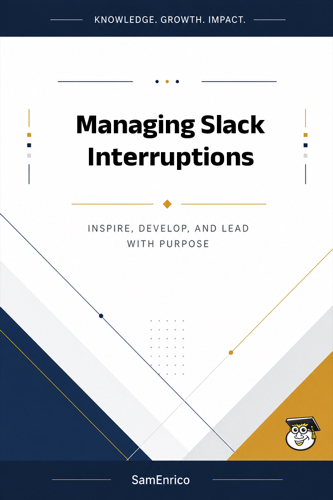
Managing Slack Interruptions eBook
Sets status and notification boundaries.
by Hayward Sima
Sets status and notification boundaries.
Formats
Free sample
Chapter 1: The Green Dot Lie--–- It begins, as it always does, with a dot. A small, unassuming circle of green light, no larger than the tip of a ballpoint pen, sitting patiently next to your name in the sidebar of your company’s Slack workspace. That dot is not a status indicator. That dot is a leash.You have been trained to believe that the green dot represents availability. You have been conditioned to feel a small pang of guilt when it is gray, a flicker of anxiety when it is yellow, and a sense of dutiful readiness when it glows green.
But here is the truth that no collaboration software vendor will ever put in their marketing materials: the green dot has nothing to do with your actual availability and everything to do with other people’s expectations. It is a social signal dressed up as a technical one, and it is quietly destroying your ability to do meaningful work.This chapter is called “The Green Dot Lie” because we need to start with an exorcism. Before we can build better boundaries, before we can configure notification settings or write the perfect status message, we have to unlearn the most dangerous assumption of the modern workplace: that being visible means being productive, and that being offline means being lazy. The green dot has seduced an entire generation of knowledge workers into a state of permanent, low-grade distraction, and the first step toward freedom is understanding exactly how that seduction works.The 23-Minute Crime Scene Let us reconstruct a crime scene. The time is 10:14 on a Tuesday morning.
You have been working on a quarterly financial model for the past forty-seven minutes. You are deep in what psychologist Mihaly Csikszentmihalyi called “flow”—that state of effortless concentration where time seems to disappear and the work feels almost automatic. Your fingers move across the keyboard. The spreadsheet bends to your will. You are, in every meaningful sense, winning.Then you hear it.
A soft ding. Or perhaps a boop. Or, if you are one of the unfortunate souls who never changed the default notification sound, that cheerful two-note chirp that Slack uses to announce its presence. Your eyes flick to the upper right corner of your screen. A red badge appears on the Slack icon.
The number inside the badge is 1. Just one message. Just one quick question. Just one tiny interruption.You tell yourself you will just look. You will not reply.
You will simply see who it is and what they want, and then you will return to your spreadsheet. This is the lie we tell ourselves approximately forty-seven times per workday.You click the icon. The message is from a colleague named Mark. Mark is not a bad person. Mark is not trying to sabotage your career.
Mark simply has a question about the Q3 revenue numbers, and he noticed that your green dot was illuminated, which in the unspoken grammar of Slack means “I am available to be interrupted.” The message reads: “Hey, got a sec?”Now you have a problem. You cannot simply ignore Mark, because ignoring him would be rude. You cannot reply “no,” because that would also be rude. You cannot say “I’m busy,” because your green dot suggests otherwise. So you type: “Sure, what’s up?” Mark replies with his actual question.
You answer it. Mark says “thanks.” You say “no problem.” The entire exchange takes ninety seconds. No harm, no foul.Except there is a harm, and it is a profound one. You return to your spreadsheet, but something has changed. The flow is gone.
The numbers no longer seem to arrange themselves into neat rows of meaning. You find yourself reading the same cell three times. You cannot remember which formula you were about to enter. You check your phone. You glance at the news.
You get a glass of water. Twenty-three minutes later—twenty-three minutes by the clock, though it feels like an eternity—you finally re-engage with the spreadsheet at something approaching your previous level of focus.Those twenty-three minutes are not an outlier. They are not an exaggeration. They are the empirically verified result of research conducted by Dr. Gloria Mark at the University of California, Irvine, who has spent two decades studying attention in the workplace.
Dr. Mark’s research found that knowledge workers switch tasks an average of every three minutes and five seconds, and that after any interruption—even a brief one—it takes an average of twenty-three minutes and fifteen seconds to fully return to the original task.Let me say that again, because it is the single most important number in this entire book: twenty-three minutes. Every time you glance at a Slack notification, you are not losing ninety seconds. You are losing twenty-three minutes. That “quick question” from Mark did not cost you a minute and a half.
It cost you nearly half an hour of productive capacity. If you receive just ten Slack notifications in a day—a conservative estimate for most knowledge workers—you are losing nearly four hours of productive time. Not four hours of time at your desk. Four hours of focused, meaningful, cognitively demanding work.The spreadsheet, by the way, is a generous example. If your work involves creative output—writing, design, strategy, coding, research—the recovery time is often longer.
Software engineers who are interrupted mid-task take an average of twenty-five minutes to return to their previous state of flow, according to research published in the Proceedings of the National Academy of Sciences. For writers, the recovery time can exceed thirty minutes. The more complex the task, the more devastating the interruption.The Neuroscience of the Switch Cost Why does this happen? Why can’t we just snap back to work after a ninety-second exchange? The answer lies in the architecture of the human brain, which is not designed for the kind of rapid task-switching that Slack encourages.Your brain operates in two distinct modes, which neuroscientists call the default mode network and the task-positive network.
The task-positive network is active when you are engaged in focused, goal-directed work—building that spreadsheet, writing that report, debugging that code. Your prefrontal cortex, the seat of executive function, is fully engaged. Working memory is loaded with relevant information. Neural pathways are firing in efficient, predictable patterns.The default mode network, by contrast, is active when you are at rest—daydreaming, showering, walking without a destination. This is the brain’s idle state, and it is far more important than most people realize.
The default mode network is where creativity happens, where problems are solved unconsciously, where the brain consolidates memories and makes unexpected connections. It is also the state you enter when you are not actively engaged in a demanding task.Here is the problem: your brain cannot operate both networks simultaneously. They are like two sides of a seesaw. When one is active, the other is suppressed. When you are deep in focused work, your task-positive network is dominant, and your default mode network is quiet.
When you glance at a Slack notification, you are not simply pausing your work. You are triggering a complete neural…
This is the end of the free sample. Get the eBook to keep going. Buy now
About this book
Details
- Author
- Hayward Sima
- Publisher
- SamEnrico
- Language
- English
- Genre
- Non-Fiction, Self-Help, Slack
- Released
- 2026-06-12
- Pages (approx.)
- 110
- Available as
- eBook, Audiobook

Read better in the ZLOADR app
Your eBooks on your phone or tablet. Sign in with your SamEnrico account and start reading.
More by Hayward Sima
 Zumba Toning Stick WorkoutHayward Sima$11.99
 Mindfulness for Anger BeginnersHayward Sima$11.99
 Anki For GMAT FocusHayward Sima$11.99
 Sumatran Jungle Tiger EncounterHayward Sima$11.99
 The Al Anon Companion GuideHayward Sima$11.99
 Forgiving a ThiefHayward Sima$11.99
 Road Rage Support GroupsHayward Sima$11.99
 The Vanishing of the Lyttelton Gold: A Ransomware of the PastHayward Sima$11.99
 The Bollywood Butcher: India's Deadly Underworld ConnectionHayward Sima$11.99
 US Business Credit for Nonprofits GuideHayward Sima$12.99
 Hybrid Event on Budget GuideHayward Sima$12.99
 How to Produce Radio and TV AccessoriesHayward Sima$11.99