
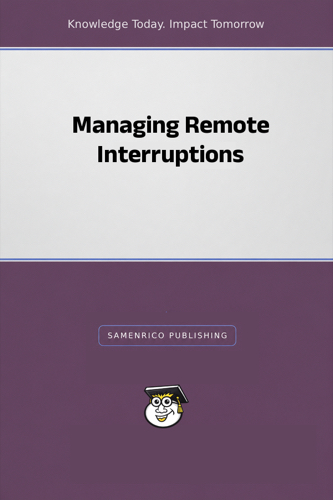
Non-FictionSelf-HelpInterruptions
Managing Remote Interruptions eBook
Handles family, pet, and delivery disruptions.
Handles family, pet, and delivery disruptions.
Formats
Free sample
Chapter 1: The Food Processor Day--–- The email came in at 7:14 AM. By 7:16, Sarah had already answered it from her phone while pouring coffee. By 7:45, she had reviewed three Slack messages, approved an expense report, and reminded her 8-year-old to put on shoes. At 8:00 AM, she sat down at her home desk—a converted sewing table in the corner of the living room—with a clear to-do list: finish the Q3 forecast, prep for the 11 AM client call, and review her direct report’s draft. Six hours later, at 2:00 PM, she had done none of those things.
She had, however, signed for a package, let the dog out twice, settled a screaming match over LEGOs, answered fourteen “quick questions” from her spouse, and eaten a sad desk lunch over the trash can because the kitchen was occupied. At 5:00 PM, she closed her laptop with nothing checked off, a dull headache behind her eyes, and the sinking feeling that she had worked very hard all day and accomplished absolutely nothing of significance.This is not a story about a lazy person. This is not a story about someone who lacks discipline or grit or a properly organized bullet journal. This is a story about a person whose workday was shredded into confetti by a hundred tiny interruptions, none of which felt serious enough to justify saying no, and all of which added up to a day that felt both exhausting and empty.You know this feeling. You have lived this feeling.
And if you are reading this book, you have likely decided that you cannot live it anymore.Welcome to the Food Processor Day.The Great Illusion of the Office Before we solve the problem of remote interruptions, we must first dismantle a dangerous myth: the belief that the office was ever a place of pristine focus and deep, uninterrupted work. Most remote workers look back at their pre-pandemic office days with a kind of wistful nostalgia. “If only I could go back to my cubicle,” they tell themselves, “I would get so much done.” This is a lie your brain tells you, and it is a lie we need to kill in the first few pages of this book.Let us be honest about what the office actually was. The office was an open floor plan where your coworker’s phone rang every eleven minutes. The office was a conference room where meetings ran over by twenty minutes because someone had “just one more question.” The office was the person who tapped you on the shoulder to ask about lunch plans right as you were solving a difficult problem.
The office was the fire drill, the birthday cake in the break room, the IT guy showing up to replace your monitor, and the manager who “popped by to check on something.” The office, in other words, was an interruption factory.The researchers who study knowledge work have known this for decades. In one widely cited study of workplace interruptions, Gloria Mark and her colleagues at UC Irvine found that the average office worker experiences an interruption every eleven minutes—and that after each interruption, it takes an average of twenty-three minutes to return to the same depth of focus. Let me repeat that number because it is the single most important number in this entire book: twenty-three minutes.Think about what that number means. If you are interrupted at 10:00 AM for thirty seconds, you are not back to full cognitive function until approximately 10:23 AM. The interruption itself was negligible.
The recovery was catastrophic. And if you are interrupted six times in a day—a conservative estimate for most remote workers—you lose over two hours of productive cognitive capacity to the aftermath of interruptions alone. That is before you count the time spent on the interruptions themselves, or the emotional toll of starting and stopping, starting and stopping, like a car stuck in traffic that never reaches highway speed.But here is where the home office gets tricky. When you worked in an office, the interruptions were impersonal. A coworker’s question about the TPS report did not trigger your nervous system in the same way that your child’s cry does.
The office fire drill was annoying, but it did not make you feel guilty. The meeting that ran late was frustrating, but it did not make you question whether you were a good parent or a good partner.The home office replaces colleague-based interruptions with family-based, pet-based, and delivery-based interruptions. And the difference is not just logistical. It is neurological. It is emotional.
It is existential.The Velcro Principle (A Preview)We will explore this phenomenon in depth in Chapter 2, but for now, understand this: your brain is wired to respond to the sounds of your dependents. The cry of your specific child, the whine of your specific dog, even the particular timbre of your partner’s voice when they are about to ask a question—these sounds bypass your rational brain and activate your limbic system directly. You do not decide to flinch when your toddler screams. You flinch. And then you spend the next twenty-three minutes trying to remember what you were doing before the flinch.This is not a character flaw.
This is evolution. Your ancestors who ignored the sound of a crying child did not pass down their genes. The fact that you cannot ignore your family while you work is proof that your nervous system is functioning exactly as it should. The problem is not your biology. The problem is that you are trying to do two things that your biology was never designed to do simultaneously: protect and provide, nurture and produce, be present and be productive.The office worker could walk out the door and leave the interruptions behind.
The remote worker lives inside the interruptions. The office worker’s commute was a transition ritual that signaled to the brain: “Now you are at work. Now you are at home.” The remote worker’s commute is the twelve feet from the coffee maker to the desk, and their brain never fully switches modes.This is why you are exhausted. This is why you feel like you worked a twelve-hour day and accomplished nothing. This is why you lie awake at night wondering if you are secretly bad at your job.You are not bad at your job.
You are playing a game with impossible rules—and it is time to rewrite the rules.The Cost of an Interruption: Beyond the Clock Before we build solutions, we need to understand the full anatomy of an interruption. Most people think an interruption is simply the time it takes to handle the interruption itself. Sign for the package: thirty seconds. Answer the child’s question: forty-five seconds. Let the dog out: one minute.
By this accounting, a day’s worth of interruptions might add up to fifteen or twenty minutes. No big deal, right? Just work an extra twenty minutes at the end of the day.This is tragically wrong.The full cost of an interruption has three components, and only the first one is obvious.Component 1: The interruption itself. This is the time you spend actually…
This is the end of the free sample. Get the eBook to keep going. Buy now
About this book
Details
- Author
- Guillen Stevie
- Publisher
- SamEnrico
- Language
- English
- Genre
- Non-Fiction, Self-Help, Interruptions
- Released
- 2026-06-05
- Pages (approx.)
- 122
- Available as
- eBook, Audiobook

Read better in the ZLOADR app
Your eBooks on your phone or tablet. Sign in with your SamEnrico account and start reading.
More by Guillen Stevie
 Guided Imagery for RestGuillen Stevie$11.99
 ABC Prioritization RulesGuillen Stevie$11.99
 DBT for Anxiety RegulationGuillen Stevie$11.99
 Leadership Empathy SkillsGuillen Stevie$11.99
 Prescription Opioid Taper GuideGuillen Stevie$11.99
 Marie Antoinette Life GuideGuillen Stevie$11.99
 Blue Zone Meal Prepping GuideGuillen Stevie$11.99
 The Siege of Herat: Timur's Bloody Lesson in Loyalty (1381)Guillen Stevie$11.99
 Gilgamesh and the Hidden Tablet: The Unwritten EpicGuillen Stevie$11.99
 A Collector's Handbook to the Heron EuropeGuillen Stevie$11.99
 How to Produce Toilet Seat CoversGuillen Stevie$11.99
 Cash Discount Strategy InflationGuillen Stevie$12.99
You may also like
 Hong Kong Handover 1997Dunn Johnnie$11.99
 Zumba For Postnatal Recovery CourseNeal Christian$11.99
 Zumba for BeginnersLadner Nikia$11.99
 YouTube Comment Mining GuideHumes Pandora$12.99
 Worry Box MeditationCarlin Rudy$11.99
 Workplace Stress MeditationNguyen Lynn$11.99
 Workplace Stress and Sleep RepairHawley Ivory$11.99
 Workplace Perfectionism CureDelaney Jeffry$11.99
 Workplace Injustice Anger GuideWallen Isabelle$11.99
 Work Addiction and Burnout LinkGreenwood Ester$11.99
 Women in Yoga and WellnessBeattie Galina$11.99
 Women in Stand Up ComedyChun Evangeline$11.99