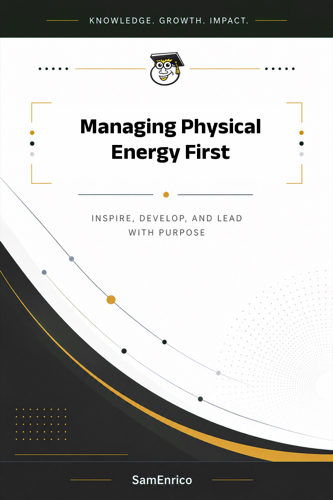
Managing Physical Energy First eBook
Optimize sleep nutrition and movement to build you
Optimize sleep nutrition and movement to build your fundamental energy reserve.
Formats
Free sample
Chapter 1: The Great Deception--–- The email arrived at 6:47 PM on a Tuesday. James, a 34-year-old project manager, had been working since 7:30 AM. He had crossed seventeen items off his to-do list, attended six meetings, and drank four cups of coffee. His inbox still held forty-three unread messages. His jaw ached from clenching.
His vision blurred slightly when he looked at the clock. And yet, when his phone buzzed with his wife asking if he would be home for dinner, he typed back automatically: "Thirty more minutes. Almost done."Three hours later, at 9:45 PM, James closed his laptop. He had not eaten dinner. He had not called his wife back.
He had completed three more minor tasks and generated approximately 1,200 words of email traffic that nobody would read until morning. He fell into bed exhausted, set his alarm for 6:00 AM, and promised himself that tomorrow would be different.Tomorrow was not different. Neither was the day after. James had become a master of time management. He used every productivity app on the market.
He color-coded his calendar. He read two bestselling books on getting things done. And yet, at thirty-four, he felt fifty-four—perpetually behind, perpetually tired, perpetually convinced that if he could just find the right system, everything would change.This book begins with James because James is not a person. James is a pattern. He is the high-performing professional who confuses busyness with effectiveness.
He is the entrepreneur who believes that working more hours is the only path to success. He is the student, the executive, the artist, and the parent who has been sold a lie. The lie is this: that time is the ultimate resource, and that managing it with sufficient precision will unlock the life you want.The truth is far stranger, far simpler, and far more uncomfortable. Time is fixed. You cannot manufacture a twenty-fifth hour.
You cannot borrow from tomorrow. You cannot save unused minutes in a bank. Every human being on earth receives exactly 86,400 seconds per day, and no productivity system in history has changed that number by a single tick. The real variable—the only variable that actually expands and contracts—is your physical energy.This chapter dismantles the great deception of modern self-help: that time management is the answer. It introduces the four dimensions of human energy and establishes, through science and case studies, why physical energy must come first.
By the end of this chapter, you will understand why your to-do list keeps defeating you. More importantly, you will understand why the solution has nothing to do with better scheduling and everything to do with building a bigger battery.The Tyranny of the Clock The modern obsession with time management began in 1911, when Frederick Winslow Taylor published The Principles of Scientific Management. Taylor watched factory workers shoveling pig iron and concluded that every motion could be optimized, every second accounted for, every inefficiency eliminated. His methods doubled and tripled output. They also reduced human beings to cogs in a machine.A century later, we have internalized Taylor's logic so completely that we no longer recognize it as a philosophy.
We treat it as physics. We wake up and immediately check the time. We allocate blocks of minutes to tasks. We measure our worth by how much we "got done." We speak of "killing time," "saving time," "spending time," and "running out of time"—as if time were a commodity rather than a dimension. And we have built an entire industry of planners, apps, and methodologies designed to squeeze more productivity from each waking hour.There is just one problem.
It does not work.Not for lack of effort. Not for lack of sophisticated tools. It does not work because the underlying assumption is false. Time management assumes that the limiting factor in human performance is the number of available hours. But if that were true, then a person who worked sixty hours would always outperform a person who worked forty hours.
A person who slept four hours would always outperform a person who slept eight. A person who never took a break would always outperform a person who rested.You know from experience that the opposite is true. You have worked twelve-hour days that produced less value than four-hour mornings. You have pushed through exhaustion only to make mistakes that required hours to correct. You have attended back-to-back meetings and emerged with no memory of what was decided.
These are not failures of time management. They are failures of energy management.Consider the research. In a landmark study published in the Journal of Applied Psychology, researchers tracked the work patterns of 100 employees over two weeks. They found that the employees who reported the highest levels of productivity worked an average of six hours per day—not eight, not ten, not twelve. They worked in intense sprints of ninety minutes or less, followed by deliberate breaks.
They stopped working when their energy dipped, rather than pushing through. And they accomplished more, in less time, than their colleagues who ground through full shifts without interruption.The difference was not in how they managed their calendars. The difference was in how they managed their biology.The Four Dimensions of Energy Energy is not a single substance. It is not merely "feeling awake" or "having motivation." Jim Loehr and Tony Schwartz, in their seminal work The Power of Full Engagement, identified four distinct dimensions of human energy. Each dimension fuels a different type of performance.
Each dimension can be expanded through training. And each dimension relies, directly or indirectly, on the one beneath it.Physical energy is the most fundamental. It is the energy of biology: the ATP produced in your mitochondria, the glucose circulating in your bloodstream, the oxygen exchange in your lungs, the restorative sleep that repairs your neurons. Physical energy determines whether you can stand, walk, lift, and—critically—think. The brain, though only two percent of body mass, consumes twenty percent of your glucose.
When physical energy dips, the brain is the first organ to notice.Emotional energy is the energy of feeling. It is your capacity for patience, empathy, joy, and resilience. It determines whether you snap at a colleague or respond with curiosity. It governs whether you can handle criticism without collapsing or success without arrogance. Emotional energy is not separate from the body.
It rises and falls with hormones: cortisol, adrenaline, testosterone, oxytocin. You cannot "think" your way out of a cortisol spike any more than you can think your way out of a fever.Mental energy is the energy of focus. It is your ability to sustain attention, process information, solve problems, and make decisions. Mental energy is limited and depletable. Every decision you make—what to eat, what to wear, which email to answer first—draws from the same finite reservoir.
This is why decision fatigue is real. This is why your willpower crumbles by evening. This is why multitasking is not a skill but a fantasy.Spiritual energy is the energy of purpose. It is the fuel that comes from acting in alignment with your deepest values. Spiritual energy does not magically create ATP or glucose.
But it can raise your tolerance for discomfort. It can make a difficult task feel meaningful rather than miserable. It…
This is the end of the free sample. Get the eBook to keep going. Buy now
About this book
Details
- Author
- Nicholas Angelena
- Publisher
- SamEnrico
- Language
- English
- Genre
- Non-Fiction, Business Brief, Wellness
- Released
- 2026-06-12
- Pages (approx.)
- 148
- Available as
- eBook, Audiobook

Read better in the ZLOADR app
Your eBooks on your phone or tablet. Sign in with your SamEnrico account and start reading.
More by Nicholas Angelena
 Self Esteem In Interabled RelationshipsNicholas Angelena$11.99
 The Special Needs Parent Sanity GuideNicholas Angelena$11.99
 Behavioral Addiction and DivorceNicholas Angelena$11.99
 Whispers of the Forgotten: The Lost Code of the Voynich ManuscriptNicholas Angelena$11.99
 The Forgotten Icebound: The 1860s British Expedition to Lake TanganyikaNicholas Angelena$11.99
 Understanding Hepatitis CNicholas Angelena$17.99
 Administrative ReceptionistNicholas Angelena$11.99
 E-Commerce Dynamic Pricing OutlookNicholas Angelena$12.99
 Online Masters From Harvard Or LSE ManualNicholas Angelena$12.99
 How to Become a DispatcherNicholas Angelena$11.99