
Non-FictionSelf-HelpCognitive Psychology
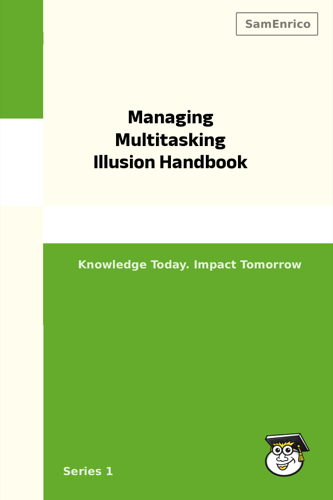
Managing Multitasking Illusion Handbook eBook
Understand the cognitive cost of task switching an
Understand the cognitive cost of task switching and replace it with rapid serial processing.
Formats
Free sample
Chapter 1: The 40% Heist--–- Every time you switch from one task to another, you lose something you will never get back. Not just time, though you lose plenty of that. Not just focus, though that scatters like startled birds. You lose your cognitive momentum—the invisible aerodynamic lift that makes difficult work feel manageable. And here is the cruelest part: you feel productive while you are losing it.Let us start with a simple experiment you can perform right now, using nothing but your own attention.
Open a timer on your phone. For sixty seconds, count the number of times the letter "E" appears in the next sentence. Do nothing else. Just count.The quick brown fox jumps over the lazy dog near the riverbank where three small fish swim silently.Now write down your number. Then, reset the timer.
For another sixty seconds, count the letter "E" in the same sentence while silently reciting the alphabet backward in your head. Z, Y, X, W, V, U, T, S, R, Q, P—you get the idea. Count the E's while doing that.Your first number was likely accurate. Your second number was likely lower, and the alphabet recitation probably fell apart entirely. You did not actually do two things at once.
You flipped back and forth between counting and reciting so rapidly that your brain created an illusion of simultaneity. And in that flipping, you lost accuracy, speed, and a strange sense of effortlessness that was present in the first round.This chapter is about why that happens, what it costs you over days and years, and why the most dangerous part of the process is that it feels like you are being efficient even as you sabotage yourself. We are going to name the enemy—the 40% heist—and by the end of this chapter, you will never unsee it.The Birth of a Lie The word "multitasking" did not come from psychology or neuroscience. It came from engineering. In the 1960s, IBM engineers used the term to describe the ability of a computer's central processing unit to work on multiple tasks simultaneously.
A computer can actually do this because it has multiple cores, dedicated interrupt handlers, and a clock speed measured in billions of cycles per second. Your brain has none of these things.When the term jumped from engineering to popular culture in the 1990s, it brought a dangerous implication: if computers can parallel process, and if computers are smarter than us in many ways, then maybe humans can and should parallel process too. This was a category error of enormous consequence. The brain is not a CPU. It is a sequential processor wearing a parallel processing costume.By 2005, the myth was fully embedded.
Job descriptions listed "excellent multitasking skills" as a qualification. Parents bragged that their teenagers could do homework while texting while watching You Tube. Open-plan offices were designed on the assumption that rapid task switching was a form of productivity. And everyone felt exhausted at 3 PM, blaming everything except the actual cause: they had switched tasks eighty times before lunch.The first person to rigorously challenge this myth was a Stanford psychologist named Clifford Nass. In a landmark study, Nass and his team recruited students who identified as "heavy multitaskers"—people who regularly consumed multiple media streams simultaneously.
The researchers expected to find that these students had developed superior filtering abilities. What they found instead was the opposite. Heavy multitaskers were worse at filtering irrelevant information, worse at switching between tasks when asked to do so experimentally, and worse at maintaining mental focus than the light multitaskers in the control group. They had trained their brains to be distractible.Nass later summarized the finding bluntly: "The people who multitask the most are the people who are worst at multitasking."This is the first crack in the illusion. If the people who practice multitasking the most are actually the least capable of doing it well, then multitasking is not a skill you can develop.
It is a habit that degrades the very ability it claims to use.The 40% Number Let us get specific. In a controlled laboratory setting, researchers ask participants to perform Task A (for example, sorting shapes by color), then switch to Task B (sorting shapes by shape), then switch back to Task A. The time difference between performing Task A without switching and performing Task A immediately after a switch is called the switch cost.Across dozens of studies, switch costs range from 20% to over 100% depending on task complexity. For simple tasks like shape sorting, the cost averages around 40%. That is, you lose 40% of your productive time every time you switch between tasks, even when the tasks are trivial.Forty percent.
Let that sit for a moment.If you work eight hours in a day and spend four of those hours switching between tasks (which is conservative for most knowledge workers), you lose 1.6 hours every single day to switch costs. That is eight hours per week. That is one full workday lost every week to the invisible friction of changing your mind.Over a fifty-week working year, that is fifty days—ten full workweeks—lost to switching. Over a forty-year career, that is nearly five years of your working life that you will spend not doing work, but switching between pieces of work. And you will not even notice it happening because your brain will give you a tiny dopamine reward every time you switch, making you feel like you are being productive at the exact moment you are being least productive.This is the heist.
The 40% heist. And it is happening to you right now, in this moment, if you have a browser tab open that you intend to check later, or a phone buzzing in your pocket, or a half-written email in your drafts folder. Every open loop, every pending notification, every unfinished thought is a tax on the task you are trying to do.The Anatomy of a Switch To understand why switching costs are so high, you need to understand what actually happens inside your brain during a task switch. The process has four distinct stages, and every single one of them consumes time and metabolic energy.Stage One: Goal Shifting. Your prefrontal cortex—the executive center located just behind your forehead—must disengage from the rules and objectives of Task A and orient toward the rules and objectives of Task B.
This is not instantaneous. Your brain literally has to suppress one neural activation pattern and amplify another. The more different the tasks, the longer goal shifting takes. Switching from checking email to writing a report might take a few hundred milliseconds. Switching from solving a calculus problem to comforting a crying child might take several seconds.
Those milliseconds add up.Stage Two: Rule Activation. Once your brain knows what it wants to do, it has to load the "rules" for that task into working memory. This includes procedural rules (how to do the task), declarative rules (what information is relevant), and inhibitory rules (what to ignore). Rule activation is why you sometimes walk into a room and forget why you went there—your brain was still in the rule…
This is the end of the free sample. Get the eBook to keep going. Buy now
About this book
Details
- Author
- Mcnamara Jessia
- Publisher
- SamEnrico
- Language
- English
- Genre
- Non-Fiction, Self-Help, Cognitive Psychology
- Released
- 2026-06-07
- Pages (approx.)
- 148
- Available as
- eBook, Audiobook

Read better in the ZLOADR app
Your eBooks on your phone or tablet. Sign in with your SamEnrico account and start reading.
More by Mcnamara Jessia
 Imposter Syndrome For VeterinariansMcnamara Jessia$11.99
 Fashion Consumption DivideMcnamara Jessia$11.99
 Delegation for SolopreneursMcnamara Jessia$11.99
 Callous Unemotional Trait PathwayMcnamara Jessia$11.99
 Total Testosterone LevelsMcnamara Jessia$11.99
 Self Directed IRA GuideMcnamara Jessia$11.99
 Anger Rupture RepairMcnamara Jessia$11.99
 The Cossack Shadow War: Stalingrad’s Forgotten ResistanceMcnamara Jessia$11.99
 The Charioteers of Rome: Fashioning Victory in the Circus MaximusMcnamara Jessia$11.99
 How to Produce Furniture HardwareMcnamara Jessia$11.99
 A Collector's Handbook to the Cadillac Fleetwood Brougham (1970-76)Mcnamara Jessia$11.99
 CS Degree Part Time GuideMcnamara Jessia$12.99
You may also like
 Hong Kong Handover 1997Dunn Johnnie$11.99
 Zumba For Postnatal Recovery CourseNeal Christian$11.99
 Zumba for BeginnersLadner Nikia$11.99
 YouTube Comment Mining GuideHumes Pandora$12.99
 Worry Box MeditationCarlin Rudy$11.99
 Workplace Stress MeditationNguyen Lynn$11.99
 Workplace Stress and Sleep RepairHawley Ivory$11.99
 Workplace Perfectionism CureDelaney Jeffry$11.99
 Workplace Injustice Anger GuideWallen Isabelle$11.99
 Work Addiction and Burnout LinkGreenwood Ester$11.99
 Women in Yoga and WellnessBeattie Galina$11.99
 Women in Stand Up ComedyChun Evangeline$11.99