
Non-FictionSelf-HelpExecutive LeadershipStrategy
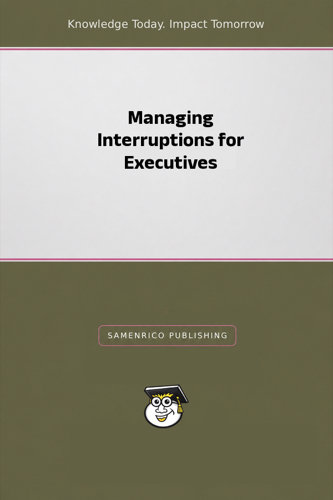
Managing Interruptions for Executives
Executive-level strategies to batch meetings, dele
Executive-level strategies to batch meetings, delegate fire drills, and protect strategic thinking time.
Formats
About this book
Free sample
Chapter 1: The Attention Autopsy--–- At exactly 8:47 AM on a Tuesday, a CEO named David sat down to review the final numbers for a quarterly board presentation. He had blocked two hours for this work. By 8:49 AM, his phone buzzed with a text from his head of sales: “Urgent. Call me.” By 8:52 AM, Slack pinged with a question about an expense report. By 8:56 AM, his EA knocked to ask about a catering change for the board dinner.
By 9:01 AM, David had answered three emails, approved a purchase order, and completely lost track of the revenue projection he had been analyzing. At 9:15 AM, he looked up, confused, and realized he had accomplished nothing of strategic value. He had been busy. He had not been effective.David’s morning is not unusual. It is the default operating rhythm for most senior executives in modern organizations.
The average executive experiences an interruption every eleven minutes. Each of those interruptions costs not just the two or three minutes of the interruption itself, but an additional twenty-three minutes to return to the original task at the same depth of focus. This is not a productivity theory. This is peer-reviewed cognitive neuroscience. When the human brain switches between tasks, it does not snap cleanly from one to the next.
It leaves behind what researchers at the University of California, Irvine call “attention residue”: fragments of the previous task that continue to occupy mental bandwidth for nearly half an hour. After four or five task-switches in an hour, the executive brain is no longer performing at an executive level. It is performing at the level of a tired administrative assistant.And yet, executives continue to tolerate this chaos. Worse, they often celebrate it. The “open door” policy has become a badge of approachability, a signal of humility and team-orientation.
But open doors do not produce strategic breakthroughs. Open doors produce fragmented attention, reactive decision-making, and a slow, creeping erosion of the very cognitive skills that justified the executive’s title in the first place. The most dangerous interruption is not the one that steals five minutes. It is…
This is the end of the free sample. Get the eBook to keep going. Buy now
Contents
- Chapter 1
- Chapter 2
- Chapter 3
- Chapter 4
- Chapter 5
- Chapter 6
- Chapter 7
- Chapter 8
- Chapter 9
- Chapter 10
- Chapter 11
- Chapter 12
Details
- Author
- Sherrill Marshall
- Publisher
- SamEnrico
- Language
- English
- Genre
- Non-Fiction, Self-Help, Executive Leadership, Strategy
- Released
- 2026-06-08
- Pages (approx.)
- 139
- Available as
- eBook, Audiobook

Read better in the ZLOADR app
Your eBooks on your phone or tablet. Sign in with your SamEnrico account and start reading.
More by Sherrill Marshall
 Chunking for TeachersSherrill Marshall$11.99
 Commercial Real Estate MomentumSherrill Marshall$11.99
 Prolonged Grief In Children GuideSherrill Marshall$11.99
 Living Abroad in Mexico ProfitablySherrill Marshall$11.99
 Growing Up in Fear PrimerSherrill Marshall$11.99
 Bell Tower ChimeSherrill Marshall$11.99
 Resume India Specific GuideSherrill Marshall$11.99
 Loving Your Body NowSherrill Marshall$11.99
 The Domino Effect: How One Bank Brought Down the Irish EconomySherrill Marshall$11.99
 The Lion of Gondar: Emperor Tewodros II's Last StandSherrill Marshall$11.99
 When the Sky God Wept: The Forgotten Lament of TiamatSherrill Marshall$11.99
 How to Become a Purification Operator IiSherrill Marshall$11.99
You may also like
 Hong Kong Handover 1997Dunn Johnnie$11.99
 Zumba For Postnatal Recovery CourseNeal Christian$11.99
 Zumba for BeginnersLadner Nikia$11.99
 YouTube Comment Mining GuideHumes Pandora$12.99
 Worry Box MeditationCarlin Rudy$11.99
 Workplace Stress MeditationNguyen Lynn$11.99
 Workplace Stress and Sleep RepairHawley Ivory$11.99
 Workplace Perfectionism CureDelaney Jeffry$11.99
 Workplace Injustice Anger GuideWallen Isabelle$11.99
 Work Addiction and Burnout LinkGreenwood Ester$11.99
 Women in Yoga and WellnessBeattie Galina$11.99
 Women in Stand Up ComedyChun Evangeline$11.99