
Non-FictionStartup GuideExecutive Search
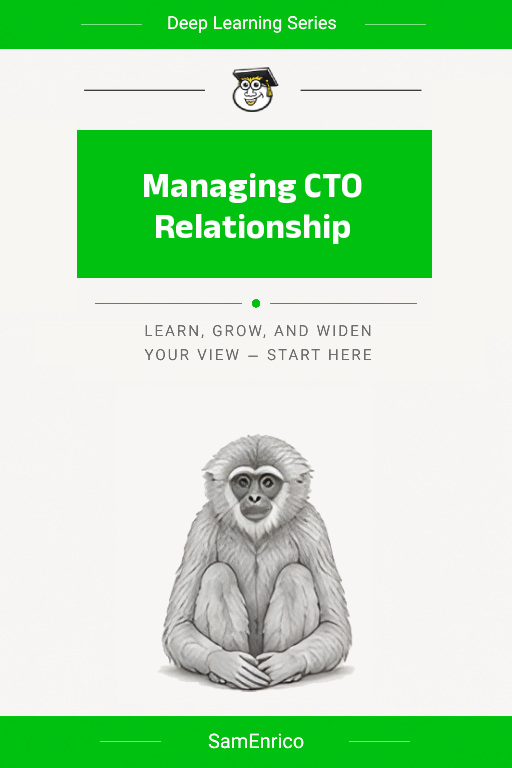
Managing CTO Relationship eBook
Manage your CTO effectively as a non-technical fou
Manage your CTO effectively as a non-technical founder. Communication, trust, and delegation.
Formats
Free sample
Chapter 1: The Translation Gap--–- The first time my CTO told me “we can’t just add a button,” I thought he was being lazy. I was wrong. He was speaking a different language.I remember the exact moment I realized my startup was in trouble. We were six months in, sitting in a poorly lit conference room that smelled like stale coffee and desperation. My CTO, a brilliant engineer named Sarah whom I had personally recruited from a top-tier tech company, had just told me that a simple feature—a “download as PDF” button on our analytics dashboard—would take three weeks.Three weeks.
For a button.I did not hide my frustration. “Sarah, it’s a button. You click it, a PDF appears. How hard can that be?”She did not roll her eyes, but I could see her jaw tighten. “The button is easy,” she said slowly, as if explaining gravity to a child.
“The problem is that right now, our data lives in six different places. To generate a PDF that matches what the user sees on screen, I have to build a reporting engine that queries all six systems, joins the data in real time, formats it, handles pagination, respects permissions, and then renders it as a PDF without crashing the server when ten people click it at once.”I heard words. I did not hear meaning.That conversation cost us three weeks of trust and two months of awkward 1:1 meetings before we finally learned to communicate. I am writing this book so you do not have to repeat my mistakes.This chapter is about the most fundamental barrier between non-technical founders and their CTOs: not intelligence, not effort, not even ego—but mental models. You think in bets.
They think in systems. Bridging that gap is the first and most important step toward a partnership that scales.The Two Worlds, Illustrated Let me draw you a picture.When you, the non-technical founder, look at your startup, you see a set of business bets. You have hypotheses about customers, markets, pricing, and growth. Your job is to place those bets with limited information, adjust when you are wrong, and double down when you are right. Time is your most precious resource because every day you are not growing, you are dying.When your CTO looks at the same startup, they see a system.
They see databases talking to APIs talking to frontend code talking to third-party services. Their job is to keep that system coherent, stable, and capable of change. Complexity is their enemy because every new feature adds connections that can break.These are not just different perspectives. They are different cognitive frameworks. Research in organizational psychology calls this “occupational stereotyping”—the tendency for people in different functions to develop fundamentally different ways of seeing problems.
Salespeople see opportunities. Accountants see risks. Engineers see dependencies.The founder sees a button. The CTO sees the thousand things that button touches.This gap is not a failure of your relationship. It is a feature of human cognition.
But left unmanaged, it becomes a bug that destroys trust, kills morale, and ships the wrong product at the wrong time.The “Just Add a Button” Fallacy Let us name the most common manifestation of this gap: the “Just Add a Button” Fallacy. I have seen this fallacy kill more founder-CTO relationships than any technical failure.The fallacy works like this. A founder sees a feature in a competitor’s product or hears a customer request. The feature seems simple from the outside. “Just add a button that does X.” The founder assumes the effort is proportional to the visible complexity.
A button looks small, so the work must be small.The CTO, however, sees the invisible complexity. Every button is a user interface element connected to a business logic layer connected to a data layer connected to a permissions layer connected to an audit log. The button may be the tip of the iceberg, but the iceberg is what sinks the ship.Here is a real example from a startup I advised. The founder wanted a “share to Slack” button next to every customer support ticket. “It’s just a button,” he said.
“Slack has an API. How hard can it be?”The CTO’s estimate: four weeks.Why? Because the support ticket system stored customer email addresses and other personally identifiable information. Sharing a ticket to Slack meant either (a) redacting sensitive data automatically, which required building a pattern-matching engine, or (b) creating a permission system that only allowed certain team members to share certain tickets, which required rebuilding the entire access control layer. Either option was weeks of work.
The button itself took two hours.The founder, who did not understand the underlying complexity, felt the CTO was padding estimates. The CTO, who did not explain the underlying complexity well, felt the founder was disrespectful. Neither was wrong. Both were failing to translate.The antidote to the “Just Add a Button” Fallacy is a simple question you should ask before every feature request: “What makes this feature expensive that I cannot see?”Ask that question with genuine curiosity, not accusation. Your CTO will almost always have an answer.
And once you hear it, you will stop seeing buttons. You will start seeing systems.The Four CTO Archetypes Not all CTOs are the same. Understanding your CTO’s natural tendencies—their archetype—will help you predict where the translation gap will be widest. Drawing from decades of technical leadership research and synthesized from best-selling sources like The Startup CTO’s Handbook, I have identified four dominant archetypes.The Architect The Architect loves elegant structure. They believe that code should be beautiful, dependencies should be minimal, and systems should be designed for the long term.
They hate shortcuts. They hate technical debt. They hate “hacks” that work today but will break tomorrow.The Architect is invaluable when you are building for scale. If you are a post-Series B company processing millions of transactions, you want an Architect. But the Architect is dangerous for an early-stage startup.
They will spend three weeks building a perfect database schema for a feature you have not validated yet. They will say “no” to speed because they value durability.How to communicate with The Architect: Frame requests in terms of trade-offs, not urgency. Say “I know we are taking on debt to ship this feature. Let us agree on when we will pay it back.” The Architect will respect a structured compromise.The Hacker The Hacker moves fast and breaks things. They love the thrill of shipping.
They will spin up a prototype in an afternoon using duct tape and good intentions. They are the CTO you want when you need to get a minimal viable product in front of customers within two weeks.The Hacker is invaluable for speed. But the Hacker is dangerous for security, reliability, and long-term maintainability. The code they write today will be the technical debt you curse tomorrow. They also tend to underestimate complexity because they assume problems can be hacked around.How to communicate with The Hacker: Ask for two estimates—the hacker estimate (fast, fragile) and the “if…
This is the end of the free sample. Get the eBook to keep going. Buy now
About this book
Details
- Author
- Lundberg Rosalina
- Publisher
- SamEnrico
- Language
- English
- Genre
- Non-Fiction, Startup Guide, Executive Search
- Released
- 2026-06-01
- Pages (approx.)
- 156
- Available as
- eBook, Audiobook

Read better in the ZLOADR app
Your eBooks on your phone or tablet. Sign in with your SamEnrico account and start reading.
More by Lundberg Rosalina
 Yes Please MemoirLundberg Rosalina$11.99
 Suicide Prevention GuideLundberg Rosalina$11.99
 The Foster Parent Who CaredLundberg Rosalina$11.99
 Parent Teen Self EsteemLundberg Rosalina$11.99
 The Student App Patterns ReportLundberg Rosalina$11.99
 The Phantom of the Opera House: The Forgotten Fire That Changed BroadwayLundberg Rosalina$11.99
 How to Become a Gear-cutting-machine Set-up Operator - ToolLundberg Rosalina$11.99
 DNSSEC for Geo DomainsLundberg Rosalina$12.99
 Partner Development ManagerLundberg Rosalina$11.99
 The Breeder's Guide to Royal Palm TurkeysLundberg Rosalina$11.99
You may also like
 Hong Kong Handover 1997Dunn Johnnie$11.99
 Zumba For Postnatal Recovery CourseNeal Christian$11.99
 Zumba for BeginnersLadner Nikia$11.99
 YouTube Comment Mining GuideHumes Pandora$12.99
 Worry Box MeditationCarlin Rudy$11.99
 Workplace Stress MeditationNguyen Lynn$11.99
 Workplace Stress and Sleep RepairHawley Ivory$11.99
 Workplace Perfectionism CureDelaney Jeffry$11.99
 Workplace Injustice Anger GuideWallen Isabelle$11.99
 Work Addiction and Burnout LinkGreenwood Ester$11.99
 Women in Yoga and WellnessBeattie Galina$11.99
 Women in Stand Up ComedyChun Evangeline$11.99