
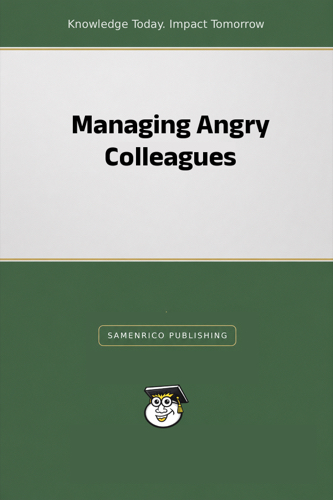
Non-FictionSelf-HelpConflict Management
Managing Angry Colleagues eBook
De escalate and cope with volatile coworkers using
De escalate and cope with volatile coworkers using this practical office conflict guide.
Formats
Free sample
Chapter 1: The Labeling Trap--–- Sarah had not slept well in fourteen months. Not since Marcus joined the accounting team. Every morning, she walked past his desk with her shoulders slightly hunched, her coffee cup held like a shield. She had a name for him—a private name she used with her husband at dinner and with her work best friend during whispered phone calls. The Monster.
It felt good to say it. It felt true. Marcus screamed at her over a missing decimal point. He threw a stapler against the wall when a report came in three hours late. He once followed her to the parking lot, still yelling, his face so close she could smell his lunch.
So yes, monster seemed accurate.But here is the problem that Sarah did not understand: by calling Marcus a monster, she had already lost. Not because she was wrong about his behavior—she was right. Not because she deserved his anger—she did not. She lost because the label monster is a form of intellectual surrender. Once you decide someone is a monster, you stop analyzing their behavior.
You stop looking for patterns. You stop asking strategic questions like “What triggers this?” or “What does he actually want?” Instead, you simply fear them. And fear, unlike strategy, has never solved a single workplace conflict.This chapter is about the single most important mental shift you will make in this entire book. It is the foundation upon which every technique, script, and protocol rests. If you skip this chapter, the rest of the book will not work.
If you master this chapter, you will walk into any angry encounter with a superpower that your volatile colleague does not even know exists: the ability to see anger as data rather than danger.The Cost of a Convenient Label Let us begin with an uncomfortable truth. You have been trained by popular culture to label difficult people. Social media feeds you articles titled “10 Signs of a Toxic Coworker.” Best-selling books teach you to identify “narcissists,” “psychopaths,” and “energy vampires.” And these labels feel like armor. They feel like knowledge. When you can name the threat, you feel safer.But research from organizational psychology tells a very different story.
A 2021 study published in the Journal of Applied Psychology followed 347 employees who had identified a “toxic” coworker. The researchers measured three things: the actual behavior of the difficult colleague, the emotional state of the person who applied the label, and the outcomes of their interactions over six months. The results were striking. The people who used global labels like “toxic,” “crazy,” or “bully” showed worse outcomes than those who simply described specific behaviors (“He raises his voice when deadlines change”). The label-users experienced higher anxiety, more avoidance behaviors, and lower job satisfaction.
They were also significantly less likely to ever resolve the conflict.Why? Because labels are a shortcut. Your brain loves shortcuts. When you call someone “crazy,” your brain stops processing new information about that person. It files them in a mental folder marked “danger – do not engage,” and then it moves on.
The problem is that angry people are not static. They are not monsters lurking in a cave. They are human beings with shifting emotional states, specific triggers, and—most importantly—unmet needs that can be addressed. But you will never discover those needs if you have already decided they are irredeemably broken.Consider the difference between two employees facing the same angry outburst. Employee A thinks: “He is such a bully.
This is just who he is. I cannot change him.” Employee B thinks: “He is yelling about the deadline. What is he actually afraid of? What does he need right now that he is not getting?” Employee A has a label. Employee B has a strategy.
Employee A will spend the next year walking on eggshells. Employee B will spend the next twenty minutes de-escalating the situation and then go back to work. Which one do you want to be?Personality Versus State: The Crucial Distinction To escape the labeling trap, you need to understand one of the most useful concepts in all of conflict psychology: the difference between personality and state.Personality refers to the stable, enduring patterns of thinking, feeling, and behaving that define who a person is across time and situations. Personality is relatively fixed. It takes years of intentional work—often with professional help—to change.
If someone has a genuinely abusive personality disorder, that is beyond the scope of this book and beyond your pay grade as a coworker.State refers to a temporary emotional condition. States come and go. They are triggered by specific events. They can be changed by environmental shifts, by words, by pauses, by sleep, by lunch. A person in an angry state is not fundamentally different from a person in a joyful state or a grieving state.
They are simply responding to a stimulus.Here is the key insight that changes everything: Almost every angry colleague you will ever face is in a state, not a personality. They are not fundamentally broken. They are temporarily flooded. They are not evil. They are emotionally unskilled.
They never learned how to say “I am overwhelmed” instead of “This report is garbage.” They never learned how to ask for help instead of demanding compliance.This is not an excuse for their behavior. Let us be very clear about that. Anger that manifests as yelling, name-calling, throwing objects, or invading personal space is unacceptable in a professional environment. Period. You do not have to tolerate it.
But understanding that it is a state rather than a personality changes your strategic options. You cannot change a personality. You can influence a state.Think of it this way. If Marcus from our opening example has a personality disorder, Sarah should go to HR, update her resume, and leave. There is no de-escalation technique that will fix a fundamentally broken personality in a workplace setting.
But if Marcus is simply a person who never learned emotional regulation—who experiences deadline pressure as a physical threat and responds with fight-or-flight—then Sarah has options. She can learn to interrupt the amygdala hijack. She can identify his archetype. She can choose the right door of de-escalation. She can change the outcome.And here is the hopeful news: research suggests that the vast majority of workplace anger—some studies say upwards of 85%—is state-based, not personality-based.
Most angry colleagues are not monsters. They are emotionally unskilled people having bad days, bad weeks, or bad years. And emotionally unskilled people can be influenced. They can be redirected. They can be calmed.
But only if you stop labeling them as monsters first.Anger as Data, Not Danger The second major shift this chapter requires is a complete reframing of what anger actually is. Most people experience anger as a threat. When someone yells at you, your own amygdala hijacks your brain. Your heart rate spikes. You prepare to fight, flee, or freeze.
You feel danger. And when you feel danger, you cannot think strategically. You can only survive.But what if anger was not danger? What if anger was simply a very loud, very…
This is the end of the free sample. Get the eBook to keep going. Buy now
About this book
Details
- Author
- Guess Kanisha
- Publisher
- SamEnrico
- Language
- English
- Genre
- Non-Fiction, Self-Help, Conflict Management
- Released
- 2026-06-06
- Pages (approx.)
- 141
- Available as
- eBook, Audiobook

Read better in the ZLOADR app
Your eBooks on your phone or tablet. Sign in with your SamEnrico account and start reading.
More by Guess Kanisha
 TM and Medication GuideGuess Kanisha$11.99
 Constraint Fuel HandbookGuess Kanisha$11.99
 The Perineal Tear Healing HandbookGuess Kanisha$11.99
 The Silent Spy: Marcel Marceau and the Art of Deception in WartimeGuess Kanisha$11.99
 Understanding Pfeiffer–tietze–welte SyndromeGuess Kanisha$17.99
 A Beginners Guide to Guess Who? (Volume 1)Guess Kanisha$11.99
 Medtech Device MapGuess Kanisha$12.99
 One Page Plan for SaaS StartupsGuess Kanisha$12.99
 Michael Jackson: King of PopGuess Kanisha$11.99
You may also like
 Hong Kong Handover 1997Dunn Johnnie$11.99
 Zumba For Postnatal Recovery CourseNeal Christian$11.99
 Zumba for BeginnersLadner Nikia$11.99
 YouTube Comment Mining GuideHumes Pandora$12.99
 Worry Box MeditationCarlin Rudy$11.99
 Workplace Stress MeditationNguyen Lynn$11.99
 Workplace Stress and Sleep RepairHawley Ivory$11.99
 Workplace Perfectionism CureDelaney Jeffry$11.99
 Workplace Injustice Anger GuideWallen Isabelle$11.99
 Work Addiction and Burnout LinkGreenwood Ester$11.99
 Women in Yoga and WellnessBeattie Galina$11.99
 Women in Stand Up ComedyChun Evangeline$11.99