
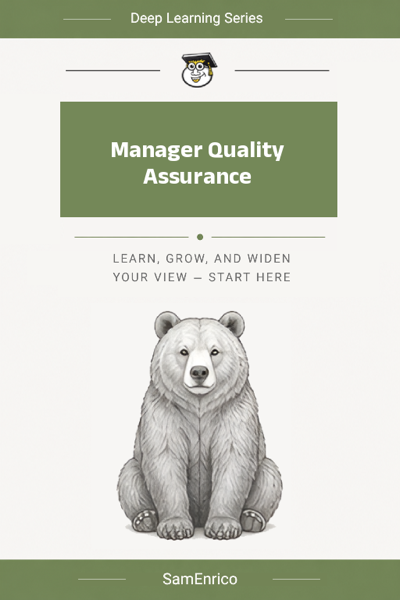
Non-FictionInformativeEducational
Manager Quality Assurance eBook
A Coursebook on Manager Quality Assurance
by Toth Sarina
A Coursebook on Manager Quality Assurance
Formats
Free sample
Chapter 1: The Inspection Illusion...-- In my first week as a quality manager, I walked into a factory that was spending $2.3 million per year on final inspection. They had thirty-seven inspectors at the end of the line, checking every single part that came off the assembly. Their defect rate was still 4.8 percent. The operations director looked me in the eye and said, "We need more inspectors." He was serious. He was also completely wrong.That moment taught me something that took me years to fully understand: most organizations confuse inspection with quality.
They believe that if they check enough parts, test enough samples, or audit enough documents, they will eventually achieve quality. This is the Inspection Illusion, and it is the single most expensive mistake in the history of quality management.This chapter exists to shatter that illusion in the first thirty pages, because nothing else in this book will work if you still believe that catching defects is the same as preventing them.The Birth of a Dangerous Myth To understand why we are so addicted to inspection, we have to go back to the early twentieth century. Before the industrial revolution, craftsmen built entire products themselves. A blacksmith who made a horseshoe inspected it with his own eyes as he worked. The person who made the product was also the person who checked it.
Quality was built in, not added on.Then came mass production. Suddenly, one person assembled, another painted, another packed, and no single person saw the whole product. The natural solution seemed obvious: hire people whose only job was to look for problems at the end of the line. Thus, the quality inspector was born.By the 1920s, statistical sampling gave this approach a scientific veneer. Walter Shewhart developed control charts at Bell Laboratories, and for the first time, companies could inspect a sample and make statistical claims about the whole batch.
This was genuine progress. But somewhere along the way, we forgot that statistical inspection was supposed to be a temporary feedback mechanism, not a permanent quality strategy.By the 1980s, American manufacturing had fully embraced the "inspect it in" model. Japanese competitors, influenced by W. Edwards Deming, had moved on. While Detroit was hiring armies of inspectors, Toyota was teaching every assembly line worker to stop the line when they saw a defect.
The result is history. By 1990, Toyota had half the defect rate of its American competitors with one-tenth the inspection staff.The lesson was right there, written in market share and bankruptcy filings: inspection does not improve quality. It only reports on the lack of it.Why Inspection Feels Like Progress Here is the uncomfortable truth that keeps the Inspection Illusion alive: inspection produces data, and data feels like action.When your team pulls a hundred parts off the line, measures them, and finds twelve that are out of spec, you have done something tangible. You have numbers. You can make a chart.
You can present the chart to your boss. You look busy, scientific, and in control. The alternative—redesigning a fixture, retraining an entire shift, or changing a supplier's process—is messy, slow, and uncertain. It might take weeks. It might fail.
Inspection takes hours and always produces a report.I have watched otherwise intelligent managers choose inspection over process improvement for exactly this reason. They are not lazy. They are terrified of looking ineffective while the slow work of improvement unfolds. So they hide in the false comfort of measurement.Consider the math. A factory produces ten thousand parts per day.
One percent are defective, meaning one hundred bad parts. The company decides to implement 100 percent inspection at the end of the line with a machine that is 99 percent accurate. How many bad parts get through?If you said "one," you are wrong. The machine misclassifies one percent of good parts as bad (ninety-nine false alarms) and one percent of bad parts as good (one escaped defect). The customer still gets a defect.
The company also has to re-inspect the ninety-nine false alarms, wasting time and money. The defect rate drops from one percent to 0.01 percent—real improvement, yes, but at what cost? The operation now spends $200,000 per year on inspection equipment and labor to catch ninety-nine of one hundred defects. The one that escaped still triggers a customer complaint and a warranty claim.Now imagine instead spending that $200,000 on a poka-yoke device that makes it physically impossible to assemble the part incorrectly. The defect rate goes to zero.
No inspection needed. No escaped defects. No false alarms. That is the difference between inspection and prevention.The True Cost of Poor Quality To break the Inspection Illusion, you need a number. Not a feeling, not a principle, not a slogan.
A specific, calculable, painful number that represents what poor quality is costing your organization every single day.That number is COPQ—the Cost of Poor Quality.Quality experts divide COPQ into four categories, and understanding these categories is the single most important financial skill a QA manager can develop. Let me walk you through each one.Prevention Costs are the money you spend to keep defects from happening in the first place. This includes training, process design, supplier qualification, preventive maintenance, and mistake-proofing devices. Prevention is the only category that reduces the other three. Most organizations underinvest here by a factor of ten.Appraisal Costs are the money you spend to find defects after they have already happened.
This includes inspection, testing, audits, calibration, and quality control. Appraisal is necessary but dangerous because it feels productive while adding zero value to the product. The customer does not care if you inspected it. They care if it works.Internal Failure Costs are the money you lose when you catch a defect before it ships. This includes scrap, rework, retesting, downtime, and the labor to handle non-conforming material.
Internal failures are expensive, but they are less expensive than external failures.External Failure Costs are the money you lose when a defect reaches the customer. This includes warranty claims, returns, repairs, lost future sales, legal fees, regulatory fines, and brand damage. External failures are the most expensive by far, often by a factor of ten to one hundred compared to internal failures.Here is the pattern that healthy organizations understand and unhealthy organizations ignore: money spent on prevention reduces appraisal, internal failure, and external failure simultaneously. Money spent on appraisal only reduces external failure while doing nothing to reduce internal failure or prevention needs.Let me give you a real example. A medical device company I consulted for was spending 1.2millionannuallyonfinalinspection(appraisal).Theirexternalfailurecostswere1.2 million annually on final inspection (appraisal).
Their external failure costs were 1.2millionannuallyonfinalinspection(appraisal).Theirexternalfailurecostswere800,000 per year from field failures. Total COPQ for appraisal plus external failure: 2million.Theyinvested2 million. They invested 2million.Theyinvested300,000 in a training program and new fixtures for their assembly line (prevention). Within eighteen months, their external failure costs dropped to 150,000,andtheirappraisalcostsdroppedto150,000, and their appraisal costs dropped to 150,000,andtheirappraisalcostsdroppedto600,000 because they needed less inspection. Total COPQ: $1.05 million.
They saved nearly a million dollars per year, every year, from a single prevention investment.The 1-10-100 Rule There is a simple rule of thumb that every QA manager…
This is the end of the free sample. Get the eBook to keep going. Buy now
About this book
Details
- Author
- Toth Sarina
- Publisher
- SamEnrico
- Language
- English
- Genre
- Non-Fiction, Informative, Educational
- Released
- 2026-05-11
- Pages (approx.)
- 137
- Available as
- eBook, Audiobook

Read better in the ZLOADR app
Your eBooks on your phone or tablet. Sign in with your SamEnrico account and start reading.
More by Toth Sarina
 Delegation Without GuiltToth Sarina$11.99
 Child Stars Of 1950s HollywoodToth Sarina$11.99
 Career Transition for Military SpousesToth Sarina$11.99
 Uber Driver Tax Deduction GuideToth Sarina$11.99
 Modesto Community ReactionToth Sarina$11.99
 Forgiveness Relationship GuideToth Sarina$11.99
 Indian GST Registration for Agents and Brokers HandbookToth Sarina$11.99
 Citation Rules for Bluebook Legal GuideToth Sarina$11.99
 Carnegie HomesteadToth Sarina$11.99
 The Last Moorish Stronghold: Granada's Fall and the End of Al-AndalusToth Sarina$11.99
 The Silent Coup: How a Whisper Toppled a GovernmentToth Sarina$11.99
 Zero-Day Protocol: The Untold Story of Stuxnet’s Digital WarToth Sarina$11.99
You may also like
 Hong Kong Handover 1997Dunn Johnnie$11.99
 Zumba For Postnatal Recovery CourseNeal Christian$11.99
 Zumba for BeginnersLadner Nikia$11.99
 YouTube Comment Mining GuideHumes Pandora$12.99
 Worry Box MeditationCarlin Rudy$11.99
 Workplace Stress MeditationNguyen Lynn$11.99
 Workplace Stress and Sleep RepairHawley Ivory$11.99
 Workplace Perfectionism CureDelaney Jeffry$11.99
 Workplace Injustice Anger GuideWallen Isabelle$11.99
 Work Addiction and Burnout LinkGreenwood Ester$11.99
 Women in Yoga and WellnessBeattie Galina$11.99
 Women in Stand Up ComedyChun Evangeline$11.99