
Non-FictionSelf-HelpManagement
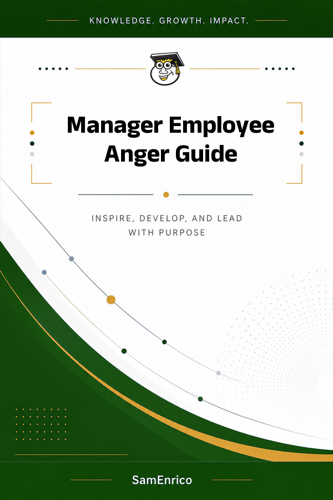
Manager Employee Anger Guide eBook
De escalates angry direct reports.
by Corley Bart
De escalates angry direct reports.
Formats
Free sample
Chapter 1: The Hidden Epidemic--–- The conference room was silent except for the ticking of a wall clock. Seven managers sat around a table, each holding a coffee cup that had gone cold twenty minutes ago. They had been asked to share their biggest fear about leadership. Not strategic failure. Not missing quarterly targets.
Not losing to competitors. Their real fear.The youngest manager in the room, a woman named Priya who had been promoted just eight months earlier, spoke first. Her voice cracked."I'm afraid of Sarah."No one asked who Sarah was. Everyone knew. Sarah was Priya's most senior direct report—a talented, experienced employee who had become increasingly volatile over the past year.
Sarah had screamed at Priya in front of the entire team two weeks ago. She had slammed a folder onto Priya's desk so hard that a papercut flew across the room. She had told Priya, in a voice loud enough for the adjoining cubicles to hear, that she was "the worst manager I have ever had."Priya had done nothing. She had frozen. She had gone home that night and cried in her parked car for twenty minutes before she could drive.
She had told no one."I don't know how to fix her," Priya whispered. "And I'm starting to think I'm the problem."The room remained silent. Then one by one, the other managers nodded. Not because they agreed that Priya was the problem. But because each of them had their own Sarah.
Their own employee whose anger they could not name, could not predict, and could not control.This book is for every manager who has ever frozen in the face of an angry direct report. It is for the leader who has swallowed their pride, their voice, and their authority because they did not know the difference between de-escalation and appeasement. It is for the supervisor who has lain awake at 2:00 AM replaying an explosion, wondering if they could have done something differently.The short answer is yes. But the longer answer is more important: you were never taught how.The Silence Around Workplace Anger Let us begin with a disturbing fact. Most managers receive more training on how to use their email software than they receive on how to handle an angry employee.
According to a 2023 survey by the Society for Human Resource Management, nearly seventy percent of managers report having experienced a direct report's anger that they felt unequipped to handle. Yet fewer than fifteen percent have received any formal training in de-escalation.This gap between reality and preparation is not an accident. It is a systemic failure. Organizations assume that anger management is a soft skill—something good managers simply possess intuitively. But de-escalation is not intuitive.
It is a teachable, learnable, replicable protocol. And like any protocol, it requires practice.The silence around workplace anger is maintained by three dangerous myths. Let us name them now so we can dismantle them together.Myth One: Anger is always irrational. This is the belief that angry employees have lost their minds, their reason, and their credibility. The truth is more uncomfortable: anger is often a rational response to a perceived injustice.
An employee who has been passed over for a promotion, denied resources they were promised, or publicly embarrassed by a colleague is not crazy. They are responding to a real or perceived threat. Their expression may be inappropriate. But their emotion is valid. Dismissing anger as irrational is the fastest way to escalate it.Myth Two: Managers shouldn't take things personally.
This is perhaps the most destructive piece of conventional wisdom in leadership. The idea that you should simply let an employee's anger roll off your back, like water off a duck, is seductive but false. Human beings are not ducks. When someone yells at you, your body releases cortisol. Your heart rate spikes.
Your amygdala—the ancient alarm system in your brain—sounds a siren. Telling yourself not to take it personally does not stop this physiological cascade. It only adds shame on top of fear. You are allowed to feel affected by anger. The goal is not to become immune.
The goal is to respond skillfully rather than react automatically.Myth Three: Ignoring anger makes it go away. This myth is the most dangerous because it feels true in the moment. When an employee storms off, stops talking, or gives you the silent treatment, there is a powerful temptation to let the moment pass. Do not poke the bear. Let sleeping dogs lie.
But anger does not dissipate when ignored. It metastasizes. It transforms from hot anger (loud, visible, explosive) into cold anger (quiet, passive-aggressive, toxic). A team that appears calm on the surface may be rotting from within. And when cold anger finally erupts into hot anger again, the damage is exponentially worse.The Rising Tide: Why Anger Is Getting Worse If you feel that workplace anger has increased in recent years, you are not imagining things.
The data is unambiguous. Multiple post-pandemic workplace studies have documented a sharp rise in anger-related incidents. The reasons are complex, but they cluster around three major shifts.First, the collapse of boundaries. Remote and hybrid work promised flexibility, and for many employees it delivered. But it also erased the physical and temporal boundaries that once contained workplace frustration.
When your office is also your bedroom, and your workday bleeds into your evening, there is no separation between professional stress and personal life. An email that arrives at 9:00 PM can trigger anger that festers until 9:00 AM the next morning—without the cooling-off period of a commute, a change of clothes, or a different physical environment.Second, chronic burnout. The World Health Organization has classified burnout as an occupational phenomenon characterized by energy depletion, increased mental distance from one's job, and reduced professional efficacy. Burnout does not cause anger directly. But burnout lowers the threshold for anger.
An exhausted employee has less emotional reserve. Small frustrations that would once have been brushed aside become intolerable. The burnt-out employee is not angry at you, their manager. They are angry at their circumstances. But you are standing in front of them, and so you become the target.Third, a crisis of psychological safety.
Many organizations talk about psychological safety—the belief that one can speak up without fear of punishment or humiliation. But talk is cheap. When employees feel that their concerns are ignored, their ideas dismissed, or their contributions undervalued, they experience a slow-burning resentment. This resentment often remains underground for months or years. And then, triggered by a single event—a rejected time-off request, a critical performance review, a reorganization—it explodes.A Note on What This Book Is Not Before we go further, it is important to clarify the scope of this book.
We are not writing about how to manage every difficult emotion. We are not writing about general conflict resolution or negotiation tactics, though those skills overlap with what we will cover. We are writing specifically and narrowly about how to de-escalate an angry direct report in real time.This means the book has limits. We will not tell you how to prevent all anger. Some anger is…
This is the end of the free sample. Get the eBook to keep going. Buy now
About this book
Details
- Author
- Corley Bart
- Publisher
- SamEnrico
- Language
- English
- Genre
- Non-Fiction, Self-Help, Management
- Released
- 2026-06-09
- Pages (approx.)
- 143
- Available as
- eBook, Audiobook

Read better in the ZLOADR app
Your eBooks on your phone or tablet. Sign in with your SamEnrico account and start reading.
More by Corley Bart
 Rest and Creativity LinkCorley Bart$11.99
 Inside The Heist CrewCorley Bart$11.99
 Cochlear Implant Decision GuideCorley Bart$11.99
 Nicotine Withdrawal Symptom GuideCorley Bart$11.99
 Dust Storm Pioneers: Chasing the Great Arabian TempestsCorley Bart$11.99
 Cosmic Grooves: How Motown’s Sound Conquered the Space RaceCorley Bart$11.99
 Understanding Cardiac Conduction Defect, FamilialCorley Bart$17.99
 Ramadan B2B Sales GuideCorley Bart$12.99
 Language Learning For CheapCorley Bart$12.99
 Real Estate AdministratorCorley Bart$11.99
You may also like
 Hong Kong Handover 1997Dunn Johnnie$11.99
 Zumba For Postnatal Recovery CourseNeal Christian$11.99
 Zumba for BeginnersLadner Nikia$11.99
 YouTube Comment Mining GuideHumes Pandora$12.99
 Worry Box MeditationCarlin Rudy$11.99
 Workplace Stress MeditationNguyen Lynn$11.99
 Workplace Stress and Sleep RepairHawley Ivory$11.99
 Workplace Perfectionism CureDelaney Jeffry$11.99
 Workplace Injustice Anger GuideWallen Isabelle$11.99
 Work Addiction and Burnout LinkGreenwood Ester$11.99
 Women in Yoga and WellnessBeattie Galina$11.99
 Women in Stand Up ComedyChun Evangeline$11.99