
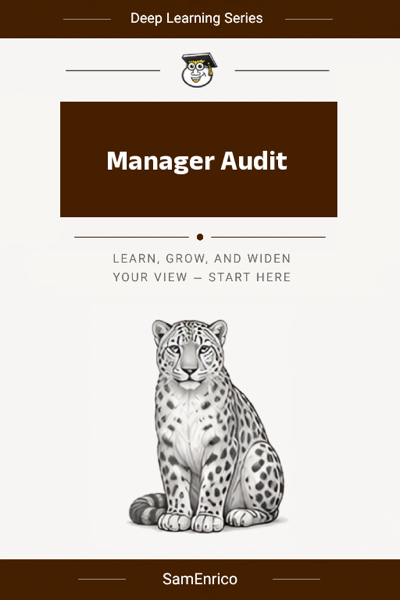
Manager Audit eBook
A Coursebook on Manager Audit
A Coursebook on Manager Audit
Formats
Free sample
Chapter 1: The Mirror Test...--–- Most managers first encounter the word "audit" the way a driver first encounters a police cruiser in the rearview mirror—with a sudden spike in heart rate, an instinctive mental inventory of everything they might have done wrong, and a desperate hope that the cruiser will simply pass them by. That feeling, that tightness in the chest when the audit notification email arrives, is not a personality flaw. It is not a sign that you are bad at your job. It is the predictable physiological response of a human being who has been taught, explicitly or implicitly, that audits are tests you can fail, traps you can fall into, and judgments you cannot escape.This book exists because that feeling is wrong.Not your feeling—your feeling is real and valid and almost certainly shared by every manager reading this sentence. What is wrong is the premise that created that feeling.
The premise that audits are about catching mistakes. The premise that auditors are adversaries. The premise that your job during an audit is to survive, to minimize damage, to say as little as possible and hope for a clean report. That premise has cost organizations billions of dollars in undetected risk, destroyed countless careers through preventable surprises, and turned what should be a strategic superpower into a source of chronic, low-grade terror.This chapter is where that premise dies.We are going to rebuild your relationship with audits from the ground up. By the time you finish this chapter, you will understand what a Manager Audit actually is (and is not), how the Three Lines of Defense framework makes you more powerful rather than more scrutinized, and why the five most common assumptions managers make about audits are quietly setting you up for failure.
More importantly, you will walk away with a single, thirty-minute action that will immediately change how you see your own operation—and how auditors see you.Let us start with a story.The $300,000 Meeting That Should Never Have Happened A few years ago, a regional operations manager named Priya walked into a conference room for what she thought was a routine quarterly business review. She had prepared the usual slides: revenue up, costs flat, customer satisfaction holding steady. Her boss nodded along. Then the head of internal audit, who had been invited at the last minute, cleared his throat."Priya," he said, "we've been looking at vendor payments in your region. There's a pattern we need to discuss."Over the next forty-five minutes, Priya learned that a vendor she had approved six months earlier—a small logistics company that had seemed perfectly reputable—had been billing for services that were never rendered.
Not once. Not twice. Twenty-seven times. Total loss: approximately three hundred thousand dollars. The audit team had caught it.
Priya had not. And when the auditors asked her what controls her team had in place to verify vendor delivery before releasing payment, she realized she did not have a good answer.Here is what is important about this story: Priya was not a bad manager. She was not lazy, corrupt, or incompetent. She was a hardworking, well-intentioned leader who had simply never been taught to see the invisible architecture of risk that surrounded every decision she made. She had assumed that because nothing had gone wrong yet, nothing would go wrong.
She had assumed that audits were something that happened to other people, in other departments, for other reasons. She had assumed that her job was to deliver results, not to audit the machinery that produced those results.Those assumptions cost her three hundred thousand dollars and nearly cost her her career.Priya survived—she implemented a new vendor verification process within two weeks, and the audit team ultimately classified the loss as a process failure rather than managerial negligence—but she never made those assumptions again. She became what this book will teach you to become: a manager who audits proactively, who sees risk before it materializes, and who treats the audit function not as a threat but as a strategic partner.This book is for every Priya. Every manager who has ever been surprised by an audit finding. Every leader who has ever thought, "How did I not see that coming?" Every executive who wants to stop reacting to crises and start preventing them.
And every auditor who has ever wished their manager counterparts would just pick up the phone before the findings report is drafted.What This Book Is—And What It Is Not Before we go any further, we need to be absolutely clear about the territory we are about to explore. This book is not a textbook for professional internal auditors. If you are studying for the Certified Internal Auditor exam, there are excellent resources for that, and you should use them. This book is not a technical guide to Generally Accepted Auditing Standards or the International Professional Practices Framework. We will reference those standards where relevant, but we will not teach them.This book is for the manager who sits on the other side of the audit table.You are the one being audited.
You are the one who receives the document requests, answers the auditor's questions, and implements the corrective action plans. You are the one whose performance review may reference audit findings, whose bonus may depend on remediation timelines, and whose career trajectory may be shaped by how well you navigate the audit process. This book is your field manual.And here is the central promise of that field manual: By the time you finish these twelve chapters, you will never again be surprised by an audit finding. You will see risks before they become findings. You will fix problems before auditors discover them.
You will speak the language of audit fluently and confidently. And you will transform from a passive target of audits into an active strategic partner that the C-suite trusts to manage risk, not just to deliver results.That is a bold promise. It is also entirely achievable. But it requires that we begin by unlearning almost everything you think you know about audits.The Four Pillars: Defining the Manager Audit Let us start with a definition. In this book, a Manager Audit means something specific, and we will use that definition consistently across every chapter.
A Manager Audit is a systematic, self-directed evaluation of four interconnected domains within your sphere of responsibility: Processes, People, Team Structure, and Culture.These are the Four Pillars, and every audit you conduct will touch some combination of them.Processes are the workflows, approvals, handoffs, and procedures that transform inputs into outputs. When you audit a process, you are asking questions like: Does the process work as designed? Do people follow it? Where do errors enter? Where does work get stuck?
How long does each step take? The process pillar is the most familiar to most managers—it is where operational audits live.People are the individuals on your team, considered in terms of their competence, judgment, decision-making patterns, and adherence to policies. When you audit people, you are not conducting performance reviews. You are asking questions like: Does each person have…
This is the end of the free sample. Get the eBook to keep going. Buy now
About this book
Details
- Author
- Espinoza Aaron
- Publisher
- SamEnrico
- Language
- English
- Genre
- Non-Fiction, Informative, Educational
- Released
- 2026-06-02
- Pages (approx.)
- 146
- Available as
- eBook, Audiobook

Read better in the ZLOADR app
Your eBooks on your phone or tablet. Sign in with your SamEnrico account and start reading.
More by Espinoza Aaron
 Public Speaking for LeadersEspinoza Aaron$11.99
 Outsourcing First Tasks GuideEspinoza Aaron$11.99
 Nonverbal Networking GuideEspinoza Aaron$11.99
 Bed Bound ExercisesEspinoza Aaron$11.99
 The Secret Scripts of The Oxford Revue: How a University Troupe Shaped Modern ComedyEspinoza Aaron$11.99
 Service Business Pricing Without FearEspinoza Aaron$12.99
 How to Produce Cargo NetEspinoza Aaron$11.99
 How to Start a Lyes Business (Beginners Guide)Espinoza Aaron$11.99