
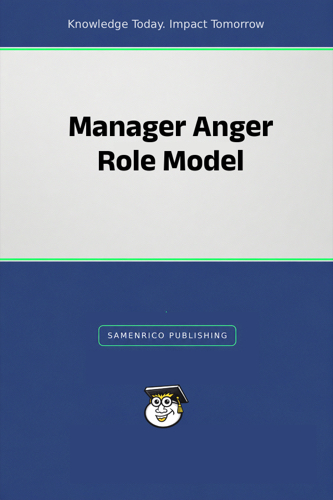
Non-FictionSelf-HelpLeadershipRole Model
Manager Anger Role Model eBook
Lead teams without modeling explosive anger or pas
Lead teams without modeling explosive anger or passive aggression.
Formats
Free sample
Chapter 1: The Nice Trap--–- It was 2:47 PM on a Tuesday when I realized I had become exactly the kind of manager I swore I would never be. The kind who smiles at problems instead of solving them. The kind who says “it’s fine” when it’s clearly not. The kind who keeps the peace by letting the peace decay from the inside out.My top performer, a senior engineer named Priya, had just submitted her resignation. Her exit interview was a masterclass in surgical honesty.
“You’re not mean,” she said, folding her hands on the table. “You’re worse. You’re nice. You let Sarah’s missed deadlines slide for six months while I covered for her. You never said a word.
You just smiled and asked everyone to ‘circle back’ and ‘stay positive.’ I’m not leaving because you’re a bad person. I’m leaving because you won’t be a real one.”That sentence stayed with me longer than any performance review I had ever received. “You won’t be a real one.” She wasn’t talking about my technical skills or my strategic vision. She was talking about my willingness to be honest, to be uncomfortable, to be the kind of leader who would rather risk a difficult conversation than slowly bleed the best people out of the organization while pretending everything was fine.This chapter is about that specific kind of failure. Not the explosive anger that makes headlines and HR complaints.
The quieter, more socially acceptable, and ultimately more destructive failure: the failure of niceness. The high cost of keeping the peace.The Myth of the Nice Leader We have been sold a lie. The lie is that effective leadership is fundamentally about keeping people happy, avoiding friction, and maintaining a pleasant atmosphere at all costs. This lie is peddled in corporate values statements, in performance review language that punishes “being too direct,” and in the subtle social signals that reward managers who never ruffle feathers.The truth is radically different. The pressure to avoid conflict, to stay positive, and to smooth over tensions does not create harmony.
It creates a slow-burning organizational poison. When a manager prioritizes comfort over candor, they inadvertently build a culture of silence where problems fester underground, resentment accumulates across the team, and performance standards erode incrementally until collapse becomes inevitable.Let me be clear about what I mean by “nice leadership.” I am not talking about basic decency, respect, or kindness. Those are non-negotiable. I am talking about the performance of niceness as a conflict-avoidance strategy. The manager who says “let’s revisit this later” knowing that later will never come.
The leader who laughs off a missed deadline with “no worries, just try harder next time” while privately seething. The executive who praises everyone equally in public while making quiet, frustrated edits in private.This pattern has a name in the research literature. It is called ruinous empathy, a term coined by Kim Scott in her work on radical candor. Ruinous empathy is the trap of being “nice” to someone’s face while allowing them to fail behind their back. It is the manager who never tells a struggling employee that they are struggling, then blindsides them with a poor performance review.
It is the team lead who accepts mediocre work without comment, then complains about the team’s quality to their own boss. It is the executive who says “I don’t want to hurt anyone’s feelings” while quietly watching their best employees burn out carrying the weight of the underperformers.Ruinous empathy feels like kindness in the moment. It is not. It is abandonment.The Price of Incivility — And the Greater Price of Avoidance Most managers understand that explosive anger is costly. Yelling, public shaming, personal attacks — these behaviors are obviously destructive.
They generate HR complaints, drive turnover, and poison team culture in visible, traceable ways. But what the research shows — and what my own experience with Priya’s resignation taught me — is that the avoidance of conflict is often more expensive than the conflict itself, precisely because it is invisible.Christine Porath’s seminal research on The Price of Incivility surveyed thousands of workers across seventeen industries. She found that even low-level disrespect — interrupting, ignoring, dismissing — had staggering costs. Among workers who experienced incivility, 48 percent intentionally decreased their work effort. 47 percent intentionally decreased the time they spent at work.
38 percent intentionally decreased the quality of their work. And 80 percent lost work time worrying about the incident.But here is the critical insight that Porath’s work revealed, and that most leadership books miss: avoidance is a form of incivility. When a manager avoids giving honest feedback, they are not being neutral. They are being disrespectful to the high performers who must carry the load. They are being disrespectful to the low performers who are being set up to fail without warning.
And they are being disrespectful to themselves, slowly eroding their own integrity one silent meeting at a time.The financial toll is staggering. Porath’s research estimated that a single incident of workplace incivility — including the incivility of avoidance — costs an organization an average of $14,000 per employee per year in lost productivity, turnover, and health care costs. For a team of twenty, that is nearly $300,000 annually. For a mid-sized organization of five hundred, that is over seven million dollars.Seven million dollars. For being “nice.”The Anatomy of Avoidance Why do intelligent, well-meaning managers fall into the trap of keeping the peace?
The answer is not laziness or malice. It is fear. Specifically, three fears that work together to paralyze even the most competent leaders.The first fear is the fear of being disliked. This is the most primal of the three. Human beings are wired for social belonging.
Our brains process social rejection in the same regions that process physical pain. When a manager contemplates giving difficult feedback, their amygdala — the brain’s threat detection system — activates as if they were about to be physically harmed. The body floods with cortisol. The heart rate increases. And the manager does what any threatened organism does: they retreat.
They delay the conversation. They soften the message. They tell themselves that “maybe it will get better on its own.”It never gets better on its own.The second fear is the fear of being wrong. What if the manager has misinterpreted the situation? What if the missed deadline was actually someone else’s fault?
What if the employee has a legitimate reason that the manager doesn’t know about? This fear leads managers to over-gather information, to delay while seeking “more data,” to consult with colleagues and HR and mentors until the moment for intervention has passed and the problem has grown from a manageable weed into an invasive species.The third fear is the fear of being cruel. This is the most noble of the three, and therefore the most dangerous. The manager who fears cruelty genuinely cares about their employees’ wellbeing. They do not want to cause pain.
They remember a time when a boss was harsh with them, and they swore they would never be that person. But…
This is the end of the free sample. Get the eBook to keep going. Buy now
About this book
Details
- Author
- Hacker Marcellus
- Publisher
- SamEnrico
- Language
- English
- Genre
- Non-Fiction, Self-Help, Leadership, Role Model
- Released
- 2026-06-10
- Pages (approx.)
- 145
- Available as
- eBook, Audiobook

Read better in the ZLOADR app
Your eBooks on your phone or tablet. Sign in with your SamEnrico account and start reading.
More by Hacker Marcellus
 Hypnosis Myths DebunkedHacker Marcellus$11.99
 The Self Awareness Body GuideHacker Marcellus$11.99
 Compulsive Spending Recovery WorkbookHacker Marcellus$11.99
 Bumble Swiping Addiction GuideHacker Marcellus$11.99
 Term Sheet Comparison AIHacker Marcellus$12.99
 Advanced Materials Capital GuideHacker Marcellus$12.99
 Understanding Midline Field DefectsHacker Marcellus$17.99
 Building EngineerHacker Marcellus$11.99
 How to Start a Hobby in Renaissance reenactmentHacker Marcellus$11.99
You may also like
 Hong Kong Handover 1997Dunn Johnnie$11.99
 Zumba For Postnatal Recovery CourseNeal Christian$11.99
 Zumba for BeginnersLadner Nikia$11.99
 YouTube Comment Mining GuideHumes Pandora$12.99
 Worry Box MeditationCarlin Rudy$11.99
 Workplace Stress MeditationNguyen Lynn$11.99
 Workplace Stress and Sleep RepairHawley Ivory$11.99
 Workplace Perfectionism CureDelaney Jeffry$11.99
 Workplace Injustice Anger GuideWallen Isabelle$11.99
 Work Addiction and Burnout LinkGreenwood Ester$11.99
 Women in Yoga and WellnessBeattie Galina$11.99
 Women in Stand Up ComedyChun Evangeline$11.99