
Non-FictionCapital & Valuation RegisterIncentive Design
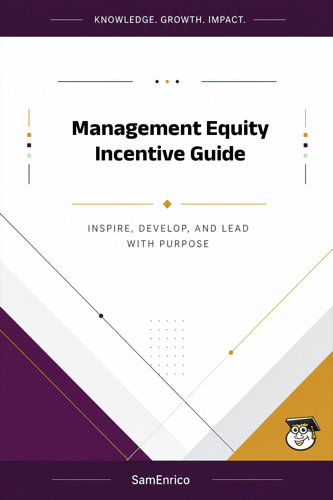
Management Equity Incentive Guide eBook
Structure rollover equity, option pools, and earn-
Structure rollover equity, option pools, and earn-out provisions for management teams.
Formats
Free sample
Chapter 1: The $10 Million Handshake--You have just spent eighteen months of your life preparing your company for sale. You have endured due diligence requests that felt like dental surgery without anesthesia. You have watched your founding team run on caffeine and anxiety. And now, finally, you are sitting across a polished conference table from a private equity partner who smiles, extends a hand, and says, “Congratulations. We have a deal.”That handshake will cost you millions.
You just do not know it yet.The private equity industry manages over eight trillion dollars globally. In any given year, thousands of management teams sell their companies to PE sponsors or accept growth equity investments that restructure their ownership. And in nearly every one of those transactions, the management team signs an equity incentive agreement that they do not fully understand. Not because they are unintelligent—founders and executives are among the sharpest people in business—but because the documents are designed to be complex, the timeline is designed to be rushed, and the incentives are designed to favor the sponsor.This book exists to fix that imbalance.The purpose of this chapter is to introduce you to the foundational conflict that drives every private equity transaction, the three tools sponsors use to align (or misalign) your interests, and the brutal truth about why most management teams leave between twenty and forty percent of their potential wealth on the table. By the time you finish reading these pages, you will understand why the handshake is dangerous, why the term sheet is where the real battle is won or lost, and why reading the next eleven chapters of this book could be the highest-return activity of your professional life.The Foundational Conflict: Selling Yesterday While Promising Tomorrow Every private equity transaction involves a fundamental psychological and economic conflict.
On one side, you are selling what you have already built. Your company has revenue, customers, intellectual property, and a track record. That past performance has real value, and you want to be paid for it. On the other side, the private equity sponsor is buying what you might build tomorrow. They are paying a price based on projections, growth assumptions, and synergies that do not yet exist.
They want you to stay, work harder than ever, and deliver a future that justifies their investment.This is the dual imperative. You are simultaneously a seller cashing out and an operator committing to years of additional labor. And these two roles pull in opposite directions. As a seller, you want the highest possible upfront price. As an operator, you want the flexibility to run the business without onerous restrictions.
The private equity sponsor understands this tension perfectly. In fact, they rely on it. Because the moment you sign the deal, your leverage shifts. Before closing, you have options—you could walk away, find another buyer, or stay independent. After closing, you are an employee with a contract.The smartest sponsors exploit this shift.
They offer generous upfront terms knowing that once you are inside the machine, your negotiating power evaporates. The equity incentive structure they present at closing is often the last meaningful negotiation you will have until exit. And most management teams approach that negotiation exhausted, relieved, and fundamentally unprepared.The Trinity of Incentives: The Three Levers That Determine Your Wealth To understand how private equity sponsors think about management incentives, you must understand what I call the Trinity of Incentives. These are the three primary tools used in almost every PE-backed transaction to align (or misalign) management behavior with sponsor returns. Each tool serves a different purpose, comes with different risks, and requires different negotiation strategies.Rollover Equity.
This is the requirement that you reinvest a portion of your sale proceeds back into the new holding company. If you are selling your company for one hundred million dollars, the sponsor may demand that you roll over twenty percent of your proceeds—twenty million dollars—into equity of the post-acquisition entity. This is not a gift. It is a hostage mechanism. The sponsor wants you to have skin in the game, to feel the pain of a downturn, and to be personally invested in the exit.
Rollover equity aligns your downside risk with the sponsor’s downside risk. But it also ties up your capital, often for five to seven years, with no guarantee of return.Option Pools. These are grants of equity to management team members who are not selling significant amounts of stock. If you are a non-founder executive joining the platform post-acquisition, you will not have sale proceeds to roll over. Instead, you will receive options, profits interests, or restricted stock that vests over time and gives you upside if the company grows.
Option pools are typically sized between five and fifteen percent of fully diluted equity in the United States, and between ten and twenty percent in the United Kingdom and Europe. The size of the pool matters enormously. A pool that is too small cannot retain talent. A pool that is too large dilutes the sponsor’s returns. And where the pool sits in the capital structure—whether it is common equity, preferred equity, or something in between—determines whether you get paid before or after the sponsor recoups their investment.Earn-Outs.
These are contingent payments based on future performance. If the sponsor values your company at one hundred million dollars but you believe it is worth one hundred fifty million dollars, you might agree to receive one hundred million at closing and an additional fifty million if you hit certain financial targets over the next two or three years. Earn-outs bridge valuation gaps, but they are also traps. The sponsor controls the business after closing. They control budgets, headcount, capital expenditures, and accounting policies.
If they want to sabotage your earn-out, they have countless legal ways to do so. Understanding how to draft earn-out provisions is one of the most valuable skills you can develop.These three tools work together. Rollover equity gives you downside exposure. Option pools give you upside potential. Earn-outs bridge valuation disagreements.
But the way these tools are structured determines whether you emerge from the transaction wealthy or disappointed.The 10% Rule and Its Hidden Nuances Let me share a piece of market data that will anchor your understanding of option pools. In the United States, the average option pool for a private equity-backed company is approximately ten percent of fully diluted equity. In the United Kingdom and Europe, the average pool is larger, typically ranging from ten to twenty percent. At first glance, this seems like a simple geographic variation. But the underlying drivers are more interesting.In lower-valuation companies, equity represents a larger portion of total compensation because cash is scarce.
A startup valued at fifty million dollars might need a fifteen percent pool to attract a chief financial officer who could otherwise work at a public company. In higher-valuation companies, cash compensation is more competitive, so the equity pool can be smaller—perhaps five to eight percent. Base salary levels also matter. In the UK, where base salaries for executives are generally lower than in the US, larger equity pools compensate for the cash gap.The implication…
This is the end of the free sample. Get the eBook to keep going. Buy now
About this book
Details
- Author
- Compton Augusta
- Publisher
- SamEnrico
- Language
- English
- Genre
- Non-Fiction, Capital & Valuation Register, Incentive Design
- Released
- 2026-06-07
- Pages (approx.)
- 141
- Available as
- eBook, Audiobook

Read better in the ZLOADR app
Your eBooks on your phone or tablet. Sign in with your SamEnrico account and start reading.
More by Compton Augusta
 Bariatric Surgery Social Situations HandbookCompton Augusta$11.99
 LBO Minority Buyout GuideCompton Augusta$11.99
 Low FODMAP Vegetarian CookbookCompton Augusta$11.99
 The Silent War: How a 1970s Whistleblower Exposed the CIA’s Secret Mind Control ExperimentsCompton Augusta$11.99
 Blade and the Blacksmith: The Forgotten Art of the KatanakajiCompton Augusta$11.99
 Security System TechnicianCompton Augusta$11.99
 Understanding Cataract Skeletal AnomaliesCompton Augusta$17.99
 Grant Proposal Collaboration GuideCompton Augusta$12.99
 AI Financial Reporting HandbookCompton Augusta$12.99
 10 Ways to Use Champagne Yeast (Recipe Book)Compton Augusta$11.99
You may also like
 Hong Kong Handover 1997Dunn Johnnie$11.99
 Zumba For Postnatal Recovery CourseNeal Christian$11.99
 Zumba for BeginnersLadner Nikia$11.99
 YouTube Comment Mining GuideHumes Pandora$12.99
 Worry Box MeditationCarlin Rudy$11.99
 Workplace Stress MeditationNguyen Lynn$11.99
 Workplace Stress and Sleep RepairHawley Ivory$11.99
 Workplace Perfectionism CureDelaney Jeffry$11.99
 Workplace Injustice Anger GuideWallen Isabelle$11.99
 Work Addiction and Burnout LinkGreenwood Ester$11.99
 Women in Yoga and WellnessBeattie Galina$11.99
 Women in Stand Up ComedyChun Evangeline$11.99