
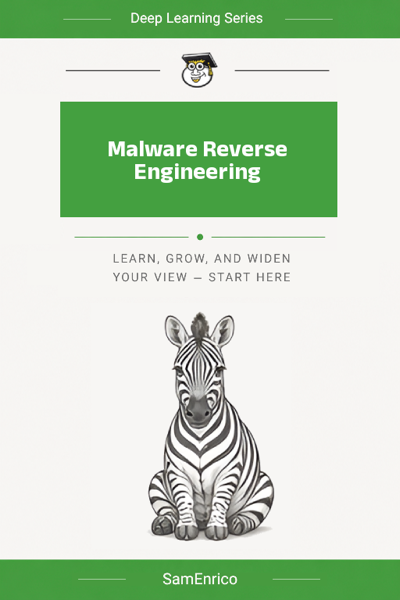
Malware Reverse Engineering eBook
A Coursebook on Malware Reverse Engineering
by Towns Raye
A Coursebook on Malware Reverse Engineering
Formats
Free sample
Chapter 1: The Billion-Dollar Byte--–- On a Friday evening in May 2021, a small IT contractor in Florida typed a password into a compromised VPN account that had no multi-factor authentication. Within four hours, 100 gigabytes of sensitive data had been exfiltrated from Colonial Pipeline’s network. Within twelve hours, the ransomware note appeared on 190 Windows servers. Within five days, the United States faced its first major fuel shortage since the 1970s, panicked drivers filled plastic bags with gasoline, and the company paid 75 Bitcoin—roughly $4.4 million at the time—to a criminal group operating out of Eastern Europe.The byte that started it all was no different from any other byte on the internet. It was a single hexadecimal value, 0x90 in one place, 0x CC in another.
But that byte—when executed in the right sequence, on the right machine, with the right privileges—unlocked a chain reaction that shut down 5,500 miles of pipeline and changed how the world thought about critical infrastructure security.Behind the headlines, a different story was unfolding. A reverse engineer—someone exactly like you will become by working through this book—sat in a darkened room with a debugger attached to a copy of the Dark Side ransomware sample. She did not have the decryption key. She did not have the attackers’ private keys. What she had was 278 kilobytes of compiled machine code, a stack of energy drinks, and the systematic methodology you are about to learn.Within forty-eight hours, she had identified the encryption algorithm (Cha Cha20 with a custom key schedule), found a flaw in the way Dark Side generated its per-file nonces, and wrote a proof-of-concept decryptor.
The FBI used her analysis to recover half of the ransom payment. The attackers rebranded twice in the following months. That is the power of understanding malware at the byte level.This chapter is not an introduction. It is a declaration: reverse engineering is not magic, not a gift, and not reserved for geniuses who started coding at age seven. It is a systematic discipline built on curiosity, methodical observation, and a set of teachable skills.
By the time you finish this chapter, you will understand the economic engine that drives malware development, the critical distinction between types of malicious code, and the ethical framework that separates a professional analyst from the attackers they study.The Economics of the Invisible Industry Malware is not an accident. It is not the work of lone teenagers in hoodies, despite what Hollywood suggests. Malware is a global industry with supply chains, R&D budgets, customer support, service-level agreements, and even annual conferences (some of which are held openly, with security researchers in attendance).Let us start with the numbers, because numbers reveal truth. In 2024, the global cost of cybercrime exceeded $9.5 trillion annually. To put that in perspective: if cybercrime were a country, its GDP would rank third behind only the United States and China, ahead of Japan and Germany.
Approximately 60% of that figure comes from malware-enabled crime—ransomware, banking trojans, infostealers, and cryptojackers.The malware economy operates on three tiers:Tier One: The Initial Access Brokers (IABs) . These are specialized groups that do not deploy ransomware themselves. Instead, they compromise networks through phishing, stolen credentials, or vulnerability exploitation and sell access to the highest bidder. A typical price list in 2025: remote desktop access to a small dental practice, $500; domain admin credentials on a mid-sized manufacturing firm, $5,000; persistent access to a hospital network with active directory, $15,000. IABs provide "proof of access" screenshots, maintain escrow services using Bitcoin, and offer customer support via Russian-language Telegram channels.Tier Two: The Malware Developers.
These teams write the code that delivers payloads, evades antivirus, persists through reboots, and communicates with command-and-control servers. A full-featured banking trojan like Grandoreiro or Mekotio sells for $50,000 to $150,000 on darknet markets, with source code included. Ransomware-as-a-Service (Raa S) platforms take a different model: affiliates pay an upfront fee (typically $1,000 to $10,000) and split ransom payments 70/30 or 80/20 with the developers. Lock Bit, before its takedown, operated with over 1,200 affiliates and paid out more than $100 million in commissions.Tier Three: The Operators. These are the hands-on-keyboard attackers who navigate compromised networks, disable defenses, deploy the final payloads, and negotiate ransoms.
They are often salaried employees of cybercrime cartels, working in office buildings in cities where law enforcement is either complicit or overwhelmed. A skilled operator earns $60,000 to $200,000 per year, tax-free, with performance bonuses tied to successful payments.Why does this matter to you as a reverse engineer? Because every piece of malware you will ever analyze was built by someone with economic incentives. Understanding those incentives tells you what to look for:A ransomware developer wants speed over stealth. The encryption must finish before the victim notices.
Look for high-performance cryptographic implementations, often using assembly-optimized loops.A banking trojan author wants persistence and evasion. The malware must survive reboots and hide from user-mode hooks. Look for kernel components, bootkit techniques, and extensive anti-debugging.An infostealer seller wants low detection rates above all else. The malware must steal credentials without triggering EDR. Look for indirect syscalls, callback obfuscation, and heavy use of Windows native APIs.The Colonial Pipeline attackers followed this economic model perfectly.
Dark Side operated as a Raa S platform. The initial access came from an IAB who had stolen VPN credentials months earlier. The operator who deployed the ransomware was a salaried employee who had never met the developer who wrote the code. When you reverse-engineer a Dark Side sample, you are not analyzing a single person's work. You are analyzing a global supply chain compressed into binary form.The Spectrum of Malicious Code Not all malware is created equal.
A reverse engineer who treats a banking trojan the same way they treat a worm will waste hours chasing false leads. The first skill you must develop—before learning a single opcode—is classification: understanding what kind of malware you are facing and what behaviors to expect.Commodity Malware is the volume business of cybercrime. These are off-the-shelf tools sold on darknet markets, often with GUI configuration panels and email support. Think of them as the malware equivalent of a crowbar: not elegant, not stealthy, but effective at scale. Examples include Emotet (a banking trojan turned loader), Qak Bot (an infostealer with worm-like propagation), and Red Line Stealer (a credential harvester sold for $200).
Commodity malware is what most analysts encounter daily—hundreds of thousands of samples, many of them nearly identical.The defining characteristic of commodity malware is reuse. The same code appears across thousands of samples with minor variations: different IP addresses, different mutex names, different encryption keys. This is excellent news for the analyst, because once you understand one family, you understand most of its variants. Commodity malware typically:Uses known packers (UPX, ASPack, MPRESS)Leaves strings mostly intact (often in plaintext)Calls standard Windows APIs without obfuscation Fails under debuggers in predictable ways Advanced Persistent Threat (APT) Malware is the opposite. APTs are state-sponsored or state-aligned groups operating with strategic objectives: espionage, sabotage, or long-term access.
Their malware is custom-built for a specific target, often with zero-day exploits, custom encryption, and multiple fallback communication channels. An APT campaign might target ten organizations over two years, spending months…
This is the end of the free sample. Get the eBook to keep going. Buy now
About this book
Details
- Author
- Towns Raye
- Publisher
- SamEnrico
- Language
- English
- Genre
- Non-Fiction, Informative, Educational
- Released
- 2026-06-02
- Pages (approx.)
- 143
- Available as
- eBook, Audiobook

Read better in the ZLOADR app
Your eBooks on your phone or tablet. Sign in with your SamEnrico account and start reading.
More by Towns Raye
 Inner Body Breath AwarenessTowns Raye$11.99
 The Relationship Repair EQ GuideTowns Raye$11.99
 Anger After Partner's PunctualityTowns Raye$11.99
 Plus Size Self Esteem WorkbookTowns Raye$11.99
 Emotional Intelligence for Customer ServiceTowns Raye$11.99
 Silent Frequency: The Lost Broadcast of 1926Towns Raye$11.99
 Procurement Compliance and Audit ManualTowns Raye$12.99
 Meeting Roles And ResponsibilitiesTowns Raye$12.99
 How to Become a Sensitized-paper TesterTowns Raye$11.99
 Understanding Male Pseudohermaphroditism Due to 5-alpha-reductase 2 DeficiencyTowns Raye$17.99