
Non-FictionSelf-HelpRetail Memory
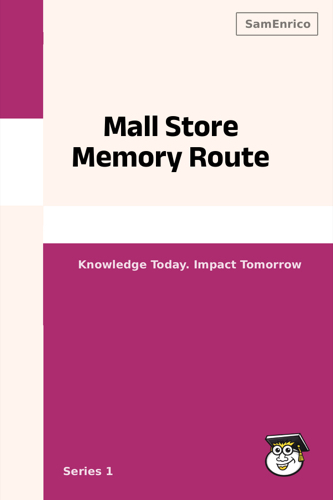
Mall Store Memory Route eBook
Turn retail stores and escalators into practical m
by Espino Becki
Turn retail stores and escalators into practical memory journeys.
Formats
Free sample
Chapter 1: The Two-Layer Secret...–- Every memory champion knows a secret that you don’t. It’s not about having a photographic memory. It’s not about being born with a bigger hippocampus. And it’s certainly not about drilling flashcards until your eyes bleed. The real secret is this: your brain evolved to remember places, not pages.
That’s why you can walk into a mall you haven’t visited in five years and still find the food court without thinking. That’s why you can close your eyes and picture the exact route from the parking garage to the cinema. Your brain is a spatial navigation device disguised as a thinking machine. And the mall? The mall is the perfect training ground.But here’s the problem that has tripped up every single person who has ever tried to build a traditional Memory Palace.
Traditional palaces are static. You use your childhood home. Your office. A church you visited once. And for a while, it works.
You memorize a grocery list. You memorize a speech. You feel like a genius. Then something changes. Your aunt repaints the living room.
Your office rearranges the cubicles. The church closes for renovation. And suddenly, your perfect Memory Palace is a house of broken images. The loci you carefully numbered are now wrong. The route you memorized is gone.
You give up. You go back to sticky notes.This book solves that problem forever.The mall is not static. The mall is alive. Stores open and close. Window displays change with every holiday.
Pop-up kiosks appear and vanish like mushrooms after rain. Most people see chaos. You will see opportunity. Because a mall that changes is not a weakness — it is a neural gym that never lets you plateau. But to harness that dynamism, you cannot use the old rules.
You need a new system. A two-layer system that gives you both rock-solid permanence and endless novelty. A system that works whether you are at a suburban mega-mall, a city shopping center, or even an airport terminal with a few shops.This chapter introduces that system. By the time you finish reading, you will understand why the traditional Memory Palace fails most people, how the mall solves that failure, and exactly how to build your first Two-Layer Memory Route. You will not just read about it.
You will do it. Today.The Broken Promise of the Traditional Memory Palace Let us start with honesty. You have probably heard of the Method of Loci. It is the technique that memory champions use to memorize the order of ten decks of cards or the names of a hundred strangers in fifteen minutes. Here is how it works: you imagine a familiar place — your childhood home, your walk to work, your favorite coffee shop.
You mentally walk through that place and assign each thing you want to remember to a specific location, or "locus" (plural: loci). Then, when you need to recall the information, you take another mental walk and "see" each item sitting in its assigned spot.It is ancient. It is powerful. And it has a fatal flaw that almost no one talks about.The flaw is this: the places you know best are the places that change the least. Your childhood home probably looks mostly the same as it did ten years ago.
That is why it works as a Memory Palace. But that stability is also why it eventually fails. Your brain craves novelty. Neuroplasticity — the ability of your brain to form new connections — requires new input. When you walk through the same mental home for the thousandth time, your brain stops paying attention.
The images become faded. The loci blur together. You start forgetting where you put the milk versus the eggs.Worse, real life changes your palaces without asking permission. A new couch. A different paint color.
A room converted into a home office. Suddenly, the lamp you used as a locus is gone. The bookshelf you numbered as Station 7 is now in a different corner. Your mental map becomes a source of confusion, not clarity.This is why most people quit memory training after two weeks. Not because the technique is hard.
But because their palaces decay.Why the Mall Is Different Now consider the mall.The average regional mall contains between 80 and 120 stores. It has multiple levels. It has escalators, elevators, fountains, food courts, cinemas, and parking structures. It is a three-dimensional grid of visual information. But unlike your living room, the mall is professionally designed to keep your attention.
Retailers spend billions of dollars on "dwell time" — the amount of time a shopper stays in the mall. The industry average is about 100 minutes. That is nearly two hours of forced exposure to a structured environment.Here is what that means for you: your brain will naturally repeat the same walking patterns whether you are trying to or not. You enter through the same door. You pass the same fountain.
You ride the same escalator. This repetition is not boring — it is the exact mechanism that memory athletes use to reinforce neural pathways. Every time you walk past the Apple Store, your brain is strengthening the connection between that physical location and your mental map.But the mall has something that your living room does not: controlled change.The stores themselves are permanent enough to serve as anchors. Macy’s will be there next year. The food court is not moving.
The cinema is not going anywhere. These are your Core Macro-stations — the architectural spine of your memory route. They are as stable as any room in your house, often more so because malls resist renovation more than homeowners resist repainting.At the same time, the mall changes constantly. Window displays rotate every six to eight weeks. Holiday decorations transform the entire environment four times a year.
Pop-up shops appear for three months and then vanish. Kiosks come and go with the seasons. This is not chaos — this is a scheduled neural workout. Every change forces your brain to re-encode information in a new context, which is the single best thing you can do for long-term retention.You get stability for reliability. You get novelty for neuroplasticity.
You get both at the same time, in the same place, during the same visit.The Two-Layer System Explained Here is the core innovation of this book. You will not build one Memory Palace. You will build two interlocking systems that work together.Layer One: The Core Spine The Core Spine consists of eight permanent architectural features in your mall. These are not stores — stores can close. These are structural elements that cannot be removed without demolishing the building.
Your Core Spine might include:The main entrance (Door 1)The central fountain or seating area The base of the main escalator bank The top of the main escalator bank The food court entrance The cinema lobby The parking garage elevator The management office corridor (or a distinctive restroom hallway)Notice what is missing: store names. You do not use JCPenney or Gap or Sephora as Core stations because those stores can close or relocate. The architectural features remain. This is how you achieve…
This is the end of the free sample. Get the eBook to keep going. Buy now
About this book
Details
- Author
- Espino Becki
- Publisher
- SamEnrico
- Language
- English
- Genre
- Non-Fiction, Self-Help, Retail Memory
- Released
- 2026-06-10
- Pages (approx.)
- 153
- Available as
- eBook, Audiobook

Read better in the ZLOADR app
Your eBooks on your phone or tablet. Sign in with your SamEnrico account and start reading.
More by Espino Becki
 ADHD Procrastination ManagementEspino Becki$11.99
 Outbreak Merger Contingency PlanEspino Becki$11.99
 The Foster Care Prom NightEspino Becki$11.99
 Dividend Tax Efficiency HandbookEspino Becki$11.99
 Third Degree BurnEspino Becki$11.99
 Benzodiazepine Seizure RiskEspino Becki$11.99
 60 120 Sprint WorkoutEspino Becki$11.99
 The Silk Road Conspiracy: How a Shadowy Network Outsmarted the CIAEspino Becki$11.99
 The Star Chart of the Dogon: Ancient Astronomers of MaliEspino Becki$11.99
 How to Produce Material HandlingEspino Becki$11.99
 A Collector's Handbook to the Morris TwentyEspino Becki$11.99
 OKR for Two Person TeamEspino Becki$12.99
You may also like
 Hong Kong Handover 1997Dunn Johnnie$11.99
 Zumba For Postnatal Recovery CourseNeal Christian$11.99
 Zumba for BeginnersLadner Nikia$11.99
 YouTube Comment Mining GuideHumes Pandora$12.99
 Worry Box MeditationCarlin Rudy$11.99
 Workplace Stress MeditationNguyen Lynn$11.99
 Workplace Stress and Sleep RepairHawley Ivory$11.99
 Workplace Perfectionism CureDelaney Jeffry$11.99
 Workplace Injustice Anger GuideWallen Isabelle$11.99
 Work Addiction and Burnout LinkGreenwood Ester$11.99
 Women in Yoga and WellnessBeattie Galina$11.99
 Women in Stand Up ComedyChun Evangeline$11.99