
Non-FictionInformativeEducational
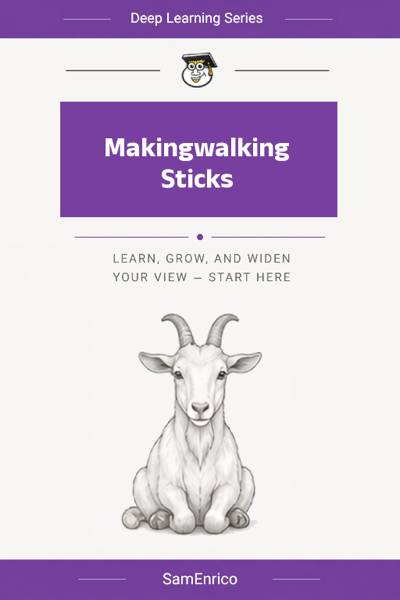
Makingwalking Sticks eBook
A Coursebook on Makingwalking Sticks
by Toney Kassie
A Coursebook on Makingwalking Sticks
Formats
Free sample
Chapter 1: The Walking Stick Renaissance...-- The first time you hold a well-made walking stick, something unexpected happens. Your grip settles into a curve you did not consciously choose. Your shoulder relaxes. Your stride lengthens slightly. You stand a little taller.
This is not imagination or sentimentality. This is the residue of one million years of human evolution, during which a stick in the hand meant safety, purpose, and dignity. The walking stick is not an accessory. It is an ancient conversation between the human body and the natural world – and making one by hand is how you learn to speak that language.This book is not a catalog of patterns to copy. It is a course of study.
By the time you turn the last page, you will have completed seven distinct projects, mastered four families of joinery, and learned to see the landscape differently. Every hedge, woodlot, and fallen branch will present itself as a possibility. But before we cut a single piece of wood, we need to understand what we are making, why it matters, and where this craft comes from. The walking stick has been forgotten and rediscovered many times. You are joining a revival that began long before you were born and will continue long after your own sticks become heirlooms.THE THREE LIVES OF THE WALKING STICKEvery object with a long history lives many lives.
The walking stick is no different. To understand what you are about to make – and to make it well – you must understand how the stick has been seen by those who came before you. These are not merely historical curiosities. They are the accumulated wisdom of generations who discovered, through trial and error, what works and what does not.The Utilitarian Age: The Stick as a Tool Long before there was a word for "stickmaker," there were shepherds. The crook – that iconic curve at the top of a shepherd's staff – was not invented for decoration.
It was engineered for a specific, brutal task: hooking a sheep by the leg or neck without breaking the animal's stride. A shepherd moving a flock across a hillside could not afford to stop and bend down. The crook extended the arm, multiplied leverage, and saved hours of labor every day.The mathematics of the crook are not accidental. A well-made shepherd's crook has a throat radius of approximately four inches – tight enough to catch a sheep's leg but wide enough to release instantly when the animal pulls away. The angle of the bend, measured from the shaft, is typically between 45 and 60 degrees.
These numbers were discovered through centuries of trial and error, not by engineers in laboratories but by working men and women who threw away the sticks that failed and kept the sticks that worked.The utilitarian stick had no ornament. It was often left unbarked, with the natural patina of the wood serving as its only finish. The shaft was thick enough to serve as a lever but thin enough to be carried for ten miles. The wood was almost always a single species found locally – hazel in England and Wales, ash in Scotland and Ireland, hickory in the American South. These were not aesthetic choices.
They were survival choices. A shepherd whose stick broke a mile from the nearest tree might lose a sheep.This era of stickmaking left us a crucial lesson: form follows function, but function is not ugly. The simple, unadorned thumbstick – which you will make in Chapter 4 – is beautiful precisely because every curve serves a purpose. There is no wasted material, no false ornament, no gesture that does not originate in the human hand.The Victorian Age: The Stick as a Statement The Industrial Revolution changed everything. For the first time in human history, a middle class emerged with disposable income and leisure time.
Walking was no longer just a way to get from one place to another. It became a pastime, a form of exercise, a way to see and be seen. The walking stick transformed accordingly.The Victorian dress cane was not made to support weight or hook sheep. It was made to signal status. Exotic woods – ebony from Africa, snakewood from South America, rosewood from India – replaced local hazel and ash.
Handles were carved from ivory, silver, and gold. Hidden compartments held flasks, pistols, and even collapsible telescopes. The cantilever umbrella, patented in 1852, was combined with walking sticks to create the modern "umbrella stick" – a device that was neither a good umbrella nor a good walking stick but was an excellent conversation piece.This era gave us the vocabulary of stickmaking that persists today. Terms like "ferrule" (the metal collar between handle and shaft), "crook" (the curved handle), and "knobstick" (a straight stick with a rounded top) were codified in Victorian trade catalogs. The London company Thomas Brigg & Sons, founded in 1810, published the first known illustrated guide to stick styles in 1847.
If you have ever wondered why a certain handle shape is called a "bollock" or a "derby" or a "parliamentary," the answer lies in Victorian London.But the Victorian era also left us a warning. Ornament without function becomes fragility. The elaborately carved canes of the late 1800s were often unusable within a decade – the thin ivory handles cracked, the delicate ferrules loosened, the exotic woods split along grain lines that their makers had ignored. A walking stick must first be a walking stick. Everything else is secondary.The Modern Revival: The Stick as Art The 20th century was unkind to the walking stick.
Automobiles, paved roads, and the decline of rural life made the stick seem obsolete. By the 1950s, stickmaking was a dying craft practiced only by elderly shepherds and a handful of hobbyists.Then something unexpected happened. In 1976, a small group of British stickmakers founded the British Stickmakers Guild. Their goal was modest: to keep the craft alive for one more generation. Within a decade, the guild had grown to over a thousand members.
Annual competitions drew hundreds of entries. New techniques – particularly the use of ram's horn for handles – were developed and refined. The walking stick was no longer a tool or a status symbol. It was an art form.The modern revival, which continues today, is different from what came before. Contemporary stickmakers are not shepherds or Victorian gentlemen.
They are woodworkers, carvers, and nature lovers who discovered the craft through books, workshops, or online forums. They make sticks for hikers, for collectors, for competition, and for themselves. They experiment with materials – ram's horn, deer antler, buffalo horn, exotic hardwoods – that would have been unimaginable to a shepherd in 1800.This revival has produced a distinctive aesthetic. Modern sticks are often more sculptural than their predecessors. Wildlife toppers – carved heads of dogs, foxes, eagles, and otters – are a specialty of the contemporary stickmaker.
The "film eye," a technique for carving a realistic eye from a single piece of wood without using glass inserts, was developed within the last forty years. The Barton screw joint, which allows a stick handle to be unscrewed for travel, was invented in the 1990s by an American stickmaker named David Barton.You are not learning an ancient craft that has remained unchanged for centuries.…
This is the end of the free sample. Get the eBook to keep going. Buy now
About this book
Details
- Author
- Toney Kassie
- Publisher
- SamEnrico
- Language
- English
- Genre
- Non-Fiction, Informative, Educational
- Released
- 2026-05-06
- Pages (approx.)
- 130
- Available as
- eBook, Audiobook

Read better in the ZLOADR app
Your eBooks on your phone or tablet. Sign in with your SamEnrico account and start reading.
More by Toney Kassie
 Validation For BoredomToney Kassie$11.99
 The Working Parent Anger GuideToney Kassie$11.99
 ED and Relationship GuideToney Kassie$11.99
 The MO Change Over Time GuideToney Kassie$11.99
 Step Six Readiness CourseToney Kassie$11.99
 The Phoenix Protocol: How a Cold War Spy Saved the World from Nuclear AnnihilationToney Kassie$11.99
 A Beginners Guide to Hardball squash (Volume 1)Toney Kassie$11.99
 Minority Subcontracting PlansToney Kassie$12.99
 PR for B2B StartupsToney Kassie$12.99
 The Breeder's Guide to Narragansett TurkeysToney Kassie$11.99
You may also like
 Hong Kong Handover 1997Dunn Johnnie$11.99
 Zumba For Postnatal Recovery CourseNeal Christian$11.99
 Zumba for BeginnersLadner Nikia$11.99
 YouTube Comment Mining GuideHumes Pandora$12.99
 Worry Box MeditationCarlin Rudy$11.99
 Workplace Stress MeditationNguyen Lynn$11.99
 Workplace Stress and Sleep RepairHawley Ivory$11.99
 Workplace Perfectionism CureDelaney Jeffry$11.99
 Workplace Injustice Anger GuideWallen Isabelle$11.99
 Work Addiction and Burnout LinkGreenwood Ester$11.99
 Women in Yoga and WellnessBeattie Galina$11.99
 Women in Stand Up ComedyChun Evangeline$11.99