
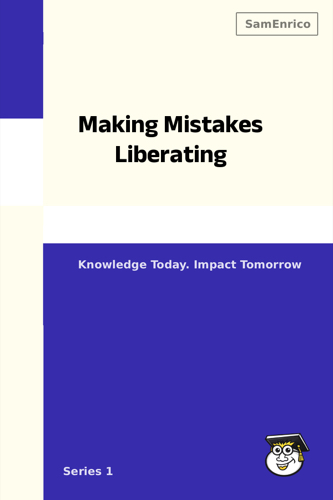
Non-FictionSelf-HelpFailure Recovery
Making Mistakes Liberating eBook
Celebrate errors as opportunities using improv's f
by Goff Nakesha
Celebrate errors as opportunities using improv's fearless approach.
Formats
Free sample
Chapter 1: The Certainty Trap--–- The morning I deleted my company’s entire client database, I did not feel like a revolutionary. I felt like a fraud who was about to be exposed. My finger hovered over the “confirm” button for exactly one second too long. In that second, eighteen months of work, 247 client profiles, and the trust of my six-person team vanished into the digital ether. I stared at the blank screen.
Then I closed my laptop, walked to the bathroom, and sat on the floor for twenty minutes. I did not tell anyone for three weeks. I lied to my co-founders. I fabricated progress reports. I blamed “software glitches” for missing deadlines.
Every day, the lie grew heavier. Every night, I rehearsed confession speeches I never gave. By the time the truth emerged—as truths always do—the damage was not the lost data. The damage was the three weeks of silence. My team didn’t fire me because I made a mistake.
They nearly fired me because I was too scared to admit it.This is not a book about how to make mistakes. This is a book about how the fear of making mistakes has quietly stolen your agility, your creativity, and your freedom—and how to take it all back. We live in a culture that worships the right answer. From the first graded spelling test in kindergarten to the quarterly earnings report in corporate America, we are rewarded for certainty and punished for error. But here is the paradox that will unravel everything you think you know: the relentless pursuit of being right is the single fastest path to being wrong.
Spectacularly, publicly, expensively wrong.The illusion that you can plan your way to safety, that you can follow the script and avoid surprise, is the most seductive lie of modern life. I call it the Certainty Trap. And the first step toward making mistakes liberating is recognizing that you are already inside it.The Neuroscience of Uncertainty Let us begin with the biology of fear, because you cannot outthink a mechanism that evolved over five hundred million years. The human brain is a prediction engine. It consumes an enormous amount of metabolic energy—roughly 20 percent of your daily calories—to do one primary thing: anticipate what will happen next.
This is not a flaw. It is the reason our species survived. Your ancient ancestors who could predict where the predator would leap, or which berries would cause illness, lived long enough to pass on their genes. The ones who wandered carelessly into danger did not.This predictive machinery resides largely in the amygdala, a small, almond-shaped cluster of neurons deep within the temporal lobe. The amygdala does not think.
It reacts. It scans every input—a sound, a facial expression, a memory—for potential threats. When it detects uncertainty, it triggers a cascade of stress hormones: cortisol, adrenaline, norepinephrine. Your heart rate increases. Your pupils dilate.
Blood flows away from your digestive system and toward your large muscle groups. Your prefrontal cortex—the rational, planning part of your brain—literally receives less blood flow. You become physically less capable of complex reasoning in the very moment you most need it.Here is what this means for your daily life. When you face an uncertain outcome—a job interview, a difficult conversation, a creative project—your brain treats it as a physical threat. Not metaphorically.
Literally. The same neural pathways activate whether you are being chased by a lion or sending an email to your boss. Uncertainty equals danger.Now add the second layer: social threat. Neuroscientists have discovered that social pain—rejection, embarrassment, public failure—activates the same brain regions as physical pain. The anterior cingulate cortex and the insula light up whether you are being burned by a hot stove or being laughed at in a meeting.
Your brain does not distinguish between “I am in physical danger” and “I look stupid in front of my peers.” Both are processed as survival threats.This is the biological foundation of perfectionism. You are not weak. You are not uniquely anxious. You are operating with a brain that evolved to treat uncertainty as a predator. The person who appears effortlessly confident has not eliminated this response.
They have learned to override it—or, more precisely, to ride it like a wave rather than drown in it.The Control Illusion Given that uncertainty feels like danger, it is no surprise that we crave control. The Control Illusion is the cognitive bias that leads us to overestimate our ability to predict and influence outcomes. We buy the longer warranty. We make the five-year plan. We rehearse conversations in the shower.
We believe that if we just gather enough data, create enough checklists, and think through every possible scenario, we can eliminate surprise altogether.The Control Illusion is not mere optimism. It is a coping mechanism. In a series of classic experiments, researchers found that people who were given a “panic button” to stop an unpleasant noise—even when they were told the button probably wouldn’t work—reported significantly less stress than those with no button at all. The illusion of control reduces anxiety, even when the control is fake. This is why you refresh your email forty times before a response arrives.
The checking does nothing to speed the response, but it gives you the feeling of doing something.The problem is that the Control Illusion leads directly to fragility. Imagine two objects: a glass vase and a river reed. The vase is rigid. It has a fixed shape. When the wind blows, the vase does not bend.
It stands perfectly still—until the wind is strong enough to shatter it. The reed, by contrast, is flexible. It bends with the wind. It looks less impressive in calm weather, but it survives the storm.Perfectionism is the vase. It feels strong because it resists deviation.
But resistance is not strength. Resistance is the absence of adaptability. The person who has meticulously planned every detail of their wedding, their presentation, their career trajectory does not feel safe because they are resilient. They feel safe because they have constructed a world that has not yet been tested. The first deviation—a canceled flight, a critical question they didn’t anticipate, a partner who changes their mind—shatters the illusion.
And because they have spent no time developing the muscle of adaptation, they shatter too.The scripted life promises safety. It delivers fragility. The unscripted life looks messier. It feels uncertain. But it bends.
And bending is how you survive.The Scripts You Did Not Write Where do these scripts come from? You did not invent them. You inherited them. Let me name a few.The Academic Script: From the first day of formal schooling, you learned that there is a single right answer and that your value as a student—and, by extension, as a person—is measured by how many times you produce it. Wrong answers are marked in red.
Red is the color of danger. Red is the color of blood. By the time you graduate high school, you have received thousands of implicit messages…
This is the end of the free sample. Get the eBook to keep going. Buy now
About this book
Details
- Author
- Goff Nakesha
- Publisher
- SamEnrico
- Language
- English
- Genre
- Non-Fiction, Self-Help, Failure Recovery
- Released
- 2026-06-06
- Pages (approx.)
- 145
- Available as
- eBook, Audiobook

Read better in the ZLOADR app
Your eBooks on your phone or tablet. Sign in with your SamEnrico account and start reading.
More by Goff Nakesha
 Rib Pain Meditation GuideGoff Nakesha$11.99
 Networking for Sales ProfessionalsGoff Nakesha$11.99
 Clutter and Spend ConnectionGoff Nakesha$11.99
 Cycling Time Trial Hypnosis GuideGoff Nakesha$11.99
 Press Release Quick ReferenceGoff Nakesha$11.99
 The Layoff Survival PlanGoff Nakesha$11.99
 Morning Meditation for AnticipatoryGoff Nakesha$11.99
 Indian Migrant Worker StoryGoff Nakesha$11.99
 Steel Titans of the Pacific: The Birth of Carrier Warfare (1942)Goff Nakesha$11.99
 The Tides of Timbuktu: How African Mathematicians Charted the CosmosGoff Nakesha$11.99
 How to Produce Bean SproutsGoff Nakesha$11.99
 College Essay Metaphor And ThemeGoff Nakesha$12.99
You may also like
 Hong Kong Handover 1997Dunn Johnnie$11.99
 Zumba For Postnatal Recovery CourseNeal Christian$11.99
 Zumba for BeginnersLadner Nikia$11.99
 YouTube Comment Mining GuideHumes Pandora$12.99
 Worry Box MeditationCarlin Rudy$11.99
 Workplace Stress MeditationNguyen Lynn$11.99
 Workplace Stress and Sleep RepairHawley Ivory$11.99
 Workplace Perfectionism CureDelaney Jeffry$11.99
 Workplace Injustice Anger GuideWallen Isabelle$11.99
 Work Addiction and Burnout LinkGreenwood Ester$11.99
 Women in Yoga and WellnessBeattie Galina$11.99
 Women in Stand Up ComedyChun Evangeline$11.99