
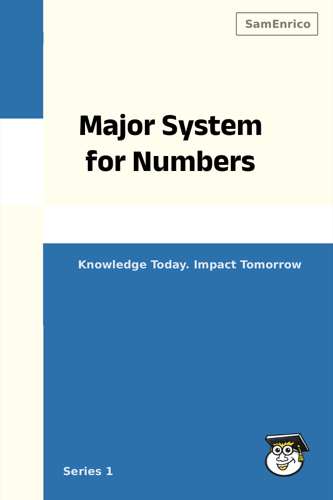
Non-FictionSelf-HelpAdvanced Mnemonics
Major System for Numbers eBook
Convert digits to consonant sounds and words for l
Convert digits to consonant sounds and words for long number recall.
Formats
Free sample
Chapter 1: The Shape of Sound--–- You have already forgotten more numbers today than you will remember by bedtime. Your brain is not broken. It is working exactly as evolution designed it. For 200,000 years, humans never needed to recall a 10-digit sequence. We needed to remember which berries were poisonous, where the river curved, and who in the tribe could be trusted.
The modern world buried us in digits – PIN codes, phone numbers, passwords, credit cards, birthdays, serial numbers, confirmation codes – and left us with a Stone Age memory system. This book rewires that system.The Major System is not a trick. It is a cognitive technology. It takes advantage of how your brain naturally encodes information: through images, stories, and locations. Every digit you forget is not a failure of intelligence.
It is a failure of translation. You are trying to remember abstract symbols. Your brain hates abstract symbols. It loves concrete scenes. The solution is simple but not easy: convert digits into consonant sounds, then into words, then into images.
This chapter builds the foundation. You will learn the phonetic code that turns numbers into a language your visual memory understands.The Problem with Digits Close your eyes for five seconds and try to hold this sequence: 7392158. Now open them. Most people will recall four to six digits correctly. A few will get seven.
Almost no one will get all seven in the correct order. That is Miller’s Law in action. In 1956, cognitive psychologist George Miller published a landmark paper titled “The Magical Number Seven, Plus or Minus Two.” He demonstrated that the average human working memory can hold only seven unstructured items, plus or minus two, for about fifteen to thirty seconds.But here is what Miller also discovered: we can hold much more if we chunk information. A chunk is a single unit that contains multiple pieces of raw data. For example, the letter sequence C-I-A-F-B-I-N-B-S is eleven items.
But if you recognize it as CIA, FBI, and NBC, those become three chunks. The raw data has not changed. Your brain simply reorganized it using existing knowledge.The Major System is chunking at the level of sound. It converts the abstract shape “7” into the consonant sound “k” or “g.” It converts “3” into “m.” Together, 73 becomes “k” + “m” – which, with vowels, becomes “come” or “gym.” Suddenly a meaningless pair of digits becomes a verb or a place. That is chunking.
That is the Major System.Why Rote Repetition Fails Before we build the new system, we must understand why the old one collapses. You have tried repeating a number over and over. You have said it aloud, written it on your hand, typed it repeatedly. And still, an hour later, it vanished. This is not because you are lazy or stupid.
It is because rote repetition does not engage the brain’s long-term encoding machinery.Memory operates in three stages: encoding, storage, and retrieval. Rote repetition keeps information in working memory by constant rehearsal – like spinning plates. The moment you stop spinning, the plates fall. Long-term memory requires elaborative encoding: attaching new information to existing knowledge, emotions, or sensory experiences. The Major System forces elaborative encoding because you cannot turn a digit into a word without making choices.
Those choices create hooks.Consider the number 42. Repeating “four-two, four-two, four-two” creates no hooks. But converting 4 to “r,” 2 to “n,” and building the word “rain” creates multiple hooks: the sound of rain, the feeling of getting wet, the smell of a storm. One hour later, you will not remember the abstract digits 42. You will remember the image of rain.
And from that image, you can retrieve the digits. That is elaborative encoding. That is the power of the Major System.The History of the Major System Every powerful idea has a lineage. The Major System – sometimes called the Phonetic Number System or the Mnemonic Number System – traces back to 1648. That year, German mnemonist Stanislaus Mink von Wennsshein published The Universal Memory System.
He proposed that digits could be represented by consonant sounds based on the shape of the mouth or the look of the written number. His original mapping differed slightly from the modern version, but the core insight was revolutionary: digits are not visual, but sounds can be.Over the next two centuries, various mnemonists refined the system. In 1730, Richard Grey published Memoria Technica, which adapted the phonetic principle. In 1806, Gregor von Feinaigle, a German monk, toured Europe demonstrating spectacular memory feats using a similar code. But the system that we use today crystalized in the late 19th century through the work of Aimé Paris, a French mathematician, and later through the popularization efforts of Harry Lorayne in the 1950s and 60s.Lorayne’s contribution was not invention but accessibility.
He stripped away the academic language and taught the Major System to millions through books like The Memory Book (co-authored with Jerry Lucas). He replaced the intimidating name “Mink von Wennsshein’s System” with the simpler “Major System” – a pun on the word “mnemonic” (since “major” sounds like the first syllable of “mnemonic”). Today, every competitive memory champion uses a version of the Major System. It is the foundation upon which world records are built.The Core Rule: Sounds, Not Letters Here is the rule that governs everything in this book: The Major System maps digits to consonant sounds, not to letters. This distinction seems subtle, but it is the single most common source of error for beginners.
You must train yourself to hear sounds, not see letters.Take the word “phone.” It begins with the letter P. If you mapped by letters, you would assign P to digit 9. But the Major System does not care about letters. It cares about the sound you make when you speak. The sound at the beginning of “phone” is F.
F is digit 8. That is why “phone” encodes to 8, not 9. The silent P is invisible to the system because it makes no sound.The same principle applies to “knife.” The K is silent. Only the N sound matters. So “knife” encodes to 2 (n), not 7 (k) plus 2.
Similarly, “Cathy” with a soft C? The first sound is K (hard C) because “Ca” is a hard K sound. “Cathy” encodes to 7 (k) plus 1 (t) or 0? Wait, “Cathy” = K (7) + th (1) – yes, 71. But “Cynthia” starts with a soft C (S sound), so 0.
You are learning to hear past spelling.The Free Sounds: Vowels, W, H, YNot every consonant sound has a digit. Vowels – a, e, i, o, u – have no numeric value. They are the glue that turns consonant skeletons into real words. Without vowels, “r” plus “n” is unpronounceable. Add an ‘a’ and an ‘i’, and you get “rain.” The vowels add meaning without changing the underlying number.The consonants W, H, and Y are also free.
They carry no digit value. This is because in English, these sounds often appear as modifiers rather than core consonant sounds. For example, “wine” begins with W (free) and then N (2) – so “wine” encodes to 2, not a W-digit (there is none). The W is ignored. “Yellow” begins with Y (free), then L (5) – so 5.
“High” begins with H (free), then a long I sound (ignored) – so “high” encodes to zero? No – careful…
This is the end of the free sample. Get the eBook to keep going. Buy now
About this book
Details
- Author
- Russell Rufus
- Publisher
- SamEnrico
- Language
- English
- Genre
- Non-Fiction, Self-Help, Advanced Mnemonics
- Released
- 2026-06-09
- Pages (approx.)
- 105
- Available as
- eBook, Audiobook

Read better in the ZLOADR app
Your eBooks on your phone or tablet. Sign in with your SamEnrico account and start reading.
More by Russell Rufus
 Burnout and Boundaries GuideRussell Rufus$11.99
 The Remote Executive Time GuideRussell Rufus$11.99
 NICU Trauma TriggersRussell Rufus$11.99
 Hydration Alcohol Detox GuideRussell Rufus$11.99
 Sunburn Treatment ProtocolRussell Rufus$11.99
 Persuasion Through StorytellingRussell Rufus$11.99
 Artist Imposter SyndromeRussell Rufus$11.99
 The Golden Conspiracy: How a Secret Society of 18th-Century Jewelers Outsmarted the Spanish CrownRussell Rufus$11.99
 The Shanghai Shadow Syndicate: The Prohibition-Era Credit Card Conspiracy (1920s)Russell Rufus$11.99
 Bernese Mountain Dog: Gentle Giant & Slow MaturingRussell Rufus$11.99
 A Collector's Handbook to the Audi 100 AvantRussell Rufus$11.99
 How to Produce SandboxesRussell Rufus$11.99
You may also like
 Hong Kong Handover 1997Dunn Johnnie$11.99
 Zumba For Postnatal Recovery CourseNeal Christian$11.99
 Zumba for BeginnersLadner Nikia$11.99
 YouTube Comment Mining GuideHumes Pandora$12.99
 Worry Box MeditationCarlin Rudy$11.99
 Workplace Stress MeditationNguyen Lynn$11.99
 Workplace Stress and Sleep RepairHawley Ivory$11.99
 Workplace Perfectionism CureDelaney Jeffry$11.99
 Workplace Injustice Anger GuideWallen Isabelle$11.99
 Work Addiction and Burnout LinkGreenwood Ester$11.99
 Women in Yoga and WellnessBeattie Galina$11.99
 Women in Stand Up ComedyChun Evangeline$11.99