
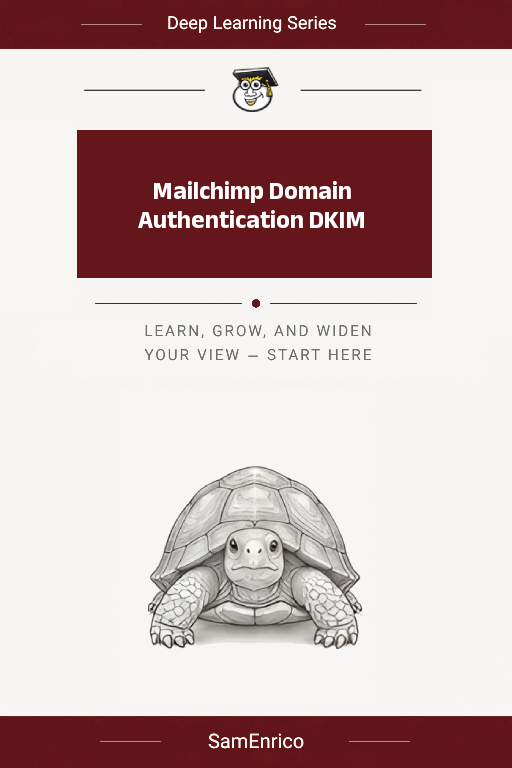
Mailchimp Domain Authentication DKIM eBook
Add DKIM record to domain DNS to prove email legit
Add DKIM record to domain DNS to prove email legitimacy and avoid phishing filters.
Formats
Free sample
Chapter 1: The Spam Folder Funeral--The email campaign had taken Sarah eighteen hours to write, design, and test. She had segmented her list perfectly, personalized every subject line, and followed every “best practice” guide she could find. Her client, a boutique coffee roastery launching their first holiday subscription box, was counting on this campaign to generate $50,000 in pre-orders. Sarah clicked “Send” at 9:00 AM on a Tuesday, leaned back in her chair, and waited for the orders to roll in.By 2:00 PM, the open rate was 2 percent. The click rate was zero.
And the client’s phone was ringing—not with orders, but with complaints. “Why aren’t you replying to my emails?” one wholesale partner asked. “I sent you three messages last week.” Sarah checked her sent folder. She had replied to every single one. Then she checked her spam folder.
There they were. All three replies, sitting unopened, alongside her own beautiful, painstakingly crafted campaign.Sarah had just attended her first spam folder funeral. And she was the guest of honor.If you are reading this book, you have either already experienced a version of Sarah’s nightmare, or you are smart enough to know it is coming for you. The days when email marketing was as simple as “build a list, send a campaign, watch the money appear” are over. They have been replaced by something far more complex, far more technical, and far more unforgiving: the era of mandatory domain authentication.This chapter is not about DKIM records or DNS settings.
Those come later. This chapter is about understanding the crisis that makes those technical steps necessary. It is about the fundamental shift in how email providers like Gmail, Outlook, and Yahoo decide who gets into the inbox and who gets buried in spam. And most importantly, it is about why ignoring this shift will cost you real money, real reputation, and real customers.The Great Filtering Shift of 2024-2025In February 2024, Google and Yahoo simultaneously announced new email requirements that sent shockwaves through the marketing world. For the first time in the history of commercial email, authentication was no longer optional.
Any sender dispatching more than 5,000 emails per day was required to implement SPF, DKIM, and DMARC—the three pillars of email authentication that we will explore in depth in Chapter 2.To understand why this was such a seismic event, you have to understand what came before. For decades, email operated on a model of implicit trust. If an email claimed to come from noreply@yourcompany.com, most receiving servers would simply believe it. This trust model was convenient, but it was also catastrophically vulnerable. It allowed criminals to forge the “From” address on their phishing emails, making fraudulent messages appear to come from legitimate banks, shipping companies, and even friends.
By the early 2020s, phishing attacks had grown into a multi-billion-dollar criminal enterprise, and spam made up over 85 percent of all email traffic.The major email providers responded by building increasingly sophisticated spam filters. But these filters faced an impossible trade-off. If they were too aggressive, they blocked legitimate email—a problem known as a “false positive.” If they were too permissive, they let phishing attacks through. For years, they balanced on this knife’s edge, relying on content analysis and user engagement signals to separate good senders from bad.Then came the breaking point. In late 2023, a series of high-profile phishing attacks bypassed every major provider’s filters.
The attackers had discovered a simple truth: most spam filters were so focused on looking at what an email said that they barely checked who it came from. Google and Yahoo decided to flip the script. They announced that authentication would no longer be a “nice to have.” It would become the gatekeeper.The new rules were simple but brutal. If you send more than 5,000 emails per day, you must authenticate your domain using SPF and DKIM at minimum. You must also give recipients a one-click way to unsubscribe.
And you must keep your spam complaint rate below 0.3 percent. Fail any of these requirements, and your emails would be rejected outright or dumped into spam with no appeal.The industry scrambled to comply. But here is the thing that most marketers still do not understand: those requirements were just the beginning. They were the visible tip of an iceberg that has been growing beneath the surface for years. The real story is not about a specific threshold or a specific policy.
It is about a fundamental shift in philosophy. Email providers have moved from “innocent until proven guilty” to “guilty until authenticated.”If you send an email from an unauthenticated domain today, you are not simply at a disadvantage. You are indistinguishable from a Nigerian prince scammer. You are technically identical to the criminal who wants to steal your customer’s credit card information. The spam filter does not know your intentions.
It only knows your technical posture. And without authentication, your technical posture is indistinguishable from a threat.The Anatomy of a Modern Spam Filter To understand why authentication has become so critical, you need to understand how modern spam filters actually work. The old model—looking for words like “VIAGRA” or “FREE” in all caps—is dead. It was killed by two forces: the sophistication of legitimate marketers who learned to avoid obvious trigger words, and the sophistication of criminals who learned to mimic legitimate email.Today’s spam filters are powered by machine learning models that evaluate hundreds of signals simultaneously. These models are not programmed with rules like “if the word ‘mortgage’ appears, mark as spam.” Instead, they are trained on billions of emails that humans have already classified as spam or not spam.
The model learns patterns, correlations, and anomalies that no human could ever codify.But despite this complexity, the major signals can be grouped into three categories. Understanding these categories is essential because they map directly to the chapters of this book. You cannot fix your deliverability by addressing only one category. You must address all three.The first category, authentication, accounts for approximately 40 percent of your spam filter score. This includes SPF (does the sending server have permission to send for this domain?), DKIM (is the email cryptographically signed by the domain owner?), and DMARC (what should the receiver do if authentication fails?).
If you fail any of these checks, you start the race 40 percent behind. In many cases, you fail so badly that the filter never even looks at the other categories. Your email is simply discarded.The second category, engagement, accounts for approximately 35 percent of your spam filter score. This is where many authenticated senders still fail. Engagement signals include open rates, click rates, reply rates, and—most powerfully—actions like “move from spam to inbox” and “add to contacts.” When your recipients actively engage with your emails, you are telling the filter “this sender is wanted.” When they ignore your emails, or worse, delete them without opening, you are telling the filter “this sender is irrelevant.” When they mark your emails as spam, you are telling the filter “this sender is harmful.”The third category, content, accounts for approximately 25 percent of your spam filter score.
This includes the words you use, the ratio of text to images, the quality of your HTML code, the presence…
This is the end of the free sample. Get the eBook to keep going. Buy now
About this book
Details
- Author
- Shorter Lahoma
- Publisher
- SamEnrico
- Language
- English
- Genre
- Non-Fiction, First 30 Days
- Released
- 2026-05-29
- Pages (approx.)
- 125
- Available as
- eBook, Audiobook

Read better in the ZLOADR app
Your eBooks on your phone or tablet. Sign in with your SamEnrico account and start reading.
More by Shorter Lahoma
 Tailgating Trigger Control WorkbookShorter Lahoma$11.99
 Meeting Scheduling OptimizationShorter Lahoma$11.99
 Cocaine Recovery Anhedonia GuideShorter Lahoma$11.99
 September Massacres GuideShorter Lahoma$11.99
 Talking About Postpartum Depression GuideShorter Lahoma$11.99
 Anger and Pornography UseShorter Lahoma$11.99
 Postpartum Depression Financial Stress GuideShorter Lahoma$11.99
 Self Hypnosis Script HandbookShorter Lahoma$11.99
 Exercise Protocols for Joint Pain ReliefShorter Lahoma$11.99
 The Visionaries of Stone: How Christopher Wren Built a New LondonShorter Lahoma$11.99
 Quetzalcoatl’s Feathered Serpent: The Cosmic Dance of CreationShorter Lahoma$11.99
 The Last Sip: How Nespresso Revolutionized Coffee CultureShorter Lahoma$11.99
You may also like
 Hong Kong Handover 1997Dunn Johnnie$11.99
 Zumba For Postnatal Recovery CourseNeal Christian$11.99
 Zumba for BeginnersLadner Nikia$11.99
 YouTube Comment Mining GuideHumes Pandora$12.99
 Worry Box MeditationCarlin Rudy$11.99
 Workplace Stress MeditationNguyen Lynn$11.99
 Workplace Stress and Sleep RepairHawley Ivory$11.99
 Workplace Perfectionism CureDelaney Jeffry$11.99
 Workplace Injustice Anger GuideWallen Isabelle$11.99
 Work Addiction and Burnout LinkGreenwood Ester$11.99
 Women in Yoga and WellnessBeattie Galina$11.99
 Women in Stand Up ComedyChun Evangeline$11.99