
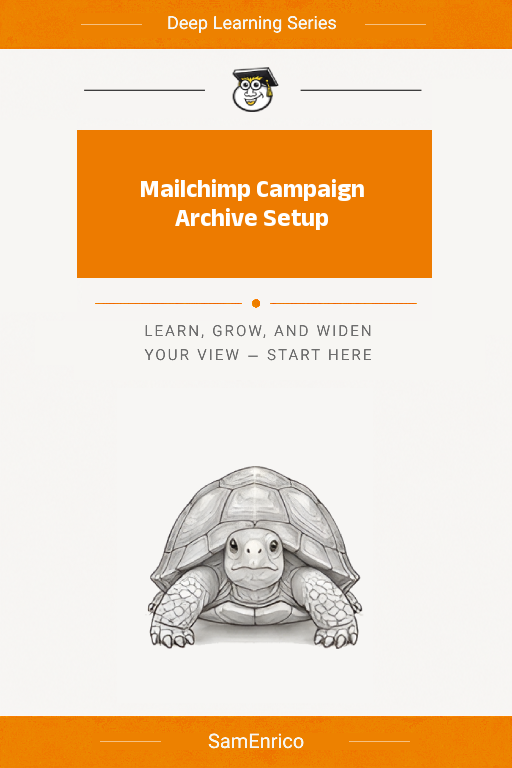
Mailchimp Campaign Archive Setup eBook
Enable public archive so subscribers can access pa
Enable public archive so subscribers can access past emails from a browser link automatically.
Formats
Free sample
Chapter 1: The Invisible Asset--Every email you have ever sent is still alive.Not in the way a living thing breathes and moves, but in the way a seed buried in dry soil waits for rain. Your past campaigns sit inside Mailchimp—hundreds, maybe thousands of them—locked away behind password-protected inboxes and “View in Browser” links that almost no one clicks. They are invisible to the world. They generate zero traffic, zero leads, and zero revenue.And that is a tragedy.Most marketers treat an email as a disposable asset. You write it, design it, send it, and then forget about it the moment the open rates come in.
If a campaign performed well, you might save the subject line for inspiration. If it bombed, you never look at it again. This cycle repeats week after week, year after year. You are throwing away your best content the moment you hit “Send.”This book exists because that habit is leaving money on the table.The public archive feature inside Mailchimp—when configured correctly—transforms your email history from a forgotten back-end folder into a permanent, searchable, shareable library of your expertise. It turns past newsletters into lead generation machines that work while you sleep.
It converts strangers into subscribers without a single popup form. It builds trust faster than any “Subscribe Now” button ever could.But here is the problem: almost no one uses this feature correctly.Most Mailchimp users enable the public archive with a single click, never realizing they have just exposed every A/B test draft, abandoned cart reminder with broken links, and outdated pricing page they ever sent. Others never enable it at all, assuming the “View in Browser” link is sufficient. Both approaches are wrong.This chapter introduces the core strategic framework that will guide everything else in this book. You will learn why your email history is more valuable than your future email queue.
You will understand three distinct ways a public archive generates value—none of which rely on search engines (that comes later in Chapter 9). And you will begin to see your past campaigns not as a record, but as a second marketing channel.By the end of this chapter, you will never look at a sent email the same way again.The Disposability Fallacy Let me ask you a blunt question.When was the last time you re-read an email you sent six months ago?Not a transactional receipt or a password reset. A real newsletter—the kind where you poured hours into the subject line, the design, the storytelling, the call-to-action. When was the last time you visited that email’s “View in Browser” link and thought, This could still help someone?If you are like most marketers, the answer is never.We treat emails like newspapers. Read once, then recycled.
The industry reinforces this behavior with metrics that obsess over the first 48 hours: open rate, click-through rate, conversion rate. If an email performs well in that narrow window, we call it a success. If it does not, we call it a failure and move on.This is the Disposability Fallacy—the belief that an email’s value expires after its initial send.The truth is exactly the opposite. An email’s value compounds over time, but only if it remains accessible. A blog post from three years ago still drives traffic today because it lives on your website.
A You Tube video from five years ago still generates views because it lives in a channel. But an email from three months ago? It sits in a database, invisible to anyone who was not on your list that day.That is illogical when you think about it.You are creating content—often excellent content—and then locking it in a vault that only current subscribers can open. And even they can only open it if they remember to click “View in Browser” before deleting the email.The public archive smashes that vault open.When you enable and properly configure your Mailchimp archive, every past email becomes a public web page. Anyone with the link can read it.
Anyone who finds it through a shared link, a social media post, or a forum discussion can explore your entire history of content. Your email becomes a lead generation tool for people who never subscribed in the first place.Let that sink in.Your next subscriber might not come from a form on your website. They might come from a link to an email you sent three years ago that someone shared on Linked In yesterday.The Three Silent Revenue Streams of a Public Archive Most guides on Mailchimp archives focus on the technical how-to. Click this button. Copy this code.
Paste it here. Done. They treat the archive as a feature—a checkbox to tick off your list.This book treats the archive as a strategy.A properly configured public archive generates value through three distinct mechanisms. None of them require you to send another email. None of them cost you additional money.
They simply unlock value that is already sitting in your account.Stream One: The Shared Link Lead Every email you send contains a “View this email in your browser” link. Most subscribers ignore it. But the ones who click it—the power users, the superfans, the people who actually read your content—become your distribution network.When a subscriber clicks that link, they land on a Mailchimp-hosted page that contains your full email. If you have enabled the public archive (correctly), that page also contains links to your other emails. But here is the critical insight: your subscriber can now share that link anywhere.They can post it on Twitter.
They can paste it into a Slack channel. They can email it to a colleague. They can save it to a bookmarking site. And every person who clicks that shared link lands on your archive page, where they see not just one email, but your entire history of content.This is the Shared Link Lead mechanism.Someone who never signed up for your list finds your archive through a shared link. They browse two or three emails.
They see consistency. They see expertise. They see value. And then—without a popup form, without a discount code, without any friction—they decide to subscribe.The public archive converts through demonstration, not persuasion.Think about how different this is from a traditional opt-in form. A popup asks for trust before providing value.
“Give me your email address, and I promise I will send good things.” The archive reverses the sequence. It provides value first—full emails, complete archives, proof of quality—and then asks for trust second, usually through a subtle subscribe button placed naturally within the page.Which approach builds more genuine subscribers?The data from thousands of Mailchimp users who have implemented this strategy shows that archive-driven subscribers have higher long-term engagement than popup-driven subscribers. They know what they are getting because they have already seen it.Stream Two: The Resource Page Asset Your emails contain expertise. Maybe you write a weekly newsletter about social media strategy. Maybe you send monthly case studies about email marketing.
Maybe you publish quarterly reports about industry trends. Every one of those emails is a piece of original research, analysis…
This is the end of the free sample. Get the eBook to keep going. Buy now
About this book
Details
- Author
- Michaud Erlinda
- Publisher
- SamEnrico
- Language
- English
- Genre
- Non-Fiction, First 30 Days
- Released
- 2026-05-30
- Pages (approx.)
- 142
- Available as
- eBook, Audiobook

Read better in the ZLOADR app
Your eBooks on your phone or tablet. Sign in with your SamEnrico account and start reading.
More by Michaud Erlinda
 Postpartum Depression Exercise PrescriptionMichaud Erlinda$11.99
 Living Abroad Cost CalculatorMichaud Erlinda$11.99
 IBS Overlap Migraine GuideMichaud Erlinda$11.99
 Anger in First Responder LoveMichaud Erlinda$11.99
 Distraction Proof Sales ProspectingMichaud Erlinda$11.99
 Pelvic Floor for IBSMichaud Erlinda$11.99
 The Accountability ConversationMichaud Erlinda$11.99
 The Golden Child Dilemma WorkbookMichaud Erlinda$11.99
 Body Image For Csection ScarsMichaud Erlinda$11.99
 Ride the Iron Horse: The Untold Tale of the Pony Express’s Last StandMichaud Erlinda$11.99
 Gold, Swords, and Loyalty: The War That Bankrupted the SamuraiMichaud Erlinda$11.99
 Understanding Andre SyndromeMichaud Erlinda$17.99
You may also like
 Hong Kong Handover 1997Dunn Johnnie$11.99
 Zumba For Postnatal Recovery CourseNeal Christian$11.99
 Zumba for BeginnersLadner Nikia$11.99
 YouTube Comment Mining GuideHumes Pandora$12.99
 Worry Box MeditationCarlin Rudy$11.99
 Workplace Stress MeditationNguyen Lynn$11.99
 Workplace Stress and Sleep RepairHawley Ivory$11.99
 Workplace Perfectionism CureDelaney Jeffry$11.99
 Workplace Injustice Anger GuideWallen Isabelle$11.99
 Work Addiction and Burnout LinkGreenwood Ester$11.99
 Women in Yoga and WellnessBeattie Galina$11.99
 Women in Stand Up ComedyChun Evangeline$11.99