
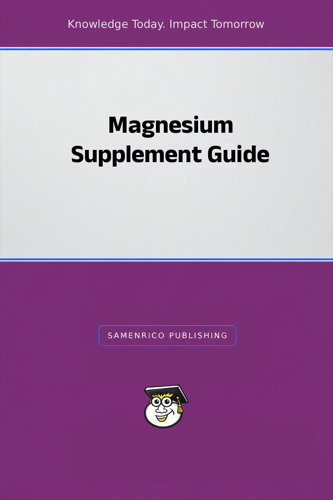
Non-FictionHealth & WellnessMineral Supplement
Magnesium Supplement Guide eBook
Best forms and dosages for leg relaxation.
Best forms and dosages for leg relaxation.
Formats
Free sample
Chapter 1: The Calcium Trap...--–- It starts, as most things do in the human body, with a beautifully simple dance between two minerals. One pushes. The other pulls. When they are in rhythm, you sleep through the night, wake up refreshed, and walk down the stairs in the morning without gasping as your calf seizes into a knot of white-hot pain. When they fall out of balance, your legs become a battlefield.The dance is between calcium and magnesium.
And for the last seventy years, we have been taught to worship calcium with an almost religious fervor. Drink your milk. Take your calcium supplement. Fortify your orange juice. Build strong bones.
The message has been so relentless, so universally accepted, that the average person today consumes calcium at levels that would have been unimaginable to our ancestors. Meanwhile, magnesium—the quiet, unglamorous partner in this dance—has been steadily depleted from our soil, our water, and our diets. The result is not just a deficiency. It is a physiological trap. And your legs are the first place it springs shut.This chapter will show you exactly why your legs won't relax, how the calcium-magnesium balance determines whether your muscles contract or release, and why the standard American diet has inadvertently turned your body into a cramp factory.
By the time you finish reading, you will understand the single most important mechanism behind nocturnal leg cramps, restless legs, and post-exercise muscle stiffness—and you will never look at a glass of milk the same way again.The Neuromuscular Junction: Where Nerves Meet Muscle To understand why your legs cramp, you need to understand the tiny intersection where your nervous system talks to your muscle fibers. This is called the neuromuscular junction. Think of it as a handshake between a nerve cell and a muscle cell. When your brain decides to move your leg, it sends an electrical signal racing down the nerve. That signal reaches the end of the nerve and triggers the release of a chemical messenger called acetylcholine.
Acetylcholine crosses the microscopic gap between nerve and muscle and lands on receptors on the muscle cell's surface. When those receptors are activated, they open channels that allow calcium to rush into the muscle cell.This calcium flood is the "go" signal. Inside the muscle cell, calcium binds to a protein called troponin, which acts like a molecular switch. When calcium flips that switch, it allows another protein called myosin to grab onto actin—the two filaments that generate contraction. The myosin pulls, the muscle shortens, and your leg moves.
This entire process takes milliseconds. It is elegant, efficient, and essential for everything from walking to breathing.But here is the part that most people never learn: the muscle cannot relax on its own. It has no active mechanism to release the contraction. Instead, relaxation depends entirely on removing calcium from the cell. And that job belongs to magnesium.Magnesium: The Gatekeeper of Relaxation Inside every muscle cell, there are tiny molecular pumps called calcium-ATPases.
These pumps use energy (in the form of ATP) to actively transport calcium back out of the cell and into storage compartments called the sarcoplasmic reticulum. But these pumps cannot function without magnesium. Magnesium is a cofactor for the ATPase enzyme. No magnesium, no pump activity. No pump activity, calcium stays inside the cell.
Calcium inside the cell means the muscle stays contracted.This is the single most important sentence in this chapter: A muscle contracts because calcium enters the cell. A muscle relaxes because magnesium removes it.When magnesium levels are optimal, the pumps work efficiently. Calcium enters during contraction, then gets rapidly pumped back out. The muscle cycles through contraction and relaxation smoothly, like a well-tuned engine. You feel no pain, no twitching, no sudden spasms in the middle of the night.When magnesium levels are low, the pumps slow down.
They struggle to keep up. Calcium begins to accumulate inside the cell. At first, this causes subtle problems: muscle twitching (fasciculations), a feeling of "tightness" that stretching doesn't relieve, or fatigue that lingers long after exercise. As the imbalance worsens, the calcium buildup reaches a threshold. The muscle cell becomes hyperexcitable.
It fires spontaneously, without any signal from your brain. That spontaneous firing is a cramp. If the cramp is severe enough, the muscle locks into a sustained contraction that can last seconds or minutes—the classic charley horse.But why does this happen so often at night? Why in the calves? And why does it seem to target otherwise healthy people who eat well and exercise?
The answers lie in the peculiar relationship between magnesium deficiency, circadian rhythms, and the modern diet.The Nocturnal Cramp: Why Night is the Worst Time If magnesium deficiency causes cramps, why don't they happen constantly throughout the day? Why do they overwhelmingly strike at night, often waking you from deep sleep? The answer involves three factors that converge in the early morning hours.First, magnesium levels in the blood follow a circadian rhythm. Multiple studies have shown that serum magnesium naturally drops during the night, reaching its lowest point between 2:00 AM and 4:00 AM. This is exactly when most people report being woken by leg cramps.
In a magnesium-sufficient person, this nocturnal dip is harmless—the levels stay well above the threshold for normal muscle function. But in someone who is already borderline deficient, the nighttime drop pushes them below that threshold. The pumps fail. Calcium accumulates. The calf muscle, which is already under unique mechanical stress from a day of walking and standing, becomes the first casualty.Second, nighttime is when you are lying still.
During the day, even minor movements—shifting in your chair, walking to the bathroom, adjusting your posture—stimulate muscle spindles and keep the neuromuscular system active. This low-level activity actually helps maintain calcium homeostasis. When you lie perfectly still for hours, your muscles enter a state of prolonged rest. The calcium pumps have less work to do, but they also receive less mechanical feedback that normally helps regulate excitability. In a magnesium-depleted muscle, stillness paradoxically increases the risk of spontaneous firing.Third, your sleeping position often shortens the calf muscle.
If you sleep on your stomach with your toes pointed (a position called plantar flexion), the calf muscle is held in a shortened position for hours. Shortened muscles are more likely to cramp than lengthened muscles. When you combine a shortened position with low nighttime magnesium and a hyperexcitable muscle cell, the cramp becomes almost inevitable.This is why the classic nocturnal leg cramp is so predictable. It hits the calf or the small muscles of the foot. It strikes in the early morning.
It locks the muscle in a contracted position that you cannot voluntarily release. And it leaves behind a soreness that can last for days—the result of microscopic muscle damage from the forced contraction.Restless Leg Syndrome vs. True Cramps: A Critical Distinction Before we go any further, we need to make a crucial distinction. Not every leg problem at night is a cramp. Many people suffer from Restless Leg Syndrome (RLS), which feels completely different and has a different underlying mechanism.
Understanding the difference is essential because magnesium helps both conditions, but the dosing and forms may differ.A true nocturnal leg…
This is the end of the free sample. Get the eBook to keep going. Buy now
About this book
Details
- Author
- Burt Tiffanie
- Publisher
- SamEnrico
- Language
- English
- Genre
- Non-Fiction, Health & Wellness, Mineral Supplement
- Released
- 2026-06-07
- Pages (approx.)
- 154
- Available as
- eBook, Audiobook

Read better in the ZLOADR app
Your eBooks on your phone or tablet. Sign in with your SamEnrico account and start reading.
More by Burt Tiffanie
 Benzo Recovery and DrivingBurt Tiffanie$11.99
 Partner Passenger Critic GuideBurt Tiffanie$11.99
 Sleep Interruption MethodBurt Tiffanie$11.99
 Per Stirpes GuideBurt Tiffanie$11.99
 Film Room Genius HabitsBurt Tiffanie$11.99
 Menstrual Pain Natural ReliefBurt Tiffanie$11.99
 Episodic Memory SleepBurt Tiffanie$11.99
 The Silent Revolution: How a Forgotten Genius Invented the First SmartphoneBurt Tiffanie$11.99
 Brew of the Phoenix: How Coffee Saved a CivilizationBurt Tiffanie$11.99
 How to Start a Cultural Service Administration (public Sector) Business (Beginners Guide)Burt Tiffanie$11.99
 Growing ReineckiaBurt Tiffanie$11.99
 The Dancer's Guide to JigBurt Tiffanie$11.99
You may also like
 Hong Kong Handover 1997Dunn Johnnie$11.99
 Zumba For Postnatal Recovery CourseNeal Christian$11.99
 Zumba for BeginnersLadner Nikia$11.99
 YouTube Comment Mining GuideHumes Pandora$12.99
 Worry Box MeditationCarlin Rudy$11.99
 Workplace Stress MeditationNguyen Lynn$11.99
 Workplace Stress and Sleep RepairHawley Ivory$11.99
 Workplace Perfectionism CureDelaney Jeffry$11.99
 Workplace Injustice Anger GuideWallen Isabelle$11.99
 Work Addiction and Burnout LinkGreenwood Ester$11.99
 Women in Yoga and WellnessBeattie Galina$11.99
 Women in Stand Up ComedyChun Evangeline$11.99