
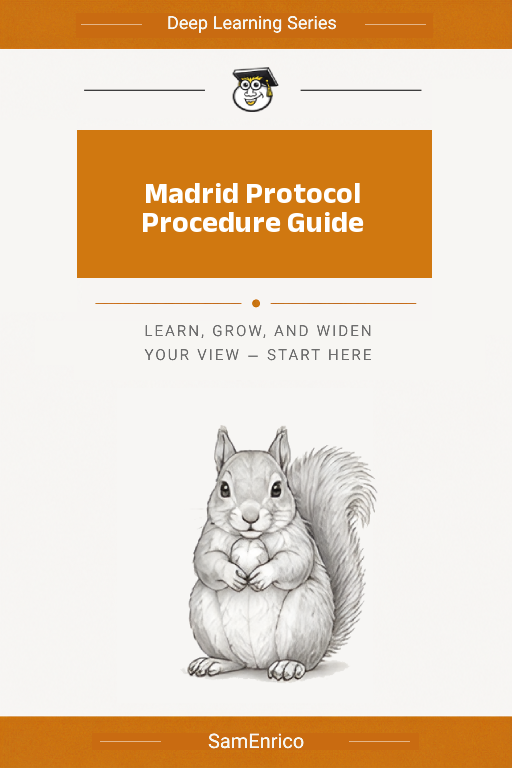
Madrid Protocol Procedure Guide eBook
Navigate Madrid Protocol for international tradema
by Chung Tessie
Navigate Madrid Protocol for international trademark registration. Application, examination, and designation.
Formats
Free sample
Chapter 1: The $50,000 Mistake---- Every year, thousands of companies lose their trademark rights in foreign markets not because their brand was weak, not because someone else had a better claim, but because they made a single procedural error in the first sixty days of the international filing process. That error—choosing the wrong filing route, missing a two-month deadline, or misunderstanding what "automatic protection" actually means—costs businesses an average of $50,000 in abandoned applications, duplicated legal fees, and lost market opportunities. This book exists to ensure you are not one of them.The Madrid Protocol is one of the most powerful yet misunderstood tools in international intellectual property law. It allows a trademark owner to file a single application in a single language, pay a single set of fees in a single currency (Swiss francs), and potentially secure protection in more than 130 countries. On paper, it sounds like magic.
In practice, it is a system of precise, unforgiving rules where a single misstep can destroy an entire global portfolio. This chapter provides the foundational logic of that system—not as abstract history, but as a practical map for every decision you will make in the chapters that follow.The Problem That Demanded a Solution Before the Madrid Protocol existed, protecting a trademark internationally was a nightmare of redundancy. A company wanting to register its brand in fifteen countries had to file fifteen separate applications, hire fifteen local lawyers, pay fifteen sets of fees in fifteen different currencies, and manage fifteen different renewal calendars. Each country examined the application independently, often reaching different conclusions about the same mark. The cost was prohibitive for all but the largest corporations.
The administrative burden was crushing. And the risk of losing rights due to a missed deadline in a single country was extraordinarily high.This fragmented system created a competitive disadvantage for businesses trying to operate globally. A small company with a innovative product might have the resources to file in two or three countries but not in twenty. Meanwhile, a larger competitor with deeper pockets could block them country by country. The trademark system, which was supposed to promote fair competition, instead rewarded those with the largest legal budgets.The need for a centralized solution was obvious.
But getting nations to agree on that solution took nearly a century.The Madrid Agreement of 1891: A Flawed First Attempt The first attempt to solve this problem came in 1891 with the Madrid Agreement. Nine countries signed on, agreeing to a system where a trademark owner could file a single "international registration" at WIPO (the World Intellectual Property Organization) and then designate other member countries where protection was desired. This was revolutionary for its time. But the Agreement contained three fatal flaws that would eventually limit its usefulness, particularly for major economies like the United States, Japan, and Germany.First, the language barrier. The Madrid Agreement operated exclusively in French.
That might have been reasonable in 1891, when French was the dominant language of diplomacy. But by the mid-twentieth century, English had become the primary language of international commerce. Requiring all applications to be filed in French placed an unreasonable burden on companies from English-speaking countries and created translation-related errors that led to refusals.Second, the five-year dependency period was absolute and unforgiving. Under the Madrid Agreement, an international registration remained completely dependent on the "basic mark" (the home country registration) for five years. If the basic mark was cancelled or refused for any reason during that period—even for a technicality unrelated to the mark's inherent validity—the entire international registration collapsed in every designated country simultaneously.
There was no remedy. No conversion into national applications. No right to preserve the filing date. One administrative error at home could wipe out trademark rights in thirty countries overnight.Third, the refusal period was too short. Designated offices had only twelve months to examine an international application and issue a refusal.
For countries with large backlogs or complex examination procedures, twelve months was often insufficient. Many countries responded by simply refusing all Madrid designations as a matter of course, which defeated the purpose of the system entirely.As a result of these flaws, the Madrid Agreement never attracted the world's largest economies. The United States never joined. Japan never joined. Germany joined but maintained a separate national filing system for most applicants.
The Agreement became a niche tool used primarily by French-speaking countries and a handful of others. By the 1970s, it was clear that a new approach was needed.The Madrid Protocol of 1989: The Game Changer The Madrid Protocol was adopted in 1989 and entered into force in 1995. It did not replace the Madrid Agreement; both treaties exist in parallel today, and a handful of countries remain party only to the Agreement. But for practical purposes, the Protocol rendered the Agreement obsolete. All major economies—including the United States, which finally joined in 2003—are members of the Protocol only.
When practitioners refer to the "Madrid System" today, they mean the Protocol.The Protocol fixed each of the Agreement's fatal flaws while introducing new features that made the system genuinely useful for global brand protection.Language expansion. The Protocol permits applications in English, French, or Spanish. The applicant chooses the language based on the requirements of their Office of Origin. This simple change opened the system to the world's largest trademark jurisdictions. For a US-based applicant, filing in English through the USPTO is seamless.
For a Spanish company, filing in Spanish through the Spanish Patent and Trademark Office is equally straightforward. The translation burden shifted from the applicant to the designated offices, which can require translations into their local languages during the national phase if necessary.Transformation rights. This is arguably the most important innovation of the Protocol. If an international registration is cancelled during the five-year dependency period, the Protocol allows the former holder to "transform" the cancelled registration into separate national applications in each designated country. The deadline is three months from the date of cancellation, and the transformed applications preserve the original international filing date.
This means that a central attack—the nightmare scenario under the Madrid Agreement—is no longer a death sentence. It is a costly and stressful event, but not a catastrophic one. Transformation gives the applicant a second chance to maintain their rights on a country-by-country basis. (Chapter 8 provides a complete guide to transformation, including the precise deadlines and required forms.)Extended refusal period. The Protocol gives designated offices eighteen months to issue a refusal, up from twelve months under the Agreement.
Even this extension is not always sufficient for countries with complex examination procedures, so the Protocol includes an exception: countries that have declared an even longer refusal period (typically eighteen months from notification, rather than from filing) may take additional time. But for most designations, the eighteen-month clock is the operative deadline—a point we will return to in the discussion of the 18-Month Rule below.Individual fees. Under the Agreement, all countries charged the same standardized fees. The Protocol allows countries to set "individual fees" that better reflect the actual cost of examination. This might sound like a disadvantage for applicants—higher fees for major economies—but it actually made the system sustainable.…
This is the end of the free sample. Get the eBook to keep going. Buy now
About this book
Details
- Author
- Chung Tessie
- Publisher
- SamEnrico
- Language
- English
- Genre
- Non-Fiction, Business Brief, IP Protection
- Released
- 2026-05-29
- Pages (approx.)
- 145
- Available as
- eBook, Audiobook

Read better in the ZLOADR app
Your eBooks on your phone or tablet. Sign in with your SamEnrico account and start reading.
More by Chung Tessie
 Diplomat International StressChung Tessie$11.99
 The Listening Therapist's GuideChung Tessie$11.99
 The Finals Week PlannerChung Tessie$11.99
 DBT For Digital NomadsChung Tessie$11.99
 The Ex Partner CyberstalkerChung Tessie$11.99
 The Lion of Aksum: Ezana’s Conquests and the Rise of a Christian KingdomChung Tessie$11.99
 Media Buying and Traffic AcquisitionChung Tessie$11.99
 Understanding Temporal Epilepsy, FamilialChung Tessie$17.99
 How to Become a Shaping-machine OperatorChung Tessie$11.99
You may also like
 Intellectual Property Customs GuideBueno Donald$11.99
 Alibaba Intellectual Property GuideCordova Palmira$11.99
 Madrid Refusal Response GuideVenegas Dorene$12.99
 ARIPO Representative GuideGooden Raye$12.99
 WIPO Trademark Registration GuideMoseley Latesha$12.99
 Trademark Search WIPOBeasley Sammie$12.99
 Trademark Search ARIPOSavoy Matthew$12.99
 OAPI vs ARIPO GuideLarsen Marissa$12.99
 Madrid Representative GuideHwang Lucius$12.99
 Madrid Irregularities GuideBeals Merle$12.99
 Madrid Examination ProcessSalas Cori$12.99
 Madrid Application ProcessMccune Dane$12.99