
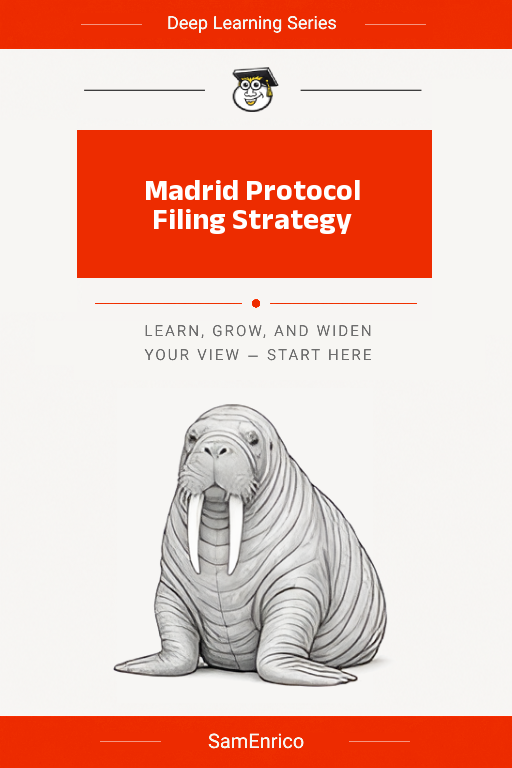
Madrid Protocol Filing Strategy eBook
Choose which countries to designate and how to man
Choose which countries to designate and how to manage costs for international registration.
Formats
Free sample
Chapter 1: The Hidden Trap--–- The email arrived at 4:47 PM on a Friday. Sarah, the founder of a fast-growing organic skincare line, had been waiting for this notification for eleven months. The subject line read: "WIPO Notification - International Registration Designations." She opened it with the excitement of a founder who believed she had finally secured her brand's global future.The message was short. It was also devastating. Her international registration, the one she had paid $8,400 to file, the one that was supposed to protect "Juniper & Ash" in fourteen countries, had been cancelled.
Not refused in one country. Not delayed in another. Cancelled entirely. Every designation. Every country.
Every penny.The reason? A minor error in her United States trademark application—the one her attorney had filed as the "basic" for her entire international portfolio. A specimen that showed her product packaging from an angle that slightly obscured the brand name. A missed deadline to respond to a routine office action. A $225 administrative mistake that her attorney had assured her was "no big deal."That "no big deal" cost Sarah her European expansion, her Japanese distributor, and $47,000 in legal fees trying to fight the squatter who registered her brand name in Germany two weeks after her international registration collapsed.This chapter is about why that happens, how to prevent it, and why almost everything you have heard about the Madrid Protocol is dangerously incomplete.The Million-Dollar Promise That Destroys Brands The Madrid Protocol is one of the most misunderstood treaties in international business.
Administered by the World Intellectual Property Organization (WIPO) in Geneva, it allows a trademark owner to file a single international application and designate over 130 member countries. One form. One filing date. One set of fees in Swiss francs. On paper, it is the closest thing to "global trademark protection" that exists.Law firms love to market it.
"Protect your brand in 120+ countries with one application!" "The most cost-effective way to go global!" "One-click international protection!"These statements are not technically false. They are also not entirely true. And the gap between marketing promise and legal reality has destroyed more international brand portfolios than any other single cause.Here is what the marketing materials do not tell you: the Madrid Protocol is not a registration system. It is a designation system. It does not grant you trademark rights.
It merely transmits your application to each country you designate. Each country then examines your application under its own laws, in its own language, with its own examiners, on its own timeline. A country can refuse your designation for any reason that would allow it to refuse a direct national application.That is the first trap.The second trap is far more dangerous.The Dependency Trap: A Five-Year Death Sentence Article 6(3) of the Madrid Protocol contains a provision that most applicants do not understand until it is too late. For the first five years after your international registration is recorded, it is legally dependent on your "basic application" or "basic registration"—the trademark application or registration you hold in your home country.This is called the dependency period. During these five years, your entire international portfolio is chained to your home country rights.
If your home application is refused, abandoned, or cancelled for any reason within those five years, your international registration automatically ceases to have effect in every country you designated.Not some countries. Not countries that have already issued registrations. Every country.I have watched a pharmaceutical company lose patent-like protection for a drug name in thirty-two countries because the USPTO decided their specimen showed a "mock-up" rather than actual commercial use. I have watched a fashion brand's entire Asian portfolio evaporate because their US attorney forgot to file a Section 8 declaration of use in year five of the US registration. I have watched a software startup lose their EU trademark—which had already been approved and was days away from registration—because their US basic application was abandoned due to a missed response deadline.In each case, the client had paid between 12,000and12,000 and 12,000and35,000 in filing fees.
In each case, they received zero protection. In each case, they heard the same devastating phrase from their lawyer: "I'm sorry, but your international registration has been cancelled due to a central attack."The dependency period is not a theoretical risk. It is the single most common cause of international trademark portfolio failure. And most applicants do not know it exists until their portfolio is already destroyed.The Anatomy of a Central Attack A central attack is exactly what it sounds like: an attack on the central (home) application that brings down the entire international structure. The attack does not need to come from a competitor or a squatter.
Most central attacks are self-inflicted.Consider the most common causes of central attacks that I have seen in practice:Specimen failures in the USPTO. The United States has uniquely strict requirements for "specimens of use"—actual evidence that your trademark is being used in commerce. A website screenshot showing the mark in the header is often insufficient. A product box that shows the mark but the image is slightly blurry may be rejected. A social media post showing the product but not the mark on the product itself will be rejected.
Each of these rejections, if not corrected, becomes a final refusal. That final refusal triggers a central attack on your entire Madrid portfolio.Missed deadlines. The USPTO gives you three months to respond to most office actions. Miss that deadline, and your application is abandoned. Many international applicants miss these deadlines because they are focused on their international portfolio and assume their US attorney has everything under control.
When the US application dies, the Madrid portfolio dies with it.Failure to file a Statement of Use. If you file a US application based on "intent to use," you have six months after the notice of allowance to file a Statement of Use (with extensions). If you fail to file, the application is abandoned. This happens constantly with international applicants who view the US application as merely a "base" for their Madrid filing and neglect its maintenance.Cancellation of the basic registration. Even if your US application matures into a registration, that registration can be cancelled for non-use (Section 8 declaration required between years five and six) or for failure to renew.
Each of these cancellations triggers a central attack on any Madrid portfolio still within the five-year dependency period.The common thread in every central attack is that it is preventable. The tragedy is that most applicants do not know they need to prevent it until it is too late.The Transformation Illusion: Why Losing Your Base Is Still a Disaster Article 9quinquies of the Madrid Protocol provides a remedy for central attacks: transformation. If your international registration is cancelled due to a central attack, you have three months to file national applications in each country that was previously designated. These national applications retain the original filing date of your international registration.On paper, transformation sounds like a safety net. In practice, it is a nightmare.First, transformation is expensive.
Filing a national application in each of ten countries requires ten sets of local counsel fees, ten translations where required…
This is the end of the free sample. Get the eBook to keep going. Buy now
About this book
Details
- Author
- Odom Pearlene
- Publisher
- SamEnrico
- Language
- English
- Genre
- Non-Fiction, Business Brief
- Released
- 2026-05-28
- Pages (approx.)
- 151
- Available as
- eBook, Audiobook

Read better in the ZLOADR app
Your eBooks on your phone or tablet. Sign in with your SamEnrico account and start reading.
More by Odom Pearlene
 Wholesaling Craigslist GuideOdom Pearlene$11.99
 Loneliness After Abuse GuideOdom Pearlene$11.99
 Recurring Nightmares Breakthrough GuideOdom Pearlene$11.99
 Wholesaling Cold Calling GuideOdom Pearlene$11.99
 Quantum Computing Investment GuideOdom Pearlene$11.99
 Breath for Addiction CravingOdom Pearlene$11.99
 Parking Lot Anger GuideOdom Pearlene$11.99
 Zumba Family Party WorkoutOdom Pearlene$11.99
 The Grand Canyon ConspiracyOdom Pearlene$11.99
 Nefertiti’s Shadow: The Forbidden Love of a Pharaoh’s WifeOdom Pearlene$11.99
 The Oscar That Shocked the World: The Day France Stole the Show (1963)Odom Pearlene$11.99
 Love, Lies, and Lattes: The Starbucks Heiress Divorce ScandalOdom Pearlene$11.99
You may also like
 Hong Kong Handover 1997Dunn Johnnie$11.99
 Zumba For Postnatal Recovery CourseNeal Christian$11.99
 Zumba for BeginnersLadner Nikia$11.99
 YouTube Comment Mining GuideHumes Pandora$12.99
 Worry Box MeditationCarlin Rudy$11.99
 Workplace Stress MeditationNguyen Lynn$11.99
 Workplace Stress and Sleep RepairHawley Ivory$11.99
 Workplace Perfectionism CureDelaney Jeffry$11.99
 Workplace Injustice Anger GuideWallen Isabelle$11.99
 Work Addiction and Burnout LinkGreenwood Ester$11.99
 Women in Yoga and WellnessBeattie Galina$11.99
 Women in Stand Up ComedyChun Evangeline$11.99