
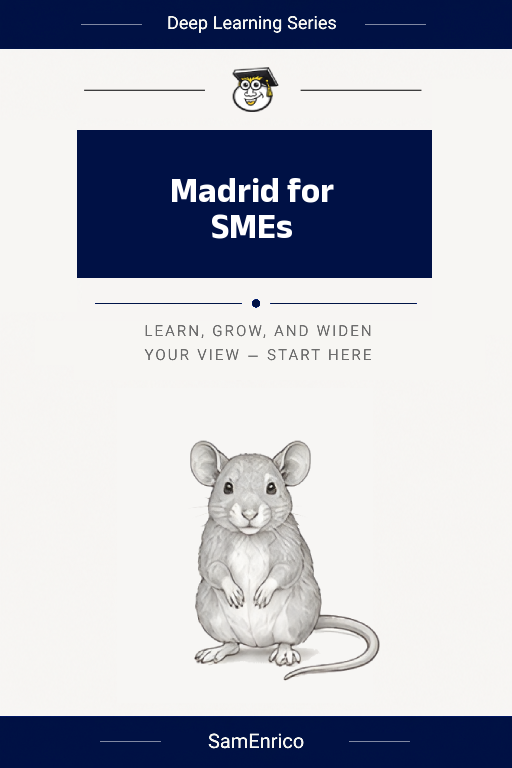
Madrid for SMEs eBook
Uses WIPO Madrid System for small and medium enter
by Dang Tanesha
Uses WIPO Madrid System for small and medium enterprises with limited budget to protect trademarks internationally.
Formats
Free sample
Chapter 1: The €45,000 Email--It was 7:43 AM on a Tuesday when Ana Chen’s phone buzzed. She was halfway through her first espresso, still in her pajamas, reviewing the previous day’s sales numbers for her natural skincare company. Her handmade tallow-and-honey balm had been a surprise hit. What started as a recipe for her daughter’s eczema had grown into a six-figure business sold on Etsy, Amazon, and a small Shopify store. She had one employee—her husband, who handled shipping—and a waiting list of 400 customers.The email was from Amazon’s Legal Department.
Subject line: “Notice of Trademark Infringement – Your listings have been suspended.”She read it once. Then again. Then a third time.A company she had never heard of—Lux Care Sp. z o.o., based in Łódź, Poland—had registered the trademark “Chen’s Balm” in the European Union two months earlier. They had filed for classes 3 (cosmetics) and 5 (pharmaceutical preparations).
They had never sold a single unit. But they had a registration number. And Amazon’s policy was simple: the registered trademark holder wins.Ana’s listings for Germany, Poland, Austria, and Spain were gone. Not temporarily suspended. Gone.
Her inventory sat in an Amazon warehouse in Frankfurt, unsellable. Her estimated loss for Q4 alone was €45,000 in revenue—money she had already budgeted for a new production line and her daughter’s private school tuition.She called a lawyer. The quote: €15,000 to fight the opposition, plus a 50% chance of winning. Or €12,000 to rebrand entirely—new packaging, new Amazon listings, new social media handles, new customer education campaign.She had neither.This book is the story of what Ana learned next. And it is the story of why you, reading this right now, cannot afford to wait another week to protect your brand.The Borderless Trap: Why Your “Local” Business Is Already Global Let us start with an uncomfortable truth.
If you have a website, you are an international business. If you sell on Amazon, Etsy, e Bay, or any marketplace that ships across borders, you are an international business. If you have an Instagram account with a “Shop Now” button, you are an international business. If you use a dropshipper that fulfills orders from a warehouse in another country, you are an international business.The old rules of trademark protection assumed that a bakery in Berlin sold only to Berliners, that a plumber in Phoenix served only Phoenix, that a fashion designer in Milan sold only to Milanese. Those rules are dead.
The digital economy has erased borders, but trademark law—which is still fundamentally national—has not caught up.Consider the following scenarios, each of which happens to an SME somewhere in the world every single day:Scenario A – The Cybersquatter: A brand owner in Texas forgets to register their trademark in China. A local company registers the exact English name, files for it in Chinese characters, and then demands $10,000 to “transfer” it back. The Texas company has no legal standing because China recognizes first-to-file, not first-to-use.Scenario B – The Amazon Hijacker: A small toy company in the UK has a hit product. A competitor in Bulgaria registers the trademark in the EU for the same goods categories. The competitor then files a complaint with Amazon.
Amazon delists the UK company. The UK company spends four months and £8,000 in legal fees to prove they used the name first—but under EU law, the registered mark holder has priority.Scenario C – The Instagram Impersonator: A beauty influencer in Australia builds a following of 200,000 people. She does not register her brand name. A company in Vietnam registers it, creates a near-identical Instagram account, and starts selling counterfeit products. Her audience is confused.
Her reputation is damaged. Her only recourse is a expensive international legal fight she cannot afford.In every single scenario, the SME could have prevented the damage with a Madrid System filing that cost less than a used car. But they did not know the system existed. Or they thought it was only for big corporations. Or they thought “later” was acceptable.The problem with “later” is that later is always too late.The Madrid System: The Best-Kept Secret in Global Business Here is the most important sentence in this book: the Madrid System is a group buying cooperative for trademarks.Think about how group buying works in other contexts.
A small restaurant cannot negotiate a lower price for beef because they buy only 50 kilograms per week. But if that restaurant joins a purchasing consortium with 500 other restaurants, suddenly they are buying 25,000 kilograms per week—and the price drops by 30%. The restaurant gets the same beef, at the same quality, but for significantly less money. The only difference is that they are buying together.The Madrid System works exactly the same way. When you file a trademark application in Germany alone, you pay German fees.
When you file in France alone, you pay French fees. When you file in China alone, you pay Chinese fees and hire a Chinese agent and translate your documents into Mandarin. By the time you have filed in five countries, you have paid five separate fees, hired up to five separate local agents, and managed five separate renewal calendars.But when you file through the Madrid System, you file one application in one language (English, French, or Spanish). You pay one set of fees in Swiss francs. You designate which of the 131 member countries you want to protect your mark.
WIPO—the World Intellectual Property Organization, a specialized agency of the United Nations—processes your application and sends it to each national office. You receive one certificate of international registration. You manage one renewal every ten years.It is group buying for trademarks. And it is available to you right now.Here is what the Madrid System does for you:One application, not fifteen One language, not fifteen translations One set of fees, not fifteen separate invoices One renewal deadline every ten years, not fifteen different deadlines One online portal (e Madrid) to manage everything Here is what the Madrid System does NOT do:It does not replace national laws (each country can still refuse your mark)It does not eliminate the need for a home registration (you must have a “basic mark” in your home country first)It does not make you immune to opposition (competitors can still challenge you in each country)But for the SME with a limited budget, the Madrid System is the only game in town. The alternative—national filings in multiple countries—will bankrupt you before you ship your first international order.The Data That Will Shock You Most SME owners assume the Madrid System is for multinational corporations with in-house legal teams.
The data says the opposite.According to WIPO’s most recent annual report, 86% of all active Madrid System users hold fewer than three international registrations. These are not corporate giants. These are small and medium enterprises with one, two, or three brands to protect. They are exactly like you.Furthermore, the median portfolio size for an SME using the Madrid System is just two designations. That means most SMEs are protecting their marks in two to five countries, not fifty.
The system is designed for small portfolios. The corporate giants with 100+ countries are the outliers, not the norm.Why does…
This is the end of the free sample. Get the eBook to keep going. Buy now
About this book
Details
- Author
- Dang Tanesha
- Publisher
- SamEnrico
- Language
- English
- Genre
- Non-Fiction, Business Brief, SME
- Released
- 2026-06-01
- Pages (approx.)
- 137
- Available as
- eBook, Audiobook

Read better in the ZLOADR app
Your eBooks on your phone or tablet. Sign in with your SamEnrico account and start reading.
More by Dang Tanesha
 Open Relationship Stress GuideDang Tanesha$11.99
 Meeting Cost Calculator GuideDang Tanesha$11.99
 Flow Success StoriesDang Tanesha$11.99
 Intuitive Eating for BingeDang Tanesha$11.99
 The Stimulus Control Eating GuideDang Tanesha$11.99
 The Labyrinth’s Last Laugh: The Minotaur’s Unfinished RevengeDang Tanesha$11.99
 Understanding Wernicke's EncephalopathyDang Tanesha$17.99
 Temagamite MiningDang Tanesha$11.99
 Ghana Intellectual Property GuideDang Tanesha$12.99
 How to Start a Blanks Made of Aluminium Business (Beginners Guide)Dang Tanesha$11.99
You may also like
 Hong Kong Handover 1997Dunn Johnnie$11.99
 Zumba For Postnatal Recovery CourseNeal Christian$11.99
 Zumba for BeginnersLadner Nikia$11.99
 YouTube Comment Mining GuideHumes Pandora$12.99
 Worry Box MeditationCarlin Rudy$11.99
 Workplace Stress MeditationNguyen Lynn$11.99
 Workplace Stress and Sleep RepairHawley Ivory$11.99
 Workplace Perfectionism CureDelaney Jeffry$11.99
 Workplace Injustice Anger GuideWallen Isabelle$11.99
 Work Addiction and Burnout LinkGreenwood Ester$11.99
 Women in Yoga and WellnessBeattie Galina$11.99
 Women in Stand Up ComedyChun Evangeline$11.99