
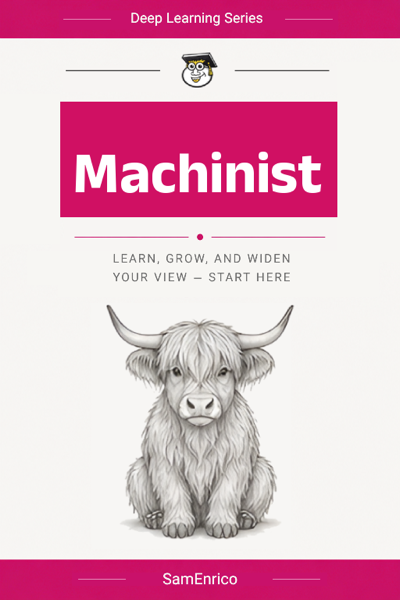
Non-FictionInformativeEducational
Machinist eBook
A Coursebook on Machinist
A Coursebook on Machinist
Formats
Free sample
Chapter 1: The Whisper of Cut Metal--The first sound you hear in a machine shop is not the roar of a spindle or the clatter of a conveyor. It is the whisper of cut metal—a high-frequency hiss that rides just beneath the noise, telling you whether the cut is alive or dying. A machinist who cannot hear that whisper is not yet a machinist. A machinist who hears it but ignores it will not remain one for long.This book is not a collection of recipes. It will not give you a single "magic speed" for cutting 4140 steel or a universal feed rate for aluminum, because those numbers change with every machine, every tool, every batch of material, and every day of the week.
What this book will give you is something far more durable: the ability to listen, to measure, to think, and to recover. It will teach you why a chip turns blue, why a surface finish ripples, why a part pulls out of a chuck, and what to do about each of these things before they become catastrophes.You are about to become a problem-solver who works in thousandths of an inch and occasionally tenths of a thousandth. You will learn to hold tolerances tighter than a human hair while standing next to a machine that could remove your finger before your nervous system registers the event. This is a serious trade, practiced by serious people, and it demands respect. Not fear—respect.
Fear leads to hesitation, and hesitation leads to crashes. Respect leads to procedure, and procedure leads to mastery.Let us begin.The Two Paths: Manual and CNCThe modern machinist walks two roads simultaneously. The first road is manual machining—the lathe, the mill, the drill press, the bandsaw. Here you turn handwheels, engage half-nuts, and feel the cutter engage the material through the palm of your hand. Manual machining is slow, deliberate, and intimate.
It teaches you the physics of chip formation because you can feel the vibration change when the rake angle is wrong. It teaches you the importance of workholding because you will personally pull a part out of a chuck if you fail to tighten it properly. It teaches you the cost of mistakes because you will be the one turning the handwheel when the cutter grabs and the part spins.The second road is CNC—Computer Numerical Control. Here you write code in a language called G-code, or you generate that code automatically through CAM software. The machine moves at speeds no human could track, with repeatability no human could match.
CNC machining is fast, automated, and impersonal. It can run unattended overnight, producing hundreds of identical parts while you sleep. But CNC machining is also unforgiving. A single incorrect character in a program—a G00 where a G01 should be, a missing decimal point, an incorrect work offset—can send a $200 end mill through a $500 vise at 400 inches per minute, destroying both in less time than it takes to blink.Here is the truth that separates successful machinists from button-pushers: you cannot master CNC without mastering manual first. Every CNC toolpath is a manual operation that has been digitized.
The G01 linear interpolation command is a straight turning pass on a lathe. The G02 circular interpolation is a radius cut on a manual mill using a rotary table. The peck drilling cycle is exactly what you would do by hand with a tailstock and a series of retractions. If you do not understand the manual operation, you will never understand why the CNC version works—or why it fails.Throughout this book, we will move back and forth between these two worlds. You will learn to cut threads on a manual lathe using a threading dial and a compound rest set at 29.5 degrees, and then you will learn to cut the same thread on a CNC using a G76 canned cycle.
The first method teaches you the geometry. The second method automates it. Neither is complete without the other.The Digital Thread: Where You Fit The phrase "digital thread" appears frequently in modern manufacturing literature, often accompanied by diagrams showing arrows between boxes labeled CAD, CAM, CNC, CMM, and ERP. Here is what those letters mean in plain English, and here is where you, the machinist, live inside that thread.CAD – Computer-Aided Design. An engineer or designer creates a 3D model of a part using software like Solid Works, Fusion 360, or CATIA.
This model is perfect. It has no tolerances, no surface finish requirements, no thermal expansion, no tool marks. It exists in a platonic universe where everything fits exactly. Your job begins when this perfect model meets the imperfect physical world.CAM – Computer-Aided Manufacturing. Someone (often a machinist, sometimes a dedicated programmer) takes the CAD model and uses CAM software to generate toolpaths.
This means telling the software: "I want to rough out this pocket with a 1/2-inch end mill, leaving 0.010 inches for a finish pass, then come back with a 1/4-inch end mill and clean up the corners." The CAM software produces G-code—a text file containing thousands of lines of machine instructions.CNC – Computer Numerical Control. The G-code is loaded into the machine control, which interprets each line and moves the axes accordingly. The machine does exactly what the code tells it to do, no more and no less. If the code says "rapid to Z0.1" but the part is at Z0.2, the machine will rapid directly through the part. The CNC has no common sense.
It has no safety instincts. It is a very fast, very strong, very stupid servant.CMM – Coordinate Measuring Machine. After the part is machined, it is measured. A CMM uses a touch probe to verify dimensions against the original CAD model. This closes the loop: design, manufacture, measure, feed data back to design.
That is the digital thread.Where do you fit? You are the interpreter between the perfect digital world and the messy physical one. You decide which tool to use, how fast to spin it, how fast to feed it, how to hold the part, how to check it, and what to do when something goes wrong. No software can replace that judgment. AI will not take your job—but a machinist who uses AI well might take the job of one who refuses to adapt.The Psychology of Safety Let us speak plainly about safety, because most safety training is useless.
It consists of lists: "Wear your safety glasses. Tie back long hair. Do not wear gloves near rotating machinery." These lists are correct but incomplete. They treat safety as a compliance activity rather than a cognitive skill.The cognitive skill of safety is called situational awareness—the continuous, active assessment of risk in your immediate environment. A machinist with good situational awareness does not simply remember to wear safety glasses; they notice that the coolant is pooling on the floor near the lathe, that the chip auger is making a different sound than usual, that the new apprentice is standing in the line of fire if the part ejects.
They see hazards before those hazards become incidents.Here is the single most important safety rule in machining, more important than…
This is the end of the free sample. Get the eBook to keep going. Buy now
About this book
Details
- Author
- Celaya Santana
- Publisher
- SamEnrico
- Language
- English
- Genre
- Non-Fiction, Informative, Educational
- Released
- 2026-06-02
- Pages (approx.)
- 148
- Available as
- eBook, Audiobook

Read better in the ZLOADR app
Your eBooks on your phone or tablet. Sign in with your SamEnrico account and start reading.
More by Celaya Santana
 Emotional Regulation For POTSCelaya Santana$11.99
 Partner Higher Libido GuideCelaya Santana$11.99
 Cialdini Six Principles GuideCelaya Santana$11.99
 Sexual Addiction Recovery for IntrovertsCelaya Santana$11.99
 Dr. Daniel Hale Williams: The Pioneer of Open-Heart SurgeryCelaya Santana$11.99
 Meeting Hierarchy ComparisonCelaya Santana$12.99
 Learn to Play the Hammered DulcimerCelaya Santana$11.99
You may also like
 Hong Kong Handover 1997Dunn Johnnie$11.99
 Zumba For Postnatal Recovery CourseNeal Christian$11.99
 Zumba for BeginnersLadner Nikia$11.99
 YouTube Comment Mining GuideHumes Pandora$12.99
 Worry Box MeditationCarlin Rudy$11.99
 Workplace Stress MeditationNguyen Lynn$11.99
 Workplace Stress and Sleep RepairHawley Ivory$11.99
 Workplace Perfectionism CureDelaney Jeffry$11.99
 Workplace Injustice Anger GuideWallen Isabelle$11.99
 Work Addiction and Burnout LinkGreenwood Ester$11.99
 Women in Yoga and WellnessBeattie Galina$11.99
 Women in Stand Up ComedyChun Evangeline$11.99