
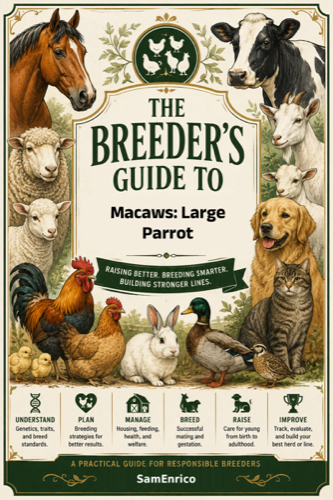
Macaws: Large Parrot eBook
This wildlife publication, published by SamEnrico,
This wildlife publication, published by SamEnrico, covers Macaws: Large Parrot
Formats
Free sample
Chapter 1: The Beak That Changed Everything--–- The first time a macaw bit me, I didn't feel it. Not immediately. What I felt was the pressure—a slow, deliberate crush that started at my knuckle and radiated up my forearm like a vice operated by a very patient, very intelligent reptile. The bird was a Blue-and-Gold named Gatsby, twenty years old, rehomed three times, and he had decided, in the half-second it took me to offer a sunflower seed, that my finger was either a threat or a very interesting new toy. When I finally extracted myself, my fingernail was purple, the skin was broken in three places, and the bird was already preening as if nothing had happened.
That was the moment I understood: a macaw is not a pet. A macaw is a force of nature with feathers, a sense of humor, and absolutely no respect for human frailty.This book exists because of that bite. Not because I wanted revenge on Gatsby—he was, after all, just being a macaw—but because I realized how catastrophically unprepared most owners are for what they are bringing into their homes. The pet store sells the cage. The breeder sells the bird.
But no one sells the truth: that you are about to live with a creature whose bite force exceeds that of a large dog, whose intelligence rivals a toddler's, and whose lifespan will likely exceed your own. This chapter, and this book, is that missing truth.The Anatomy of a Living Bolt Cutter Let us begin with the beak, because the beak is where most relationships with macaws go to die. The average large macaw—a Hyacinth, a Green-winged, a Blue-and-Gold—possesses a bite force measured in studies at approximately 500 to 700 pounds per square inch (PSI). To put that in perspective, a Rottweiler bites at around 328 PSI. A human bites at about 160 PSI.
The macaw's beak is not merely harder than your finger; it is harder than many hardwoods, capable of splintering a solid pine perch into kindling in under an hour. This is not a design flaw. This is evolution's answer to the palm nut—a seed so notoriously tough that only a handful of animals on earth can crack it open. The macaw is one of them.But the beak is more than a weapon. It is a sensory organ, a grooming tool, a third foot, and a communication device.
The upper mandible (the maxilla) articulates with the skull via a hinge that allows it to move both up and down and slightly sideways—a degree of freedom unique among birds this size. The lower mandible (the mandible) is equally specialized, with a tongue that contains bone (the hyoid apparatus) and a surface textured like fine sandpaper. When a macaw "tastes" something, it is not just using its tongue; it is using thousands of mechanoreceptors in the beak tip that transmit information about texture, temperature, and even chemical composition directly to the brain. This is why your macaw will spend ten minutes methodically testing a new toy before deciding whether to destroy it. It is not being indecisive.
It is performing a detailed materials analysis.The beak grows continuously throughout the bird's life, approximately one to three inches per year depending on species and diet. In the wild, this constant growth is checked by the bird's natural behaviors: cracking nuts, stripping bark, excavating nest cavities. In captivity, without adequate wear surfaces, the beak can overgrow into a deformity that prevents eating and requires veterinary intervention. This is why Chapter 5 will spend considerable time on perch selection and toy materials. A macaw with nothing to chew will chew its cage bars, its food bowls, and eventually its own feathers.
A macaw with appropriate outlets will keep its own beak perfectly maintained with no human assistance.One final note on the beak, and this is important: a macaw bite is almost never malicious. It is almost always a communication failure. The bird is scared, or hormonal, or protecting something valuable, or simply testing whether that fleshy pink thing is edible. The difference between a "warning bite" (pressure applied but not sustained) and a "crushing bite" (full PSI, often accompanied by a head-shaking grind) is the difference between a misunderstanding and a medical emergency. Learning to read the warning signs—pinpoint pupils, raised nape feathers, a low growl that sounds like a creaking door—will save you more pain than any training technique.
We will cover those signs in Chapter 10. For now, simply understand: the beak is not your enemy. It is a tool. But it is a tool you must respect.Zygodactyl Feet: The Original Multitool If the beak is the macaw's hammer, the feet are its hands. Macaws possess a foot configuration called zygodactyl—two toes pointing forward (digits two and three) and two toes pointing backward (digits one and four).
This is distinct from the more common anisodactyl arrangement (three forward, one back) seen in songbirds and crows. The zygodactyl foot allows the macaw to grip with incredible precision, rotating the outer rear toe (digit four) to function almost like an opposable thumb. Watch a macaw eat a nut: it holds the nut against a perch with one foot, manipulates it with the other foot, and brings the beak down like a nutcracker. That is manual dexterity on par with some primates.The foot is not just a gripping device; it is also a sensory platform. The soles of a macaw's feet are covered in tactile corpuscles similar to those found in human fingertips.
This is why macaws are so particular about perch texture and diameter. A perch that is too narrow forces the toes to overgrip, leading to arthritis. A perch that is too wide prevents the natural closure of the foot, leading to pressure sores. A perch that is perfectly sized—approximately the diameter of the bird's closed fist—allows the foot to rest in its neutral, relaxed position. Chapter 5 will provide a detailed perch diameter chart by species.The feet also serve as the bird's primary defense mechanism, second only to flight.
When threatened, a macaw will often raise one foot defensively, toes spread wide, ready to grab and hold. This is not aggression; it is the avian equivalent of a human raising their hands to ward off a blow. Unfortunately, many owners misinterpret this as a request to "step up," resulting in a painfully clamped finger. The difference between a defensive foot and an invitation foot is subtle: the defensive foot is held higher, with toes more spread, and is usually accompanied by a lean away from the hand. The invitation foot is lower, toes slightly curved, with the bird leaning forward.
Chapter 11 will cover reading these signals during training.The Truth About Those Brilliant Feathers Every macaw owner has had the experience: you walk into a room wearing a new shirt, and your bird stares at you like you have committed a crime. Then it vomits on you. Or bites you. Or screams. The reason is not madness.
It is structural color, and it changes the way macaws see the world in ways humans cannot fully comprehend.Most colors in nature come…
This is the end of the free sample. Get the eBook to keep going. Buy now
About this book
Details
- Author
- Ballard Lynne
- Publisher
- SamEnrico
- Language
- English
- Genre
- Non-Fiction, Informative, Educational
- Released
- 2026-05-11
- Pages (approx.)
- 158
- Available as
- eBook, Audiobook

Read better in the ZLOADR app
Your eBooks on your phone or tablet. Sign in with your SamEnrico account and start reading.
More by Ballard Lynne
 SMART Goals Writing WorkbookBallard Lynne$11.99
 Shopping Addiction Podcast ListBallard Lynne$11.99
 Senior Financial CheckupBallard Lynne$11.99
 Migraine Trigger GuideBallard Lynne$11.99
 Alcohol and Menopause SleepBallard Lynne$11.99
 The PPD Medication GuideBallard Lynne$11.99
 Emotional Intelligence for ChildrenBallard Lynne$11.99
 Nonverbal Cues for SalesBallard Lynne$11.99
 The Peculiar Trial of the Molesworth Cult: A Victorian Jury's DilemmaBallard Lynne$11.99
 The Blood of the Condottieri: Italy’s Mercenary Wars That Shaped EuropeBallard Lynne$11.99
 How to Produce Cricket Bat GripsBallard Lynne$11.99
 A Collector's Handbook to the Vauxhall Light Six AsyBallard Lynne$11.99