

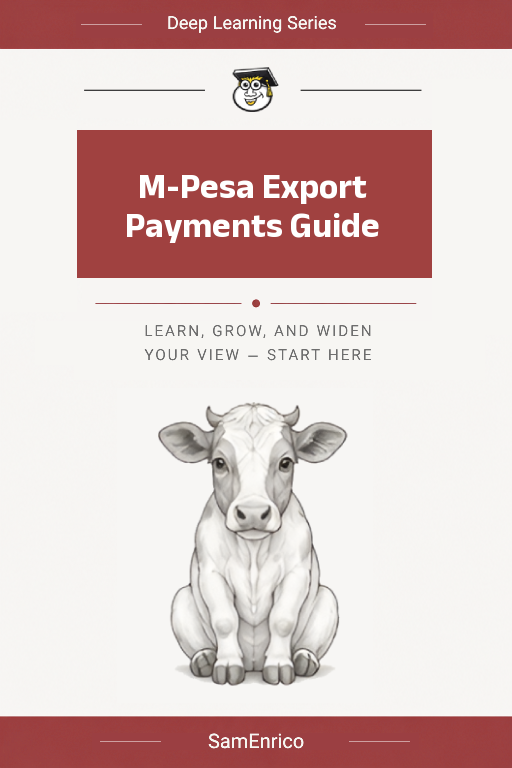
Non-FictionBusiness BriefFintech Guide
M-Pesa Export Payments Guide eBook
Receive export payments via M-Pesa from internatio
Receive export payments via M-Pesa from international buyers. Integration and conversion to local currency.
Formats
Free sample
Chapter 1: The 10-Day Bleed--–- Grace Odhiambo stared at her phone in the hot afternoon sun, watching the M-Pesa notification dance across her screen. Three thousand dollars. Finally. Her tea leaves had left Mombasa port seventeen days ago. Her buyer in London had wired the payment nine days ago.
The money had traveled through three correspondent banks, lost 47ininvisiblefees,andarrivedinher Kenyanshillingaccountexactly47 in invisible fees, and arrived in her Kenyan shilling account exactly 47ininvisiblefees,andarrivedinher Kenyanshillingaccountexactly127 lighter than she had quoted. “This is the cost of doing business,” her bank manager had told her. Grace did the math on a scrap of paper. Over the past year, she had lost nearly $4,000 to wire transfer fees, bad exchange rates, and delayed payments that forced her to borrow expensive short-term loans just to keep her packing shed open. Four thousand dollars.
That was her daughter’s entire school fees for two years. That was a new sorting machine. That was profit—vanished into a system that treated her like an inconvenience rather than a customer. Grace is not real. But her problem is.
Every day across Africa, tens of thousands of small-scale exporters, freelancers, and entrepreneurs lose money they have already earned because the traditional banking system was not designed for them. It was designed for跨国公司, for Fortune 500 companies, for businesses with finance departments and compliance officers and dedicated relationship managers. For everyone else, the system bleeds you slowly, transaction by transaction, until you accept that losing 5-10% of every international payment is simply “normal.” This book exists to prove that it is not.The Banker’s Lie Let us name the enemy clearly. The enemy is not your buyer. The enemy is not the quality of your products or your pricing or your marketing.
The enemy is the infrastructure through which money moves across borders—a system called SWIFT, the Society for Worldwide Interbank Financial Telecommunication. SWIFT was created in 1973, before email, before the internet, before mobile phones. It is a messaging system that tells banks to move money from one account to another. That is all it does. It does not move actual currency.
It sends instructions. Every time your buyer sends you $1,000, that instruction passes through an average of three intermediary banks before it reaches your account. Each bank takes a fee. Each bank applies its own exchange rate if the currency changes hands. Each bank holds the transaction for “security review” for 24 to 72 hours.
By the time the money arrives, you have lost days, dollars, and dignity.The banking industry calls this “correspondent banking.” You should call it what it is: a toll road with no fixed prices, no speed limits, and no customer service. In 2023, the World Bank reported that the average cost of sending 200acrossborderswas6.2200 across borders was 6.2% of the transaction value. For smaller amounts, the percentage is higher. For larger amounts, the absolute fees are punishing. And here is the deeper lie: banks tell you that these fees are necessary for security, for compliance, for anti-money laundering checks.
But M-Pesa, which processes over 200acrossborderswas6.2300 billion annually across Africa, manages to comply with every regulation while settling most transactions in seconds, not days. The difference is not technology. The difference is philosophy. Banks built their systems for control and exclusion. M-Pesa built its system for access and speed.
One of these serves the small exporter. The other serves the bank’s shareholders.The Mobile-First Exporter This book introduces a new category of business owner: the mobile-first exporter. A mobile-first exporter is someone who prioritizes mobile money channels over traditional banking channels for receiving international payments. This does not mean abandoning banks entirely—that would be illegal in most jurisdictions, as large sums must eventually pass through regulated financial institutions. It means recognizing that the final mile of payment delivery—the moment when foreign currency becomes local spending power—can happen faster, cheaper, and more transparently through M-Pesa than through any wire transfer.Consider the difference.
When your buyer sends a SWIFT wire, you wait. You check your bank app. You call your relationship manager. You are told to wait 48 more hours. The money is “in the system.” When your buyer sends money through a corridor that connects to M-Pesa—whether through Pay Pal, Western Union, Remitly, or a direct M-Pesa Global Pay transfer—you receive an SMS notification within hours.
Sometimes within minutes. You do not need to call anyone. You do not need to explain why the payment is legitimate. You do not need to provide additional documentation unless the amount exceeds regulatory thresholds. The money is simply there.This is not magic.
It is architecture. M-Pesa operates as a stored-value wallet, not a bank account. When money enters the M-Pesa system, it is held by Safaricom (in Kenya) or Vodacom (in Tanzania) in trust accounts at partner banks. But from your perspective as a user, the money is available immediately because the operator has already prefunded the settlement. This is the secret that banks do not want you to understand: the delay in wire transfers is not technical necessity.
It is liquidity management. Banks hold your money to earn interest on the float. M-Pesa, facing competition from other mobile money providers, chose speed as its competitive advantage. Your money is your money, available now, not when the bank has finished using it.The Promise of This Book This book will teach you exactly how to receive export payments via M-Pesa from international buyers, convert those payments to your local currency at the best possible rates, and integrate the entire system into a growing export business. By the end of these twelve chapters, you will be able to do the following:First, you will identify which payment corridors work best for your specific buyer locations.
A buyer in London requires a different setup than a buyer in Lagos or Los Angeles. You will learn the difference between Pay Pal-to-M-Pesa (fast, buyer-friendly, moderate fees), Western Union-to-M-Pesa (very fast, requires buyer to have a Western Union account), and direct M-Pesa Global Pay transfers (fastest, but requires your buyer to be within M-Pesa’s partner network). Second, you will understand exactly how much each transaction costs, down to the cent, and how to calculate your “effective received rate” before you accept a payment method. Third, you will build a compliance system that keeps your account safe from fraud and regulatory scrutiny without requiring a law degree. Fourth, you will scale from receiving sporadic payments to managing a high-volume export business where M-Pesa is your primary settlement layer.The book is organized into four parts.
Part One establishes the foundation: why M-Pesa works for trade, what financial inclusion really means, and how to assess your current banking situation honestly. Part Two covers integration: the technical setup, security protocols, and the psychological challenge of convincing international buyers to pay you through unfamiliar channels. Part Three focuses on conversion: the currency process, cost analysis, and turning mobile wallet balances into working capital. Part Four addresses compliance, ethics, and growth: how to stay on the right side of regulators, how to spot and avoid financial crime, and how to prepare for the future of mobile money.A Note on Speed: What “Instant” Really Means…
This is the end of the free sample. Get the eBook to keep going. Buy now
About this book
Details
- Author
- Meadows Lazaro
- Publisher
- SamEnrico
- Language
- English
- Genre
- Non-Fiction, Business Brief, Fintech Guide
- Released
- 2026-05-29
- Pages (approx.)
- 148
- Available as
- eBook, Audiobook

Read better in the ZLOADR app
Your eBooks on your phone or tablet. Sign in with your SamEnrico account and start reading.
More by Meadows Lazaro
 Nobel Laureates in PhotonicsMeadows Lazaro$11.99
 Gossip And Rumors Anger Management CourseMeadows Lazaro$11.99
 Utility Bill Stress FixMeadows Lazaro$11.99
 The Letting Go of Resentment WorkbookMeadows Lazaro$11.99
 Kelly Ripa Live Wire EnergyMeadows Lazaro$11.99
 The Velvet Revolution: How David Bowie and Roxy Music Redefined European Fashion (1970-1980)Meadows Lazaro$11.99
 Understanding Quebec Platelet DisorderMeadows Lazaro$17.99
 Gift Sales OutfitterMeadows Lazaro$11.99
 GitLab PLG AnalysisMeadows Lazaro$12.99
 How to Start a Percolator (electric) Business (Beginners Guide)Meadows Lazaro$11.99
You may also like
 Hong Kong Handover 1997Dunn Johnnie$11.99
 Zumba For Postnatal Recovery CourseNeal Christian$11.99
 Zumba for BeginnersLadner Nikia$11.99
 YouTube Comment Mining GuideHumes Pandora$12.99
 Worry Box MeditationCarlin Rudy$11.99
 Workplace Stress MeditationNguyen Lynn$11.99
 Workplace Stress and Sleep RepairHawley Ivory$11.99
 Workplace Perfectionism CureDelaney Jeffry$11.99
 Workplace Injustice Anger GuideWallen Isabelle$11.99
 Work Addiction and Burnout LinkGreenwood Ester$11.99
 Women in Yoga and WellnessBeattie Galina$11.99
 Women in Stand Up ComedyChun Evangeline$11.99