
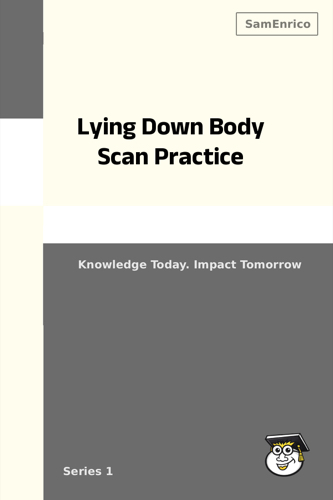
Lying Down Body Scan Practice eBook
Teaches reclined position body scanning for bedtim
by Ott Carola
Teaches reclined position body scanning for bedtime relaxation and sleep preparation.
Formats
Free sample
Chapter 1: The Reverse Grip--–- You are lying in bed right now. The lights are off. The house is quiet. And your mind is screaming.The day’s regrets are playing on a loop. Tomorrow’s to-do list is flashing like a neon sign.
You’ve tried deep breathing. You’ve tried counting sheep. You’ve tried praying, meditating, scrolling, and lying perfectly still while begging your brain to please, just this once, shut up.Nothing works.You check the clock. 11:47 PM. Then 12:23 AM.
Then 1:05 AM. Each glance is a small punch to the gut. You do the math: if you fall asleep right now, you’ll get six hours. Then five. Then four.
The arithmetic of despair.By 2:00 AM, you’re not even trying to sleep anymore. You’re trying to survive the night without losing your mind. You’re angry at your body for betraying you. You’re frustrated that something so natural—sleep—has become so impossible. And somewhere beneath the frustration is a quiet, terrible fear: What if this is just how I am now?If any of this sounds familiar, you are not broken.
You are not weak. You are not alone.More than fifty million American adults struggle with chronic sleep problems. Forty percent of adults report accidentally falling asleep during the day at least once a month. And the single most common complaint among people who can’t sleep is not pain, not noise, not even stress itself—it is the inability to stop thinking at bedtime.Your mind races. Your body tenses.
And the more you try to force sleep, the further it runs away.This chapter exists because there is a way out. It is not a pill. It is not a breathing technique. It is not another app, another gadget, or another promise to “just relax.” It is a specific, counterintuitive, scientifically proven practice that you do while lying down—a practice that works not by fighting your racing mind, but by giving it something else to do.We call it the reverse grip.Understanding the Lie-Down Paradox You have been taught that lying down is passive. It is what you do when you are tired, when you are sick, when you have given up on being productive for the day.
Lying down is surrender—or so you have been told.That assumption is wrong.Lying down in bed, specifically in the supine position (face up, spine straight, arms at your sides or slightly away from your body), is one of the most neurophysiologically active postures you can assume. When you lie flat, your body sends a cascade of signals to your brain. Your blood pressure shifts. Your heart rate settles into a different rhythm. Your diaphragm moves differently against your abdominal organs.
Even the pressure distribution across your skin changes.Your brain notices all of this. And it responds.The supine position is the body’s natural signal for safety. Think about it: when was the last time you saw an animal sleep standing up while feeling completely secure? You don’t. Vulnerability requires lying down.
And so over millions of years of evolution, your nervous system learned to interpret the horizontal position as a green light—permission to power down the threat-detection systems and switch on the repair-and-restore networks.This is the paradox: lying down is both the most vulnerable position and the most restorative one. And the difference between the two depends entirely on whether your brain feels safe enough to let go.For most people with bedtime anxiety, the brain does not feel safe. The racing thoughts, the rumination, the hypervigilance—these are not signs of weakness. They are signs that your nervous system is doing exactly what it evolved to do: scan for threats. The problem is that modern threats are not saber-toothed tigers.
They are emails, mortgages, relationship tensions, and the existential dread of an unfinished life. Your brain cannot fight these threats, and it cannot flee from them. So it lies in bed, frozen, scanning.What you need is not more effort. What you need is a different kind of attention.The Anatomy of Bedtime Performance Anxiety Before we can solve the problem, we have to name it. Clinical psychologists have a term for the specific kind of sleep difficulty that arises from trying too hard: psychophysiological insomnia.
It is a mouthful, but it breaks down simply.Psycho refers to the mind. Physiological refers to the body. Insomnia means inability to sleep.Put them together, and you get a condition where the mind and body have learned to associate the bed with frustration, alertness, and failure. Your bed stops being a place of rest and becomes a stage for performance anxiety. You lie down, and instead of relaxing, you audition for sleep.
You try to prove that you can do it. You monitor your own state: Am I relaxed yet? Am I breathing slowly enough? Is my heart rate dropping?This monitoring is the kiss of death.Here is why. Your nervous system has two main branches: the sympathetic nervous system (often called fight-or-flight) and the parasympathetic nervous system (rest-and-digest).
They are like a seesaw. When one is up, the other is down. You cannot be in a state of high alert and deep relaxation at the same time.When you lie in bed trying to fall asleep, you are activating the sympathetic system. Trying is effort. Effort is arousal.
Arousal is the opposite of sleep. Every time you think, Why am I not asleep yet? you add another log to the fire of wakefulness. Every time you check the clock, you reinforce the association between bed and frustration.This is the trap that millions of people fall into every night. And the cruelest part is that the harder you try to escape, the deeper you sink.The body scan breaks this loop not by making you try less—telling someone with insomnia to “just relax” is like telling someone with a broken leg to “just walk”—but by redirecting your attention to a different target.Introducing the Reverse Grip Imagine you are holding a bar of wet soap.
If you squeeze it tight, it shoots out of your hand. The only way to keep hold of it is to relax your grip.Sleep is exactly like that bar of soap.When you grip sleep tightly—when you monitor, check, calculate, and demand—it slips away. But when you loosen your hold, when you stop trying and start attending, sleep often arrives on its own.The body scan is that looser grip. It is not a technique for falling asleep. It is a technique for paying attention to something else.
And that something else is your body—specifically, the sensations in your body as you lie down.Here is the brilliance of the body scan: it gives your racing mind a task. But the task is not effortful. It is not competitive. It does not require you to suppress thoughts or force relaxation. The task is simply to notice.Notice the temperature of your forehead.
Notice the pressure of your skull against the pillow. Notice the tiny movements of your eyes behind closed lids. Notice…
This is the end of the free sample. Get the eBook to keep going. Buy now
About this book
Details
- Author
- Ott Carola
- Publisher
- SamEnrico
- Language
- English
- Genre
- Non-Fiction, Self-Help, Sleep
- Released
- 2026-06-10
- Pages (approx.)
- 144
- Available as
- eBook, Audiobook

Read better in the ZLOADR app
Your eBooks on your phone or tablet. Sign in with your SamEnrico account and start reading.
More by Ott Carola
 Irish Diaspora Family ReunionOtt Carola$11.99
 War Photographer Trauma GuideOtt Carola$11.99
 Pain Management Hypnosis for AthletesOtt Carola$11.99
 Attachment Wounds Self WorthOtt Carola$11.99
 Parent Friendly EmploymentOtt Carola$11.99
 Cannabis and Appetite GuideOtt Carola$11.99
 Grace and Gold: The Black Ballet Revolutionaries Who Redefined the StageOtt Carola$11.99
 Cecil Rhodes: The Empire Builder and the Boer WarsOtt Carola$11.99
 The Mineral Guide to BoraxOtt Carola$11.99
 Laffer Curve Excel SimulatorOtt Carola$12.99
 Dun Bradstreet Paydex Score GuideOtt Carola$12.99
 Growing DichelostemmaOtt Carola$11.99
You may also like
 Hong Kong Handover 1997Dunn Johnnie$11.99
 Zumba For Postnatal Recovery CourseNeal Christian$11.99
 Zumba for BeginnersLadner Nikia$11.99
 YouTube Comment Mining GuideHumes Pandora$12.99
 Worry Box MeditationCarlin Rudy$11.99
 Workplace Stress MeditationNguyen Lynn$11.99
 Workplace Stress and Sleep RepairHawley Ivory$11.99
 Workplace Perfectionism CureDelaney Jeffry$11.99
 Workplace Injustice Anger GuideWallen Isabelle$11.99
 Work Addiction and Burnout LinkGreenwood Ester$11.99
 Women in Yoga and WellnessBeattie Galina$11.99
 Women in Stand Up ComedyChun Evangeline$11.99