
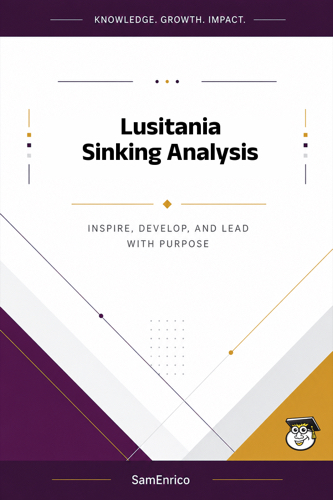
Non-FictionHistoryMaritime DisasterWWI
Lusitania Sinking Analysis eBook
Investigate the 1915 torpedoing that killed 1,200
Investigate the 1915 torpedoing that killed 1,200 and shifted public opinion.
Formats
Free sample
Chapter 1: The Greyhound’s Last Crossing...--–- The morning of May 1, 1915, dawned cold and clear over the Hudson River. At Pier 54 in New York City, a crowd of several thousand had gathered despite the early hour. They were not there for a political rally or a celebrity arrival. They were there to watch a ship depart—not just any ship, but the Lusitania, the most famous ocean liner in the world.She sat low in the water, her four towering funnels painted a distinctive Cunard red, her hull black and massive, stretching nearly 800 feet from bow to stern. At 31,550 tons, she was one of the largest moving objects ever built by human hands.
The morning light caught the brass fittings along her bridge, and steam hissed from her whistle in great white clouds that scattered the gulls circling overhead. To the crowd that pressed against the pier’s railings, she was not merely a vessel. She was a cathedral of steel, a floating palace, a declaration that the British Empire still ruled the waves despite the distant rumble of war in Europe.Among the passengers streaming up the gangplank was Alfred Gwynne Vanderbilt, one of the wealthiest men in America. At thirty-seven, he was the heir to the Vanderbilt railroad fortune, worth approximately $150 million in today’s currency. He traveled with a single valet and a small leather trunk—modest for a man who owned stables of thoroughbreds and a Fifth Avenue mansion.
That morning, he had received a telegram from a friend in London: “Heard rumors of U-boat activity. Do not sail.” Vanderbilt read it, folded it neatly, and placed it in his jacket pocket. Then he boarded anyway.He was not alone in his dismissal of danger. The Lusitania had made 201 successful crossings since her maiden voyage in 1907. She had never been seriously threatened.
Her speed—25 knots at full power—was her advertised safety. No German U-boat could catch her, or so the Cunard brochures promised. The passengers who gathered in the first-class lounge that morning, sipping champagne and comparing itineraries, called themselves the “Ostrich Club.” They buried their heads in the sand of Edwardian confidence, convinced that the world’s rules still applied even as the continent burned.They were wrong.The Ship That Could Not Sink—Or So They Believed The Lusitania was not born of commerce alone. She was born of national pride. In the early 1900s, Germany had challenged British dominance of the Atlantic with a new class of fast liners—the Kaiser class—that threatened to steal the Blue Riband, the unofficial trophy for the fastest transatlantic crossing.
Britain could not tolerate this. The Admiralty secretly funded the construction of the Lusitania and her sister ship, the Mauretania, with a tacit agreement: in wartime, these liners would be converted into armed cruisers.The arrangement was never written into a single contract, but it was understood. Cunard received a generous annual subsidy from the Crown. In exchange, the Lusitania was built to Admiralty specifications: her engine rooms were positioned to survive shell fire, her decks were reinforced to mount naval guns, and her coal bunkers were designed to feed not just her boilers but also the furnaces of a wartime vessel. She was, from her very keel, a hybrid—a civilian liner by day, a military asset by night.Her engineering was staggering.
Four steam turbines generated 68,000 horsepower, driving four screws that churned the Atlantic into foam. She could cross from New York to Liverpool in under five days. Her hull was divided into 175 watertight compartments, a feature that led newspapers to call her “practically unsinkable.” (The Titanic would later prove how hollow such claims could be.) Her first-class dining salon was modeled on the Palace of Versailles, complete with a glass dome, crystal chandeliers, and oak-paneled walls. Her second-class accommodations were superior to first-class on most other liners. Even her third-class dormitories, spartan by Edwardian standards, offered hot water and electric lights—luxuries many immigrants had never known.On May 1, 1915, as the passengers settled into their cabins, they moved through a world of breathtaking contrasts.
In first class, Vanderbilt and his fellow millionaires dined on eight-course meals prepared by French chefs. In third class, families from Italy, Russia, and Poland huddled in communal berths, clutching paper tickets and dreaming of America. Between them, a rigid social hierarchy was enforced by stewards and locked doors. The ship was a floating microcosm of the old world—its class divisions intact, its certainties unchallenged, its faith in technology absolute.None of them knew that the British Admiralty had, just days earlier, stripped the Lusitania of her usual naval escort.Captain Turner’s Dilemma Captain William Thomas Turner was a man of the old school. Born in 1856 in Liverpool, he had gone to sea at thirteen, working his way from cabin boy to master.
He was known throughout the Cunard line as a “driver”—a captain who pushed his ships to their limits, shaving hours off crossing times. He was also known for his silence. Turner rarely socialized with passengers. He ate alone in his quarters. He spoke in short, gruff sentences.
His crew respected him, but they did not love him.Turner had commanded the Lusitania since 1913, and he had crossed the Atlantic more than two hundred times. But the crossing of May 1915 was different. On April 22, he had received a confidential Admiralty notice: German U-boats were operating in the Irish Sea and the approaches to the English Channel. The notice was vague—no coordinates, no specific warnings—but it was enough to put Turner on edge.On April 25, a second notice arrived: submarines had been sighted off the Fastnet Rock, a rocky island off the southern coast of Ireland. Turner studied the charts.
He knew the Lusitania would pass within fifty miles of that rock on her approach to Liverpool. He considered altering course, swinging further north to avoid the danger zone. But that would add time to the crossing, and Cunard’s schedules were unforgiving.On April 30, the day before departure, a third notice arrived. This one was more alarming: the Admiralty had received intelligence that a U-boat was “probably” operating off the Old Head of Kinsale, a promontory on Ireland’s southern coast. Turner read the message twice.
Then he made a decision that would haunt him for the rest of his life: he would not change course. He trusted the ship’s speed. He trusted the Admiralty to protect him. He trusted that the Germans, even in war, would not dare to sink a civilian liner carrying women and children.He was wrong on all three counts.Turner did not know that Room 40, the Admiralty’s secret codebreaking unit, had already decoded German naval communications revealing U-20’s exact position. He did not know that the Juno, the closest naval escort, had been ordered back to port.
He did not know that the man responsible for that order was Admiral Henry Oliver, who acted on the advice of a man who would later become Prime Minister—Winston Churchill.The passengers waving from the decks of the Lusitania knew none of this. They saw a captain in a crisp uniform, standing on the bridge…
This is the end of the free sample. Get the eBook to keep going. Buy now
About this book
Details
- Author
- Langley Arianna
- Publisher
- SamEnrico
- Language
- English
- Genre
- Non-Fiction, History, Maritime Disaster, WWI
- Released
- 2026-06-08
- Pages (approx.)
- 113
- Available as
- eBook, Audiobook

Read better in the ZLOADR app
Your eBooks on your phone or tablet. Sign in with your SamEnrico account and start reading.
More by Langley Arianna
 The Gambling Support Group GuideLangley Arianna$11.99
 Reinventing Yourself At 70 PlusLangley Arianna$11.99
 Loving Kindness For OCDLangley Arianna$11.99
 The Listening for Therapists GuideLangley Arianna$11.99
 The Cossack Storm: Stenka Razin's Rebellion and the Birth of a LegendLangley Arianna$11.99
 How to Start a Banks (deposit Taking) Business (Beginners Guide)Langley Arianna$11.99
 Torbernite MiningLangley Arianna$11.99
 HARO Pitch Swipe FileLangley Arianna$12.99
 Manufacturing Pricing GuideLangley Arianna$12.99
 Understanding Spastic DysphoniaLangley Arianna$17.99
You may also like
 Hong Kong Handover 1997Dunn Johnnie$11.99
 Zumba For Postnatal Recovery CourseNeal Christian$11.99
 Zumba for BeginnersLadner Nikia$11.99
 YouTube Comment Mining GuideHumes Pandora$12.99
 Worry Box MeditationCarlin Rudy$11.99
 Workplace Stress MeditationNguyen Lynn$11.99
 Workplace Stress and Sleep RepairHawley Ivory$11.99
 Workplace Perfectionism CureDelaney Jeffry$11.99
 Workplace Injustice Anger GuideWallen Isabelle$11.99
 Work Addiction and Burnout LinkGreenwood Ester$11.99
 Women in Yoga and WellnessBeattie Galina$11.99
 Women in Stand Up ComedyChun Evangeline$11.99