
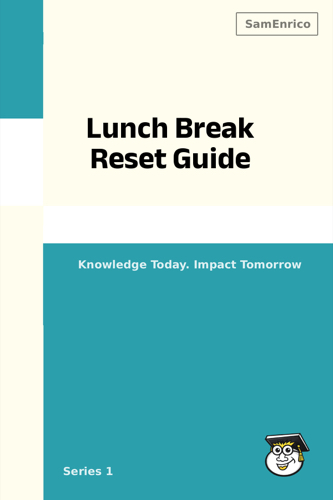
Lunch Break Reset Guide eBook
Step away from screens completely to recharge mid
by Beebe Chet
Step away from screens completely to recharge mid day.
Formats
Free sample
Chapter 1: The Dopamine Heist--–- Your phone buzzes. You swipe. You chew. You scroll. You swallow.
Another bite, another notification. By the time you look up, your food is gone, your break is over, and you feel strangely hollow—like you just ate nothing at all. That hollow feeling is not laziness. It is not a lack of discipline. It is the signature of a carefully engineered theft, and it happens to nearly two billion workers every single day.You have just been robbed.
The thief did not pick your pocket. It did not break into your home. It sat in your hand, buzzed politely, and convinced you that you were resting while systematically draining your ability to think, create, and recover. This chapter is not about willpower. It is about understanding the mechanism of the heist so that you can finally stop volunteering for it.The $10,000 Scroll Let us name the cost first, because vague discomfort does not motivate change.
Hard numbers do.A study conducted by the University of California, Irvine, found that after a single interruption—a notification, a buzz, a glance at a screen—it takes an average of twenty-three minutes and fifteen seconds to return to the original task with the same depth of focus. That is not a typo. Twenty-three minutes. Your lunch break is likely forty-five to sixty minutes long. One notification does not cost you one second.
It costs you nearly half your break, because your brain does not snap back like a rubber band. It leaks back like a sieve.Now multiply that by the number of times you check your phone during lunch. A 2023 survey by the market research firm One Poll found that the average office worker unlocks their phone fourteen times during their lunch hour. Fourteen. If each interruption costs twenty-three minutes of residual attention drag—and note that the drag overlaps, compounding rather than adding cleanly—your entire lunch break becomes a ghost town of fractured cognition.
You are not resting. You are not recovering. You are performing a low-grade, unpaid shift of attention management for the largest technology companies in human history.That is the dopamine heist. They give you a nickel of pleasure. You give them an hour of your neural real estate.
And you walk away believing you took a break.The Chemistry of the Con To understand why this happens, you must unlearn something you have been told your entire adult life. Dopamine is not a pleasure chemical. This is not a semantic quibble. It is the most important correction you will read in this entire book.For decades, pop science has described dopamine as the molecule of happiness, the reward chemical, the reason that chocolate and sex and video games feel good. That is wrong.
Dopamine is not about liking. It is about wanting. It is not the pleasure of the bite. It is the anticipation of the next bite.The neuroscientist Kent Berridge at the University of Michigan demonstrated this definitively in a series of experiments with rats. When he blocked dopamine in the rats' brains, they still experienced pleasure—they still smacked their lips when given sugar—but they would no longer exert effort to get it.
They liked the sugar. They just did not want it anymore. Dopamine is the fuel of pursuit, not the taste of satisfaction.This is the engine of the lunchtime scroll. When you see a notification badge, when you hear a buzz, when you pull down to refresh and see new content loading, your brain releases a spike of dopamine. Not because the content will be satisfying.
Because the possibility of satisfaction is neurologically intoxicating. The uncertainty is the drug.Social media platforms, news feeds, and even email inboxes are built on what behavioral psychologists call variable reward schedules. A variable reward schedule means you do not know when the next reward will come, or how big it will be, or whether it will arrive at all. That unpredictability amplifies dopamine release far more than a predictable reward. A slot machine pays out on a variable schedule.
So does your Instagram feed. So does your Slack channel. So does your work email.During your lunch break, you sit down with food in one hand and a phone in the other. You take a bite. You scroll.
You see something mildly interesting. Dopamine spikes. You scroll again. Nothing interesting. Dopamine drops.
Then a notification appears. Dopamine spikes again. Your brain is not resting. It is gambling. It is standing at a row of slot machines labeled Twitter, Tik Tok, Teams, and Gmail, pulling each lever in turn, hoping for a payout that never quite arrives.The tragedy is that you believe this is relaxing.
Your brain confuses the absence of work with the presence of rest. But rest is not merely the absence of labor. Rest is a specific physiological state: the activation of the parasympathetic nervous system, sometimes called "rest and digest." That state requires a quiet brain, slow breathing, and the absence of anticipation. Scrolling is the opposite of rest. It is sympathetic nervous system activation—low-grade fight-or-flight, dressed in the costume of leisure.Why "Just One Look" Always Fails You have told yourself the lie a thousand times.
I will just check one thing. I will just reply to this message. I will just see who liked my post. Then I will put the phone down and eat in peace.The lie is not a moral failing. It is a predictable consequence of how your brain processes unfinished tasks.
The Zeigarnik effect, named after the Russian psychologist Bluma Zeigarnik, describes a simple and powerful phenomenon: the human brain remembers unfinished tasks far better than completed ones. An open loop occupies mental real estate. A closed loop releases it.When you glance at a notification during lunch—even if you do not open it, even if you just see the sender's name—you open a loop. Your brain now holds that message in working memory, simmering just below conscious awareness. You cannot close the loop without reading, responding, or deliberately dismissing it.
But you will not dismiss it, because the variable reward schedule has already hooked you. So the loop stays open. And while it stays open, you are not resting. You are waiting.This is why a "short scroll" always turns into twenty minutes. The first glance opens a dozen loops.
Each loop demands attention. The only way to close them is to scroll further, check more, refresh again. The architecture of your attention has been hijacked by a design pattern that benefits the platform, not you.The technology designer Tristan Harris, formerly of Google, calls this the "bottomless bowl" problem. In experiments, people eat more soup from a bowl that refills invisibly than from a normal bowl, because they cannot see the stopping point. Your phone is a bottomless bowl of attention.
You scroll, more content loads, you scroll again. There is no natural end. The only way to stop is to choose to stop. But the choice becomes harder with each dopamine spike, because dopamine does not just create wanting. It creates the memory of wanting.
Your brain learns that scrolling leads to variable rewards. That learning becomes automatic. Unconscious. By the time you look up…
This is the end of the free sample. Get the eBook to keep going. Buy now
About this book
Details
- Author
- Beebe Chet
- Publisher
- SamEnrico
- Language
- English
- Genre
- Non-Fiction, Self-Help, Breaks
- Released
- 2026-06-10
- Pages (approx.)
- 138
- Available as
- eBook, Audiobook

Read better in the ZLOADR app
Your eBooks on your phone or tablet. Sign in with your SamEnrico account and start reading.
More by Beebe Chet
 Collaboration Tools GuideBeebe Chet$11.99
 Conversation Starters for FuneralsBeebe Chet$11.99
 Anger at Childs LyingBeebe Chet$11.99
 Immigrant Child Museum TripsBeebe Chet$11.99
 UAE Post Interview Follow UpBeebe Chet$11.99
 Dream Species JournalBeebe Chet$11.99
 Prototyping for Problem SolversBeebe Chet$11.99
 Cartier's Crown Jewels: The Rise of a Luxury Empire (1900-1950)Beebe Chet$11.99
 The Dark Web Syndicate: Australia's Cyber Crime UnderworldBeebe Chet$11.99
 How to Produce Oil MediumBeebe Chet$11.99
 A Collector's Handbook to the Standard Flying TenBeebe Chet$11.99
 Invoice Currency Choice GuideBeebe Chet$12.99
You may also like
 Hong Kong Handover 1997Dunn Johnnie$11.99
 Zumba For Postnatal Recovery CourseNeal Christian$11.99
 Zumba for BeginnersLadner Nikia$11.99
 YouTube Comment Mining GuideHumes Pandora$12.99
 Worry Box MeditationCarlin Rudy$11.99
 Workplace Stress MeditationNguyen Lynn$11.99
 Workplace Stress and Sleep RepairHawley Ivory$11.99
 Workplace Perfectionism CureDelaney Jeffry$11.99
 Workplace Injustice Anger GuideWallen Isabelle$11.99
 Work Addiction and Burnout LinkGreenwood Ester$11.99
 Women in Yoga and WellnessBeattie Galina$11.99
 Women in Stand Up ComedyChun Evangeline$11.99