

Non-FictionStudent's ShortcutTech
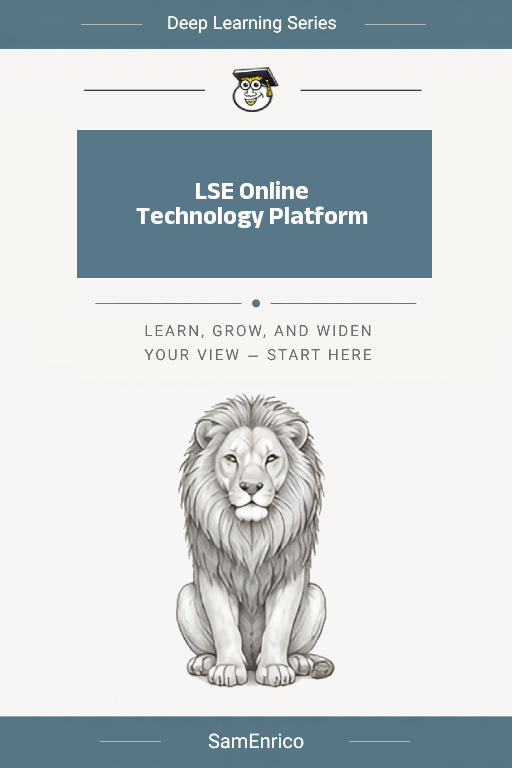
LSE Online Technology Platform eBook
Courses via Coursera or LSE proprietary platform w
Courses via Coursera or LSE proprietary platform with virtual classrooms and discussion forums.
Formats
Free sample
Chapter 1: The Digital Mirror--–- In the autumn of 2020, as pandemic lockdowns shuttered universities across the globe, a curious thing happened at the London School of Economics and Political Science. Faculty who had spent decades mastering the art of the lecture hall suddenly found themselves staring into laptop cameras, speaking to grids of silent faces. Meanwhile, in a modest office overlooking Houghton Street, a small team of learning technologists watched a different phenomenon unfold. Student engagement data was not following the expected patterns. Some courses were thriving online—discussion forums buzzing, attendance rates climbing, assessment scores holding steady.
Others were collapsing. The difference was not, as many assumed, a matter of technological sophistication or faculty age. It was something far more fundamental. It was the invisible architecture of pedagogy translated into pixels.This book is about that architecture. It is not a technical manual, though you will find detailed platform guidance within these pages.
It is not a philosophical treatise, though it rests on a specific philosophy of education. It is, instead, a practical blueprint for building online learning environments that do not merely transmit information but transform understanding. And it is built around a single institution's distinctive approach—one that has been refined over more than a century of face-to-face teaching and nearly two decades of digital experimentation.The argument of this chapter, and indeed of this entire book, is deceptively simple yet radically subversive to much contemporary Ed Tech thinking: technology is neutral, but pedagogy is not. The same platform that enables deep inquiry can just as easily enable passive consumption. The same discussion forum that builds community can become a graveyard of mandatory posts.
The difference is not in the software but in the design choices that precede any technological implementation. This chapter establishes the foundational framework that governs every subsequent chapter—a framework that resolves the apparent contradictions in online learning advice and provides a coherent philosophy for the LSE Digital Campus.The Neutrality Trap: Why Tools Alone Never Transform Teaching The history of educational technology is littered with failed revolutions. In the 1920s, Thomas Edison predicted that motion pictures would "transform education" and make books obsolete. In the 1960s, television was supposed to do the same. In the 1990s, the internet was going to democratize knowledge so thoroughly that universities would become irrelevant.
Each prediction proved wrong not because the technology lacked potential but because the pedagogy remained unchanged. A filmed lecture is still a lecture. A televised classroom is still a classroom. A discussion forum with vague prompts and no moderation is still a wasteland.This pattern persists today in the rush to adopt artificial intelligence, virtual reality, and adaptive learning platforms. Institutions spend millions on software licenses while devoting scant resources to the pedagogical redesign that alone can unlock that software's potential.
The result is what learning scientists call "techno-pedagogical mismatch"—using new tools to replicate old, often ineffective, teaching methods. The LSE Digital Campus rejects this approach. It begins not with the question "What technology should we buy?" but with the question "What kind of thinking do we want to cultivate?"That question leads directly to LSE's founding ethos. The school's motto, Rerum Cognoscere Causas—to understand the causes of things—is not merely a decorative Latin phrase. It is a pedagogical commitment.
It means that LSE courses, whether taught in a lecture hall on Aldwych or through a screen in Singapore, are designed to produce students who do not simply memorize facts but interrogate assumptions, trace causal chains, and construct evidence-based arguments. This commitment has profound implications for online platform design, as we shall see throughout this chapter and book.The Four Roles of the Digital Instructor Before we can design effective online learning environments, we must first understand what effective online teaching actually looks like. The most significant shift from physical to digital classrooms is not technical but relational. In a lecture hall, the instructor's primary role is presenter—standing at the front, controlling the flow of information, reading the room's nonverbal cues. In a digital environment, that role fragments into multiple distinct functions.
Based on LSE's fifteen years of online program delivery, we have identified four essential roles that every digital instructor must inhabit, sometimes shifting between them multiple times within a single learning module.Role One: Designer. This is the most important and most invisible role. Before any student logs in, before any live session begins, the instructor acts as an architect of learning experiences. The Designer structures asynchronous materials—recorded lectures, readings, quizzes, discussion prompts—into what we call "inquiry arcs" rather than information dumps. Each arc begins with a provocative question, provides frameworks for analysis, offers opportunities for application, and concludes with reflection.
The Designer also anticipates points of confusion, embedding formative assessments and alternative explanations at precisely those moments. This role requires approximately 60 percent of the instructor's total preparation time but is rarely visible to students, who experience its effects as "this course just makes sense."Role Two: Orchestrator. During live synchronous sessions, the instructor shifts from designer to Orchestrator. This role involves managing the flow of interaction, facilitating breakout room discussions, synthesizing small-group findings, and ensuring that the session achieves its learning objectives within the allotted time. The Orchestrator does not lecture.
Instead, they pose questions, clarify confusion, redirect off-topic conversations, and create conditions for peer-to-peer learning. This role requires quick decision-making, comfort with ambiguity, and the ability to read digital cues—chat messages, raised hands, facial expressions in gallery view, attendance patterns in breakout rooms.Role Three: Synthesizer. Between live sessions, the instructor acts as Synthesizer of asynchronous discussions. This role involves reading discussion forum posts, identifying emerging themes, highlighting exemplary contributions, and posting weekly summaries that elevate the conversation. Crucially, the Synthesizer does not respond to every post.
Day-to-day responding creates dependency, overwhelms instructors, and actually reduces student ownership of discussions. Instead, the Synthesizer posts once or twice per week, synthesizing patterns and posing meta-questions that push thinking further. This role requires discipline—the discipline to read without responding, to trust students to engage each other, and to distinguish between genuine confusion that requires instructor intervention and productive struggle that does not.Role Four: Translator. Finally, the instructor acts as Translator between pedagogical goals and technical specifications. This role involves knowing which platform features support which learning activities, configuring those features correctly, and troubleshooting when things go wrong.
The Translator works closely with learning technologists (see Chapter 11) but does not abdicate technical decisions to them. A common failure mode in online education is faculty who say "I'm not technical" and outsource all platform decisions, only to find that the resulting environment does not support their teaching philosophy. The Translator takes ownership of the relationship between pedagogy and technology.These four roles—Designer, Orchestrator, Synthesizer, Translator—form the instructor-facing side of the LSE Digital Learning Framework. They recur throughout this book, and we will explore each in depth in subsequent chapters. For now, the key insight is that effective online teaching is not a single skill but a portfolio of distinct competencies, each requiring deliberate development.The Two Faces of Assessment: Orienting and Retrieval One of the most persistent confusions in online learning design concerns the…
This is the end of the free sample. Get the eBook to keep going. Buy now
About this book
Details
- Author
- Luttrell Lamont
- Publisher
- SamEnrico
- Language
- English
- Genre
- Non-Fiction, Student's Shortcut, Tech
- Released
- 2026-06-01
- Pages (approx.)
- 151
- Available as
- eBook, Audiobook

Read better in the ZLOADR app
Your eBooks on your phone or tablet. Sign in with your SamEnrico account and start reading.
More by Luttrell Lamont
 Stonewalling Breakthrough GuideLuttrell Lamont$11.99
 Anger And Public TantrumsLuttrell Lamont$11.99
 Emotion Books GuideLuttrell Lamont$11.99
 ABCDE For Medical ResidentsLuttrell Lamont$11.99
 Tension Headache and Screen Time LimitsLuttrell Lamont$11.99
 The Assertiveness Card Deck GuideLuttrell Lamont$11.99
 Awadh Rebellion ProvinceLuttrell Lamont$11.99
 Status Quo Bias ChangeLuttrell Lamont$11.99
 Vinod Khosla SunLuttrell Lamont$11.99
 The Van Gogh Code: Decoding the Hidden Secrets of His MasterpiecesLuttrell Lamont$11.99
 Anansi the Trickster Weaves the WorldLuttrell Lamont$11.99
 The Mozart Conspiracy: A Symphony of DeceptionLuttrell Lamont$11.99
You may also like
 Hong Kong Handover 1997Dunn Johnnie$11.99
 Zumba For Postnatal Recovery CourseNeal Christian$11.99
 Zumba for BeginnersLadner Nikia$11.99
 YouTube Comment Mining GuideHumes Pandora$12.99
 Worry Box MeditationCarlin Rudy$11.99
 Workplace Stress MeditationNguyen Lynn$11.99
 Workplace Stress and Sleep RepairHawley Ivory$11.99
 Workplace Perfectionism CureDelaney Jeffry$11.99
 Workplace Injustice Anger GuideWallen Isabelle$11.99
 Work Addiction and Burnout LinkGreenwood Ester$11.99
 Women in Yoga and WellnessBeattie Galina$11.99
 Women in Stand Up ComedyChun Evangeline$11.99