
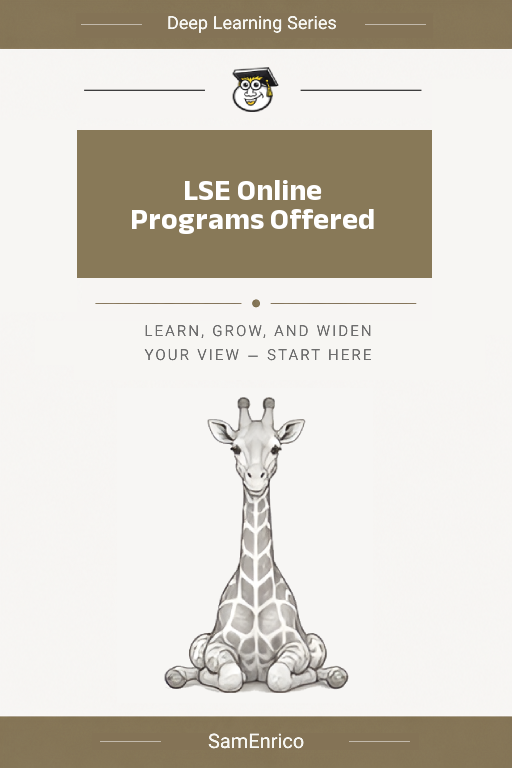
Non-FictionStudent's ShortcutPrograms
LSE Online Programs Offered eBook
Degrees: Executive MSc in Finance, Health Economic
by Word Zenia
Degrees: Executive MSc in Finance, Health Economics, Behavioural Science, and International Relations.
Formats
Free sample
Chapter 1: The Versatilist's Dilemma--–- The email arrived at 11:47 on a Tuesday night. Sarah had been staring at her spreadsheet for four hours, trying to reconcile why her hedge fund’s short position on Russian energy assets had lost seventeen million dollars in three days. Her model was flawless. Her risk metrics were pristine. Her team had won awards for their quantitative rigor.
And yet, somewhere between the oil fields of Siberia and the swap desks of London, seventeen million dollars had evaporated.She closed the laptop and looked at the photograph on her desk: her grandfather, a commodities trader in the 1970s, standing in front of a shipping container in Rotterdam. He had no MBA, no Bloomberg terminal, no Ph D in financial engineering. What he had was a map, a telephone, and a terrifyingly accurate instinct for when a port strike in one country would trigger a price spike in another. Her grandfather would have seen the Russian crisis coming. She had missed it entirely.The problem was not her intelligence, her work ethic, or her technical skills.
The problem was that she had been trained to think like a specialist in a world that no longer rewards specialists. She understood derivatives, volatility smiles, and stochastic calculus. She did not understand that a pipeline dispute in Kazakhstan would shift the loyalty of a critical swing state in Eastern Europe, which would trigger an insurance re-pricing that would cascade into her carefully hedged positions.This book is for Sarah. And for every executive, policymaker, and professional who has discovered that deep expertise in one domain is no longer enough.This is the Versatilist's Dilemma: you must be deep enough to be credible, broad enough to be useful, and wise enough to know which lens to apply when. The LSE Online Programs in Finance, Health Economics, Behavioural Science, and International Relations were designed to solve this dilemma.
This chapter explains why.The Myth of the Pure Specialist For most of the twentieth century, specialization was the path to success. Adam Smith’s pin factory demonstrated that dividing labor into tiny, repeatable tasks produced massive efficiency gains. Frederick Taylor’s scientific management promised that the best CEO was the one who reduced every problem to its component parts and assigned each part to an expert. Business schools built entire curricula around functional silos: marketing, finance, operations, strategy. You picked one lane and stayed in it for forty years.That world is dead.
It died somewhere between the collapse of Lehman Brothers (which no single regulator saw coming because every regulator was looking at their own slice of the elephant) and the COVID-19 pandemic (which no epidemiologist predicted because the critical variable turned out to be supply chain resilience, not viral reproduction rates). The problems that define our era are not disciplinary problems. They are wicked problems: climate change, geopolitical instability, health system collapse, technological disruption. Wicked problems have no single cause, no single owner, and no single solution.Consider the following events from the past decade. Each one looks like a problem in one discipline but was actually a failure across four:The 2008 financial crisis looked like a failure of financial engineering (bad mortgage models).
In fact, it was a failure of behavioral economics (herding and overconfidence), health economics (the human cost of foreclosures on community health), and international relations (regulatory arbitrage across sovereign boundaries).The Brexit vote looked like a failure of political science (populist mobilization). In fact, it was a failure of behavioral economics (identity salience overriding economic self-interest), health economics (the NHS funding lie as a voting trigger), and finance (the pound’s crash revealed hidden currency exposures).The COVID-19 pandemic looked like a failure of public health (slow lockdowns). In fact, it was a failure of international relations (WHO politics delayed information sharing), finance (just-in-time supply chains prioritized efficiency over resilience), and behavioral science (mask refusal as identity signaling).The specialist sees each of these as a problem in their own field. The Versatilist sees them as problems at the intersections. And the Versatilist is the one who gets hired, promoted, and trusted when the next crisis arrives.Introducing the Versatilist: A Precise Definition Before we go further, we need a precise definition.
The business world has used the term "generalist" for decades, usually as an insult meaning "knows a little about everything, masters nothing." It has used "specialist" as praise, meaning "knows everything about one thing, useless outside that room."The Versatilist is neither. We define the Versatilist as a professional with:Deep mastery (approximately 80 percent proficiency) in one primary domain. This is the domain where you can teach others, spot errors instantly, and operate without conscious effort. For Sarah, this was finance. For you, it might be health economics, behavioral science, or international relations.Functional fluency (approximately 40 percent proficiency) in three adjacent domains.
This means you can read a balance sheet even if you cannot build one. You can critique a behavioral intervention even if you cannot design one from scratch. You know what questions to ask, what experts to consult, and what red flags to spot.Meta-cognitive fluency in systems thinking. You understand feedback loops, delayed consequences, and non-linear causality. You do not ask "what is the cause?" You ask "what are the interacting causes, and which leverage point gives me the most power for the least effort?"The numbers are not arbitrary.
Research on expertise suggests that 80 percent proficiency requires approximately five to seven years of deliberate practice. That is the depth of a master’s degree plus several years of work experience. Forty percent proficiency requires approximately six months of focused study in a new domain. That is exactly what a single module in an LSE Online Program delivers.The Versatilist is not a superhuman who knows everything. The Versatilist is a professional who knows their limits, knows what they do not know, and knows whom to call when those limits are reached.
Humility is not the enemy of expertise; it is the foundation of it.Why Siloed Expertise Fails: Evidence from the Best Sellers The best-selling business and social science literature of the past decade has been, in retrospect, a long argument against siloed thinking. Let us examine three of the most influential books that inform this chapter and the entire LSE curriculum.The World for Sale by Javier Blas and Jack Farchy tells the story of the global commodity trading industry. These are the firms that buy and sell oil, grain, metals, and minerals. They are among the most profitable businesses on earth, yet they employ almost no Ph D economists. Instead, they employ people who understand that a strike at a port in Buenos Aires affects the price of soybeans in Shanghai within seventy-two hours.
They know that a coup in Niger matters more for your uranium exposure than any financial derivative. The book’s central lesson: finance without geography is gambling.Prisoners of Geography by Tim Marshall makes the same argument from the opposite direction. Marshall shows that every conflict, every trade route, and every alliance in human history is constrained by mountains, rivers, deserts, and coastlines. Russia invades through the North European Plain because it cannot invade through the…
This is the end of the free sample. Get the eBook to keep going. Buy now
About this book
Details
- Author
- Word Zenia
- Publisher
- SamEnrico
- Language
- English
- Genre
- Non-Fiction, Student's Shortcut, Programs
- Released
- 2026-06-01
- Pages (approx.)
- 146
- Available as
- eBook, Audiobook

Read better in the ZLOADR app
Your eBooks on your phone or tablet. Sign in with your SamEnrico account and start reading.
More by Word Zenia
 The No Drama Discipline AngerWord Zenia$11.99
 Nana Sahib Peshwa GuideWord Zenia$11.99
 The Assertive Email Writing GuideWord Zenia$11.99
 Hesperidin Circulation GuideWord Zenia$11.99
 Migraine and Gut Health ConnectionWord Zenia$11.99
 Eisenhower For Marketers GuideWord Zenia$11.99
 Weight Stigma Resilience GuideWord Zenia$11.99
 Emotion Labeling MythsWord Zenia$11.99
 Deference and Submission CuesWord Zenia$11.99
 The Titan’s Last Stand: Cronus and the Fall of the CyclopesWord Zenia$11.99
 The App That Broke the Internet: The Rise and Fall of ClubhouseWord Zenia$11.99
 The Curse of the Rakshasa’s ShadowWord Zenia$11.99
You may also like
 Hong Kong Handover 1997Dunn Johnnie$11.99
 Zumba For Postnatal Recovery CourseNeal Christian$11.99
 Zumba for BeginnersLadner Nikia$11.99
 YouTube Comment Mining GuideHumes Pandora$12.99
 Worry Box MeditationCarlin Rudy$11.99
 Workplace Stress MeditationNguyen Lynn$11.99
 Workplace Stress and Sleep RepairHawley Ivory$11.99
 Workplace Perfectionism CureDelaney Jeffry$11.99
 Workplace Injustice Anger GuideWallen Isabelle$11.99
 Work Addiction and Burnout LinkGreenwood Ester$11.99
 Women in Yoga and WellnessBeattie Galina$11.99
 Women in Stand Up ComedyChun Evangeline$11.99