
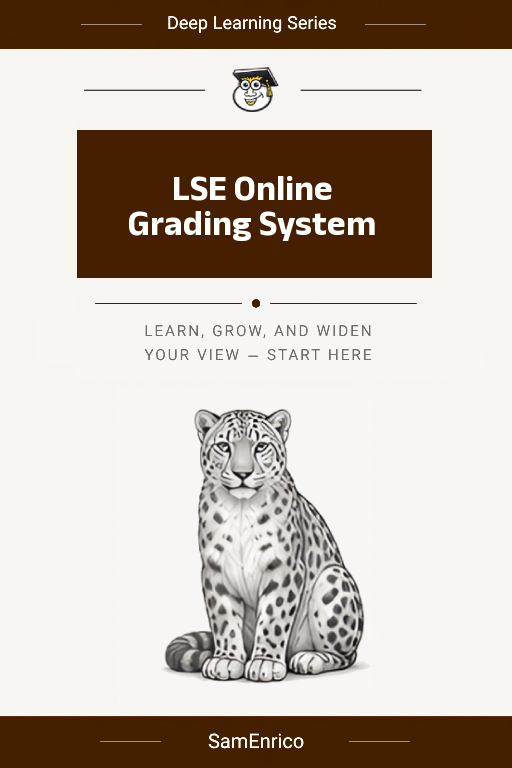
Non-FictionStudent's ShortcutGrading
LSE Online Grading System eBook
Distinction, Merit, Pass grading for UK system; as
Distinction, Merit, Pass grading for UK system; assessments include exams, essays, and projects.
Formats
Free sample
Chapter 1: The Grading Trap--–- Every October, hundreds of highly intelligent, dedicated academics sit down at their desks with a stack of student essays, a fresh cup of coffee, and the sincere intention to provide meaningful, constructive feedback. Twenty hours later, most of them have lost their will to live, and their students have learned exactly one thing: the grade at the bottom of the last page. This is the Grading Trap.The Grading Trap is not a failure of effort or expertise. It is a failure of system design. Traditional marking, whether on paper or clumsily transferred to a digital platform, rewards the wrong behaviours.
It incentivises quantity over quality, justification over development, and closure over growth. Markers write paragraphs of commentary that students never read. Students receive a number and move on, often furious or demoralised, rarely wiser. Everyone loses, and the cycle repeats next term.This chapter exists because the London School of Economics and Political Science, like every other serious higher education institution in the United Kingdom, has spent years wrestling with this trap. The solution, as this book will argue across twelve chapters, is not a single piece of software or a new marking scale.
The solution is a complete rethinking of what grading is for, how it is delivered, and who it serves. At the heart of that rethinking is a concept that LSE has quietly championed for nearly a decade: Feed-Forward.Feed-Forward is the opposite of feedback. Feedback looks backward. It explains why a past piece of work received a particular grade. Feed-Forward looks forward.
It tells a student, in specific and actionable terms, what to do differently on the next assignment. A simple grading comment says, "Your argument in paragraph three lacked evidence." A Feed-Forward comment says, "For your next essay, find two empirical studies that support your claim before you write paragraph three. Attach those studies as an appendix." The first comment closes a door. The second opens one.This chapter will establish the philosophical and pedagogical foundations for everything that follows. It will explain why digital tools, used correctly, can break the Grading Trap rather than reinforce it.
It will introduce the key distinctions that run throughout this book: formative versus summative assessment, pedagogy versus technology, and consistency versus standardisation. And it will give you, the reader, a practical framework for diagnosing whether your current grading practices are trapping you or freeing you.By the end of this chapter, you will understand why most academic feedback is ignored, what the Feed-Forward mechanism actually requires in practice, and how LSE's approach to digital grading aligns with (and in some respects exceeds) UK higher education expectations. You will also have completed a short diagnostic exercise that will tell you, in less than ten minutes, whether your current grading system is working or whether you are already in the trap.The Grading Trap in Practice Let us begin with a concrete example. Dr. Sarah Chen is a lecturer in international relations at a UK university.
She has thirty students in her master's module on global governance. Each student submits a 4,000-word policy brief. Dr. Chen spends approximately twenty minutes per paper: reading, annotating, writing a summary comment, and assigning a grade. That is ten hours of marking.
She is conscientious, so she also writes a separate paragraph of feedback for each student explaining what they could improve.She returns the papers online. Within forty-eight hours, she receives six emails. Four of them ask, "Why did I only get a Merit?" Two of them ask, "What do I need to do to get a Distinction on the next assignment?" The other twenty-four students say nothing. When Dr. Chen checks the analytics on her virtual learning environment (VLE), she sees that only three students have opened her feedback comments.
The rest have looked only at the grade.This is not Dr. Chen's fault. She is a victim of the Grading Trap. The trap has three jaws that snap shut on even the most well-intentioned markers.The first jaw is grade obsession. Students have been conditioned by a lifetime of educational systems that treat the grade as the final and most important output.
In undergraduate study, and especially in postgraduate taught programmes where students are paying high fees, the grade is a currency. It determines whether they pass, whether they qualify for funding, and whether they can progress to doctoral study. In this context, reading feedback feels like a luxury. The grade feels like survival.The second jaw is feedback overload. When a student receives a 4,000-word essay back with three hundred words of comments, the cognitive load is immense.
They must parse what the marker is saying, interpret the tone, map the comments to specific sections of their own writing, and then decide what to do differently. Most students lack the metacognitive skills to do this efficiently. So they do what any overwhelmed person does: they look at the bottom line and move on.The third jaw is the temporal gap. Formative feedback, which is supposed to help students improve before the next summative assessment, often arrives too late. If a student submits an essay in week five and receives feedback in week eight, but the final exam is in week ten, they have two weeks to absorb, understand, and act on the feedback.
That is not enough time for meaningful improvement. The feedback becomes archival rather than developmental.These three jaws are not natural laws. They are design flaws. And they can be redesigned.LSE's response to the Grading Trap has been systematic rather than cosmetic. The School did not simply buy new software or shorten feedback deadlines.
It re-examined the entire assessment chain: from learning outcomes to assignment design to marking criteria to feedback delivery to student action. The result is a digital grading ecosystem that prioritises Feed-Forward at every stage.But before we can understand that ecosystem, we must understand the distinction that underpins all of it.Formative versus Summative: A Necessary Distinction In UK higher education, assessment is conventionally divided into two categories: formative and summative. Formative assessment is low-stakes or no-stakes. It is designed to give students practice and to provide developmental feedback. Summative assessment is high-stakes.
It contributes to the final degree classification. A mid-term quiz that does not count toward the final grade is formative. A final exam that determines whether a student receives Distinction, Merit, Pass, or Fail is summative.This distinction seems straightforward, but in practice it breaks down constantly. Many modules use "formative" assignments that are marked and returned with feedback but have no grade attached. Students, having learned that ungraded work does not matter, often submit these assignments at the last minute or not at all.
Markers, knowing that the work is not summative, invest less time in feedback. The formative assignment becomes a bureaucratic exercise rather than a learning opportunity.LSE has largely abandoned this model. Instead, the School treats formative assessment as practice with consequences. Not grade consequences, but consequences nonetheless. A student who does not submit a formative essay may be required to attend an extra tutorial.
A student who submits a weak formative essay receives a structured Feed-Forward plan that they must sign and return. The…
This is the end of the free sample. Get the eBook to keep going. Buy now
About this book
Details
- Author
- Thomson Margit
- Publisher
- SamEnrico
- Language
- English
- Genre
- Non-Fiction, Student's Shortcut, Grading
- Released
- 2026-05-30
- Pages (approx.)
- 153
- Available as
- eBook, Audiobook

Read better in the ZLOADR app
Your eBooks on your phone or tablet. Sign in with your SamEnrico account and start reading.
More by Thomson Margit
 Kunwar Singh LeadershipThomson Margit$11.99
 The Assertiveness for New ManagersThomson Margit$11.99
 Arthur Rock FairchildThomson Margit$11.99
 Persuasive Sustainability PlanThomson Margit$11.99
 Diosmin Hemorrhoid GuideThomson Margit$11.99
 The Playful Parent Anger AntidoteThomson Margit$11.99
 Rhodesia Unilateral DeclarationThomson Margit$11.99
 Emotion Success StoriesThomson Margit$11.99
 Intuitive Eating Body TrustThomson Margit$11.99
 Wings Over the Arctic: The Arctic Tern's Epic 44,000-Mile JourneyThomson Margit$11.99
 The Timbuktu Tandem: A Love Story Written in NumbersThomson Margit$11.99
 The Colossal Builders: Olmec Engineering and the Birth of Mesoamerican MarvelsThomson Margit$11.99
You may also like
 Hong Kong Handover 1997Dunn Johnnie$11.99
 Zumba For Postnatal Recovery CourseNeal Christian$11.99
 Zumba for BeginnersLadner Nikia$11.99
 YouTube Comment Mining GuideHumes Pandora$12.99
 Worry Box MeditationCarlin Rudy$11.99
 Workplace Stress MeditationNguyen Lynn$11.99
 Workplace Stress and Sleep RepairHawley Ivory$11.99
 Workplace Perfectionism CureDelaney Jeffry$11.99
 Workplace Injustice Anger GuideWallen Isabelle$11.99
 Work Addiction and Burnout LinkGreenwood Ester$11.99
 Women in Yoga and WellnessBeattie Galina$11.99
 Women in Stand Up ComedyChun Evangeline$11.99