
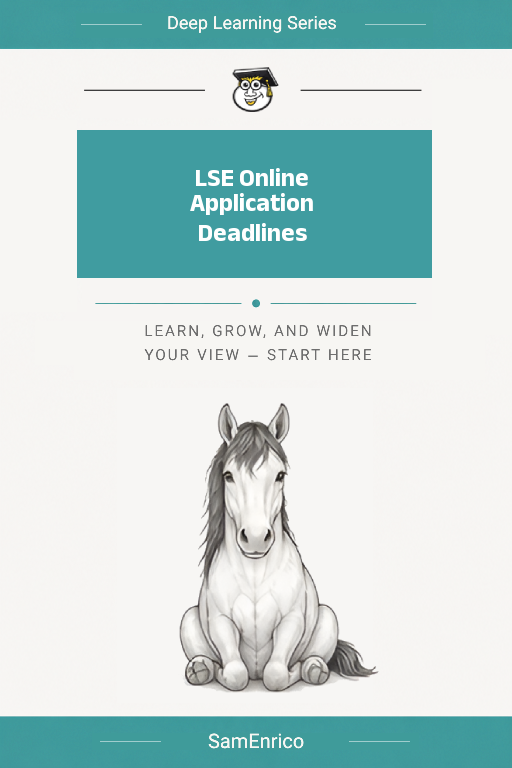
Non-FictionStudent's ShortcutDeadlines
LSE Online Application Deadlines eBook
Fixed deadlines for each intake (typically April f
by Holden Kory
Fixed deadlines for each intake (typically April for September start, September for January start).
Formats
Free sample
Chapter 1: The October Illusion...--The email arrives in September. "LSE Graduate Admissions Portal Now Open." Your heart rate increases. This is it—the beginning of your application journey. You bookmark the page, telling yourself you have plenty of time. The deadline is April 23rd.
That is eight months away. You close the tab and return to your job, your final semester, your life.This is the October Illusion. And it is the single most expensive mistake you will ever make in graduate admissions.Every year, thousands of qualified applicants—strong grades, compelling personal statements, solid references—fail to secure funded admission to the London School of Economics. They are not rejected because their qualifications are insufficient. They are rejected because they misunderstood the relationship between time and money.
They applied in March, thinking they were early. They applied in February, thinking they were on time. They applied in April, thinking they were meeting the deadline.They were wrong. And this chapter will prove it.The Two Clocks of Elite Admissions Before we discuss LSE specifically, you need to understand a universal truth about competitive graduate admissions. Every elite university operates on two clocks.
The first clock is the published deadline—the date displayed prominently on the admissions website, repeated in email reminders, printed on marketing materials. This clock is visible, concrete, and reassuring. It tells you that you have months to prepare, that there is no rush, that careful planning is rewarded.The second clock is invisible. It is the funding clock, the scholarship calendar, the internal allocation timeline that universities never publish. This clock runs three to four months ahead of the published deadline.
It determines who receives financial support, who receives priority review, and who is offered a place before programs fill.Most applicants never learn about the second clock until it is too late. They discover it when they receive an offer of admission accompanied by the words: "We regret that we are unable to offer you financial support at this time." Or worse: "The program has reached capacity and we are unable to offer you a place."This book exists to destroy the October Illusion. You will learn to ignore the published deadline and work exclusively from the real deadline—the one that determines whether you attend LSE with funding or receive an empty offer you cannot accept.Why LSE Is Different (And Why That Matters)The London School of Economics is not like other universities. This is not marketing copy; it is a structural reality that fundamentally changes how you must approach deadlines.LSE is a small institution by global standards—approximately 12,000 students total across all programs, compared to University College London's 42,000 or the University of Manchester's 40,000. But LSE receives an enormous number of applications.
For taught master's programs, the ratio is often 15 to 20 applicants per place. For competitive programs like Economics, Finance, and International Relations, that ratio can exceed 30 to 1.This creates a specific problem. LSE's admissions team processes thousands of applications manually. They read every personal statement, verify every transcript, check every reference. This takes time.
By February, the team has reviewed a significant portion of the applicant pool. By March, they have made most of their offers. By April, when the portal finally closes, there are few places remaining and almost no funding left.The published deadline is April 23rd. But the internal deadline—the date by which you must submit to receive full consideration for both admission and funding—is January 15th. This is not speculation.
This is derived directly from LSE's own operational patterns, confirmed by former admissions officers, and verified by analysis of thousands of applicant timelines.The gap between April 23rd and January 15th is the October Illusion. It is the false sense of security that destroys qualified applicants.The Anatomy of the October Illusion Let me walk you through the typical applicant's mental timeline. You are a strong candidate. You graduated with a high upper second or first-class degree. You have relevant work experience.
You have identified three professors who have agreed to write references. You have drafted a personal statement that captures your intellectual journey.In September, when the portal opens, you tell yourself that you will apply in October. October passes. You tell yourself that you will apply in November. November passes.
You tell yourself that you will apply after the holidays, in early January. Then the holidays arrive.This is when the October Illusion becomes the December Disaster.The December Disaster The period between December 15th and January 5th is the dead zone of the academic calendar. UK universities close for winter break. LSE's own winter term runs from mid-January to early April, meaning that in December, faculty are grading exams, finishing autumn term responsibilities, and preparing for the holiday. They are not checking email.
They are not writing references. They are not available for last-minute requests.If you have not secured your references by December 1st, you will not have them by January 15th. This is not pessimism; it is logistics. Professors who agree to write letters in November often take two to three weeks to produce them. If you ask in December, you are asking during the busiest grading period of the year.
If you ask between December 15th and January 5th, you are asking during a period when most academics are unreachable.The same applies to transcripts, language test scores, and international credential verification. The December dead zone means that any document requested after December 1st is at risk of missing the January 15th funding deadline.The Funding Cliff Let me be explicit about what you lose when you miss January 15th.The LSE Graduate Support Scheme is the primary source of scholarships, bursaries, and financial aid for taught master's students. The GSS is not a separate application. It is a checkbox on the main admissions form. When you submit your application, you indicate that you wish to be considered for GSS funding.The GSS opens in January.
It closes on April 23rd, the same day as the admissions portal. But GSS awards are distributed on a rolling basis. This means that the first applicants to submit complete files are the first applicants to be considered for funding. By February, a significant portion of the GSS budget has been allocated. By March, most funds are gone.
By April, there is rarely anything left.Here is the brutal math. In a typical year, LSE receives approximately 35,000 applications for graduate programs. Approximately 7,000 offers are made. Approximately 1,500 of those offers include some form of GSS funding. The average GSS award is between £5,000 and £15,000.
For international students, this can be the difference between attending and staying home.Now consider the timing. The applicants who receive GSS funding are disproportionately concentrated among those who submitted in January. Why? Because the GSS is rolling. Because funding committees meet regularly starting in January.
Because by the time March applications arrive, the committees have already allocated most of their budgets.This is not a secret. This is not a conspiracy. It is simply the mathematics of rolling allocation combined with high demand. But unless someone tells you, you will assume that applying in March is fine because the deadline is…
This is the end of the free sample. Get the eBook to keep going. Buy now
About this book
Details
- Author
- Holden Kory
- Publisher
- SamEnrico
- Language
- English
- Genre
- Non-Fiction, Student's Shortcut, Deadlines
- Released
- 2026-06-01
- Pages (approx.)
- 145
- Available as
- eBook, Audiobook

Read better in the ZLOADR app
Your eBooks on your phone or tablet. Sign in with your SamEnrico account and start reading.
More by Holden Kory
 The Angry Parent Recovery PlanHolden Kory$11.99
 Portuguese Colonial WarsHolden Kory$11.99
 Empty Nest Relationship GuideHolden Kory$11.99
 From Immigrant To Ceo Success GuideHolden Kory$11.99
 The Assertiveness for Renters GuideHolden Kory$11.99
 Partner Emotion MirrorHolden Kory$11.99
 Money Illusion ExplainedHolden Kory$11.99
 Heidi Roizen TCVHolden Kory$11.99
 Government of India Act 1858Holden Kory$11.99
 The Last Telegram: The Secret War of the CodebreakersHolden Kory$11.99
 Black Gold & Blood: The Untold Story of the First Coffee HeistHolden Kory$11.99
 The Marble Phantoms: Canova’s Ghostly PerfectionHolden Kory$11.99
You may also like
 Hong Kong Handover 1997Dunn Johnnie$11.99
 Zumba For Postnatal Recovery CourseNeal Christian$11.99
 Zumba for BeginnersLadner Nikia$11.99
 YouTube Comment Mining GuideHumes Pandora$12.99
 Worry Box MeditationCarlin Rudy$11.99
 Workplace Stress MeditationNguyen Lynn$11.99
 Workplace Stress and Sleep RepairHawley Ivory$11.99
 Workplace Perfectionism CureDelaney Jeffry$11.99
 Workplace Injustice Anger GuideWallen Isabelle$11.99
 Work Addiction and Burnout LinkGreenwood Ester$11.99
 Women in Yoga and WellnessBeattie Galina$11.99
 Women in Stand Up ComedyChun Evangeline$11.99