
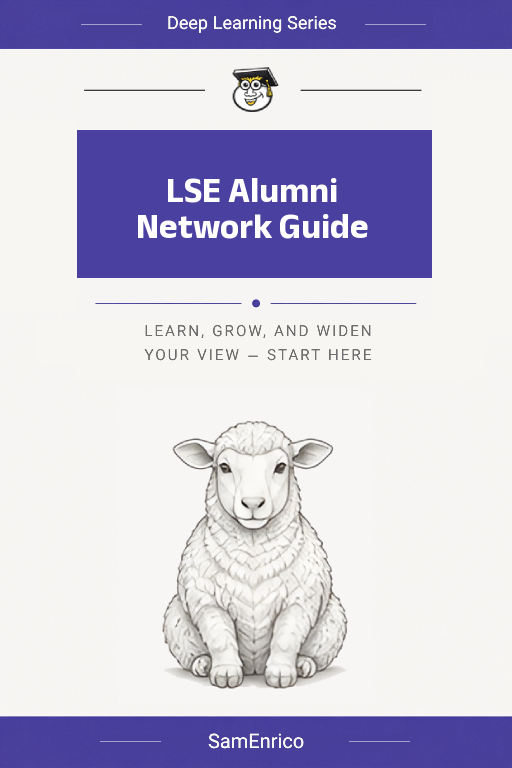
Non-FictionStudent's ShortcutLSE Alumni
LSE Alumni Network Guide eBook
LSE's powerful alumni network in finance, governme
by Antoine Mina
LSE's powerful alumni network in finance, government, and international organizations worldwide.
Formats
Free sample
Chapter 1: The Meritocratic Halo...--There is a photograph that hangs in the fourth-floor corridor of the Old Building at the London School of Economics, just outside the office that once belonged to William Beveridge. It was taken in 1935, and in it, a young man from a mining family in South Wales stands next to a woman who would go on to advise three British prime ministers. Neither of them had a family member who had ever set foot in a university. Both of them would later describe their time at LSE as the moment they realized they belonged in rooms where power was exercised. That photograph is not famous.
You will not find it in the LSE prospectus. But it captures something essential about the network you have just joined or hope to join: the LSE network was not built on privilege. It was built on proof.Journalists have called this network many things over the years. The "Houghton Street Mafia" is the most persistent nickname, a nod to the quiet power that LSE alumni seem to wield across finance, government, and international development. The phrase first appeared in a Financial Times column in the early 2000s, describing the dense web of LSE graduates who seemed to populate the upper ranks of the Bank of England, the Treasury, and the City of London simultaneously.
It was meant to evoke something slightly menacing—a closed circle of insiders who looked after their own. And to be fair, there is some truth to the observation. LSE alumni do help each other. They do cluster in powerful institutions. They do share opportunities that outsiders cannot easily access.But the nickname is misleading in one crucial respect.
A traditional mafia operates on loyalty, secrecy, and family connection. You are born into it, or you marry into it, or you pay a steep price for entry. The LSE network operates on none of those principles. It operates on a single, unwavering assumption: that the person on the other side of the email, the coffee table, or the interview is exceptionally smart.This is the Meritocratic Halo , and it is the single most important concept you will encounter in this book. Unlike the Oxbridge "old boys" network, which historically relied on shared class background, private schooling, and the right accent, the LSE network relies on shared intellectual rigor.
Unlike the Ivy League transactional network, where alumni often help each other because they expect a direct return on investment, the LSE network helps each other because they respect the quality of the mind that produced the degree. When an LSE alum opens a door for you, they are not doing you a favor. They are betting that you are smart enough to justify their reputation.This chapter dismantles the myth that all elite university networks function the same way. It explains why the LSE network is different, why that difference matters for your career, and how you can activate the Meritocratic Halo for yourself—whether you graduated last week or thirty years ago. It also introduces a theme that will run through every subsequent chapter: LSE was founded by Fabian socialists who believed that talent is distributed equally across all classes, but opportunity is not.
That ethos—the "poor but smart" ideal—is still the network's secret sauce. If you feel like an imposter, you are in good company. Most LSE alumni do.The Founding Paradox: How a Socialist Experiment Created a Capitalist Powerhouse To understand the LSE network, you have to understand the strange circumstances of its birth. The school was founded in 1895 by four Fabian Society intellectuals: Sidney Webb, Beatrice Webb, Graham Wallas, and George Bernard Shaw. Their goal was not to create another finishing school for the sons of the British elite.
They already had Oxford and Cambridge for that. Their goal was to create an institution that would train the next generation of civil servants, economists, and social reformers—people who could actually solve the problems of industrial capitalism rather than simply inherit its rewards.The founding charter is remarkably explicit about this. LSE was established "for the advancement of learning in the study of social and economic science" with a particular focus on "the problems of poverty and social justice." The first students were not aristocrats. They were clerks, teachers, trade unionists, and women who could not attend Oxford or Cambridge because those universities did not admit them. The first lecture series on economics was held in a cramped room above a shop on John Street, and the library—now one of the largest social science libraries in the world—began as a single shelf of books donated by the founders themselves.This founding ethos created a network that was radically different from anything that existed in British higher education.
Where Oxford and Cambridge prioritized social connections—the right school, the right accent, the right family name—LSE prioritized intellectual performance. It did not matter who your father was. It mattered whether you could read a balance sheet, critique a regression model, or defend a policy proposal under sustained questioning. The school's unofficial motto, Rerum cognoscere causas (to know the causes of things), was not just a Latin phrase on a crest. It was a filter.What is remarkable is how quickly this intellectual filter produced practical power.
Within thirty years of its founding, LSE graduates were running major departments in the British civil service. By the 1930s, the school had become the unofficial training ground for the Labour Party's economic policy team. By the 1960s, LSE economists were advising governments across the former British Empire. And today, as we will see throughout this book, LSE alumni occupy leadership positions in every major financial institution, central bank, and international organization on earth.But the founding ethos also produced a peculiar kind of network culture—one that feels very different from the wine-and-cheese networking events you might imagine when you think of elite university alumni associations. LSE alumni do not network the way other networks network.
They debate. They argue. They challenge each other's assumptions. And if you can hold your own in those debates, they will open doors for you that no amount of small talk could ever unlock.The Meritocratic Halo: Why Smart People Help Smart People Let me introduce you to a concept that will structure everything that follows. The Meritocratic Halo is the name I give to the distinctive psychological orientation that LSE alumni bring to their professional relationships.
It works like this: when an LSE graduate encounters another LSE graduate, they do not ask, "Does this person come from my social class?" or "Does this person share my political views?" or even "Does this person like me?" The unconscious question is far simpler and far more powerful: "Is this person smart?"If the answer is yes—or even probably yes—the halo activates. The LSE alum becomes more likely to reply to an email, more likely to agree to a coffee chat, more likely to refer a resume, more likely to advocate for a promotion, more likely to invest in a startup. This is not because LSE alumni are unusually generous people (though many are). It is because they are unusually…
This is the end of the free sample. Get the eBook to keep going. Buy now
About this book
Details
- Author
- Antoine Mina
- Publisher
- SamEnrico
- Language
- English
- Genre
- Non-Fiction, Student's Shortcut, LSE Alumni
- Released
- 2026-06-01
- Pages (approx.)
- 157
- Available as
- eBook, Audiobook

Read better in the ZLOADR app
Your eBooks on your phone or tablet. Sign in with your SamEnrico account and start reading.
More by Antoine Mina
 Meditation for Back Pain ReliefAntoine Mina$11.99
 Leading Remote Project TeamsAntoine Mina$11.99
 Freelance Income Stress GuideAntoine Mina$11.99
 Teresa of Ávila Prayer of Recollection GuideAntoine Mina$11.99
 Boundary Setting for Blended FamiliesAntoine Mina$11.99
 The Merger That Shook the World: How Coca-Cola and Pepsi Almost Became OneAntoine Mina$11.99
 The Glass Eye and the Cosmic Revelation: Hevelius and the Birth of Modern AstronomyAntoine Mina$11.99
 Information Technology SpecialistAntoine Mina$11.99
 Understanding Epidermolysis Bullosa, DermolyticAntoine Mina$17.99
 House Sitting Emergency PlanAntoine Mina$12.99
 How to Start a Shooting Club - Recreational BusinessAntoine Mina$11.99
You may also like
 Hong Kong Handover 1997Dunn Johnnie$11.99
 Zumba For Postnatal Recovery CourseNeal Christian$11.99
 Zumba for BeginnersLadner Nikia$11.99
 YouTube Comment Mining GuideHumes Pandora$12.99
 Worry Box MeditationCarlin Rudy$11.99
 Workplace Stress MeditationNguyen Lynn$11.99
 Workplace Stress and Sleep RepairHawley Ivory$11.99
 Workplace Perfectionism CureDelaney Jeffry$11.99
 Workplace Injustice Anger GuideWallen Isabelle$11.99
 Work Addiction and Burnout LinkGreenwood Ester$11.99
 Women in Yoga and WellnessBeattie Galina$11.99
 Women in Stand Up ComedyChun Evangeline$11.99