
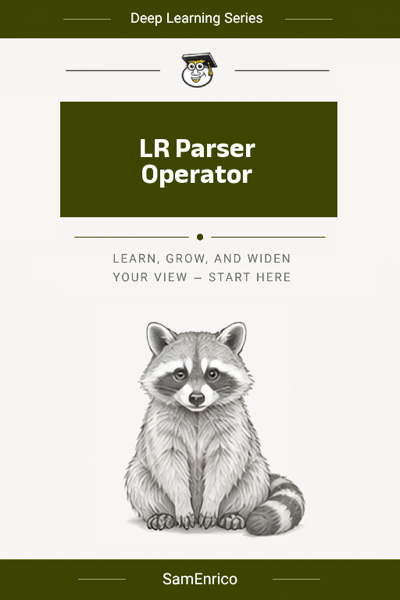
Non-FictionInformativeEducational
LR Parser Operator
A Coursebook on LR Parser Operator
by Mcneil Jetta
A Coursebook on LR Parser Operator
Formats
About this book
Free sample
Chapter 1: The Broken Calculator--–- It was 2:00 AM when Sarah, a third-year computer science student, finally admitted defeat. Her hand-written recursive descent parser for the class compiler project had grown to 847 lines of nested if-statements and switch cases. It worked perfectly for arithmetic expressions like 2 + 3 and 4 * 5. But the moment she tried 2 + 3 * 4, her parser obediently computed (2 + 3) * 4 = 20 instead of the correct 2 + (3 * 4) = 14. Worse, when she added parentheses—2 + (3 * 4)—the parser crashed with a stack overflow.
She had spent three sleepless nights adding special cases, precedence climbing hacks, and what she called “hope-based programming.” Nothing worked.Sarah’s problem wasn’t unique. Every programmer who has ever built a language parser—whether for a compiler, a configuration file validator, or a domain-specific language—eventually hits this wall. Top-down parsers (like recursive descent) are intuitive to write. You look at the next token and decide which rule to call. But they choke on left-recursive grammars (E → E + T), they struggle with operator precedence, and they require constant lookahead hacking.
The more expressive your language becomes, the more your parser resembles a house of cards.What Sarah needed—and what this book will teach you—is a fundamentally different approach: LR parsing. Not just the theory, but the practical, build-it-yourself, understand-every-line-of-code approach that transforms parser writing from black art to systematic engineering.The Silent Crisis in Modern Parser Design Walk into any software company that maintains a programming language, a configuration system, or a domain-specific tool. Ask the engineers about their parser. If you’re lucky, they’ll say, “We use ANTLR” or “We use Bison.” If you’re not lucky—and this is disturbingly common—they’ll grimace and say, “It’s a hand-written recursive descent parser. It works.
Mostly. Don’t touch it.”These “mostly working” parsers are the source of countless subtle bugs. A misplaced parenthesis crashes the build system. An unexpected semicolon produces a 200-line error message that scrolls off the terminal. An ambiguous grammar rule causes the parser to silently prefer one interpretation over another, leading to code that compiles but executes with baffling logic.The root cause is that most programmers learn parsing backwards.…
This is the end of the free sample. Get the eBook to keep going. Buy now
Contents
- Chapter 1
- Chapter 2
- Chapter 3
- Chapter 4
- Chapter 5
- Chapter 6
- Chapter 7
- Chapter 8
- Chapter 9
- Chapter 10
- Chapter 11
- Chapter 12
Details
- Author
- Mcneil Jetta
- Publisher
- SamEnrico
- Language
- English
- Genre
- Non-Fiction, Informative, Educational
- Released
- 2026-06-02
- Pages (approx.)
- 152
- Available as
- eBook, Audiobook

Read better in the ZLOADR app
Your eBooks on your phone or tablet. Sign in with your SamEnrico account and start reading.
More by Mcneil Jetta
 Post Speech Feedback AnalysisMcneil Jetta$11.99
 Nonverbal Romantic InterestMcneil Jetta$11.99
 Golf Flexibility For SeniorsMcneil Jetta$11.99
 The Opium King of Bombay: The Trial That Exposed India's Deadly TradeMcneil Jetta$11.99
 How to Produce Care Giving ProductsMcneil Jetta$11.99
 How to Start a Luggage Made of Leather or Leather Substitute Business (Beginners Guide)Mcneil Jetta$11.99
 Consulting Pricing Without Fear WorkbookMcneil Jetta$12.99
You may also like
 Hong Kong Handover 1997Dunn Johnnie$11.99
 Zumba For Postnatal Recovery CourseNeal Christian$11.99
 Zumba for BeginnersLadner Nikia$11.99
 YouTube Comment Mining GuideHumes Pandora$12.99
 Worry Box MeditationCarlin Rudy$11.99
 Workplace Stress MeditationNguyen Lynn$11.99
 Workplace Stress and Sleep RepairHawley Ivory$11.99
 Workplace Perfectionism CureDelaney Jeffry$11.99
 Workplace Injustice Anger GuideWallen Isabelle$11.99
 Work Addiction and Burnout LinkGreenwood Ester$11.99
 Women in Yoga and WellnessBeattie Galina$11.99
 Women in Stand Up ComedyChun Evangeline$11.99